Does the ‘Munna’ of Jinnah Have a Problem with ‘Vande Mataram’?
Click to start listening
Synopsis
As the Parliament celebrates 150 years of Vande Mataram, BJP MP Anurag Thakur challenges the Opposition's stance, drawing parallels with historical figures and stirring a debate over national pride. What does this mean for Indian culture and identity?
Key Takeaways
- Vande Mataram is celebrated for its historical significance as a national anthem.
- BJP MP Anurag Thakur draws on historical context to challenge the Opposition.
- The debate highlights ongoing tensions around national identity in India.
- Thakur emphasizes the cultural and spiritual importance of Vande Mataram.
- The absence of Opposition members during key moments raises questions about their stance.
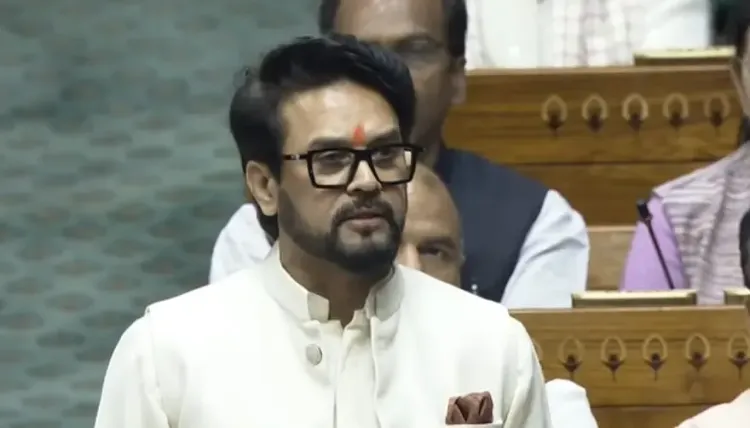
New Delhi, Dec 8 (NationPress) As the Parliament engages in discussions about the 150-year-old Vande Mataram, BJP MP Anurag Thakur directed criticism towards the Opposition, noting that both the British and Jinnah had issues with Vande Mataram. He questioned whether the 'Munna of Jinnah' shares that sentiment.
While addressing the Lok Sabha, Anurag Thakur remarked, “This year is particularly significant as we commemorate the 150th anniversaries of Birsa Munda, Sardar Patel, and Vande Mataram. I express my gratitude to the Speaker and my party leadership, including Prime Minister Modi, for sparking this debate. It was indeed PM Modi who initiated this discussion.”
He continued, “When Vande Mataram marked its centenary, the Emergency was declared, and then Prime Minister Indira Gandhi breached the Constitution. There was no conversation then. Nowadays, PM Modi has highlighted its historical and cultural significance. I am confident that Vande Mataram will evolve into a source of inspiration.”
“Vande Mataram transcends mere song; it is a Maha Mantra. I want to clarify that it is not a religious, party, or individual anthem. Vande Mataram embodies national pride and Indian culture. It is a tradition of national devotion — which is precisely why the Congress fears it,” he stated.
“Their fear is evident as two of their members were absent from the House during the PM's address. Nehru curtailed Vande Mataram and divided the nation, limiting it to just two stanzas, whereas Rahul Gandhi reduces it to a single line. Today, they were notably absent during the debate,” Thakur added.
He noted, “I have heard they intend to recite Vande Mataram without fully acknowledging it. We are still waiting. The stanzas omitted by Nehru included references to Maa Durga — removing them was akin to stripping away the soul of India.”
Describing it as sacred, he said, “Vande Mataram is as pure as the verses of the Vedas, as pure as the Quran, and as pure as the Bible.”
“On this 150th anniversary, I reiterate: The British opposed Vande Mataram, Jinnah opposed it — and I now pose the question: Does the ‘Munna’ of Jinnah oppose it as well?” he concluded.
He further stated, “Vande Mataram is the most sacred mantra — unwavering, unyielding, and eternal. It has no conclusion; it is immortal.”
In closing, he remarked, “They accuse us of tarnishing Nehru's image, but we are simply uncovering truths. At a rally in Karnataka, Rahul Gandhi urged the public to sing just one line of Vande Mataram. Nehru limited it to two lines. I fail to grasp why they criticize it — or what their true motives might be.”
Point of View
It is crucial to recognize that discussions around Vande Mataram encapsulate broader themes of national identity and cultural heritage. Thakur’s remarks reflect a sentiment that resonates with a significant portion of the populace, yet it also invites scrutiny of historical narratives. It is essential to engage in this discourse while understanding the diverse perspectives within our society.
NationPress
09/12/2025
Frequently Asked Questions
What is the significance of Vande Mataram?
Vande Mataram is not merely a song; it embodies national pride, cultural heritage, and the spirit of the Indian independence movement.
Why did Anurag Thakur criticize the Opposition?
Thakur criticized the Opposition for their perceived lack of respect towards Vande Mataram, linking their stance to historical figures who opposed it.
What historical references did Thakur make?
He referenced the British opposition to Vande Mataram, as well as figures like Jinnah and Nehru, to highlight ongoing controversies surrounding the anthem.
How does Vande Mataram relate to Indian culture?
Vande Mataram is seen as a symbol of national devotion, reflecting the cultural ethos of India and its diverse heritage.
What does Thakur's statement imply for the future?
His statement suggests a continued emphasis on Vande Mataram as a central element of national identity, potentially influencing future political discourse.