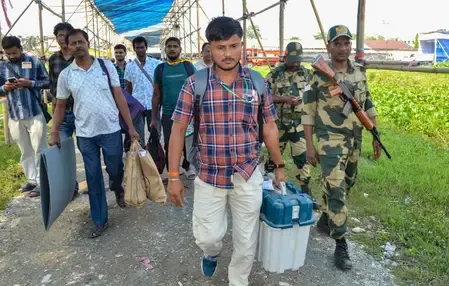
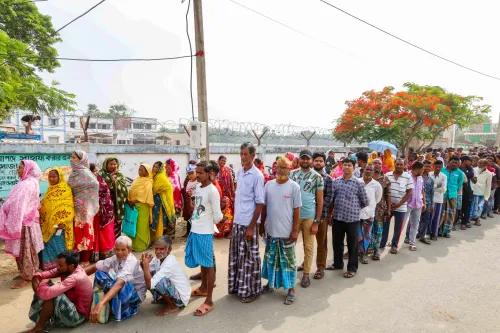
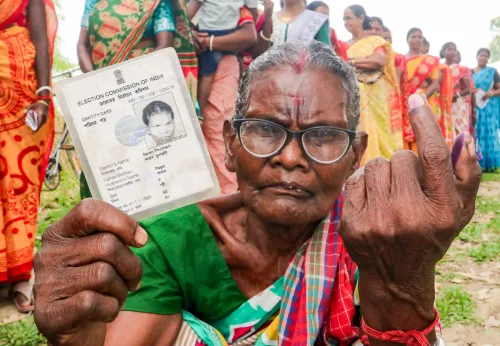
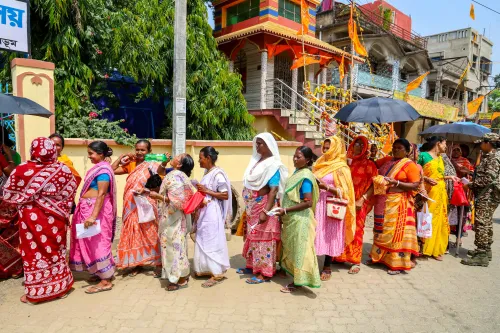
West Bengal voter turnout hits record 92.47% in 2026 Assembly polls

Synopsis
From a meagre 43% in 1951 to a record-shattering 92.47% in 2026, West Bengal's voter turnout has hit its highest mark since Independence — with women outpolling men for the second consecutive election cycle. The surge arrives ahead of results that could once again reshape the state's political landscape.
Key Takeaways
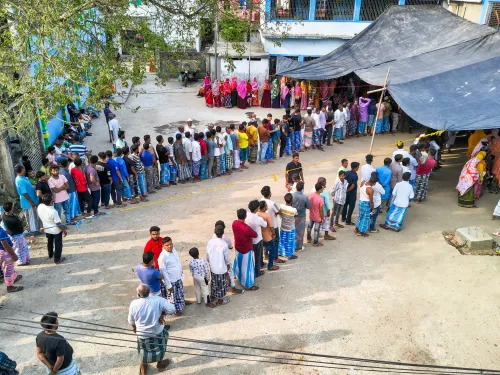
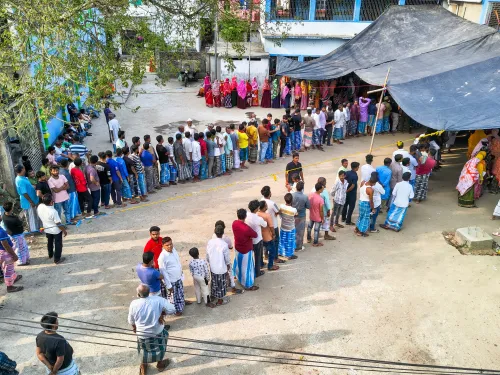
West Bengal recorded a historic 92.47% voter turnout in the 2026 Assembly election , the highest since Independence.
Women voters outpaced men, registering 93.24% turnout against men's 92.47% .
The previous record was 84.72% set in the 2011 Assembly election , which also saw women lead at 84.45% .
The state's first post-Independence poll in 1951 recorded just 43.12% turnout; the 70% mark was first crossed only in the 1980 Lok Sabha election .
High turnout in West Bengal has historically coincided with political regime changes — in 1977 and 2011 .
The 2026 election results are due on Monday .
West Bengal has recorded its highest-ever voter turnout since Independence, with 92.47% of electors casting their votes in the 2026 Assembly election, surpassing the previous peak of 84.72% set in 2011, according to the Election Commission of India (ECI). The milestone caps a decades-long arc from the state's first post-Independence poll, when participation barely crossed 43%.
Women Outpace Men at the Ballot Box
Female voters led the charge in 2026, registering a turnout of 93.24% against 92.47% for male voters — continuing a trend first visible in 2011, when women posted 84.45% against men's 84.22%. Before that, the 1996 Lok Sabha election had recorded the highest male turnout at 84.27%, against women's 80.86%, with a combined participation of 82.66%. The consistent and growing lead of women voters over men marks a significant structural shift in West Bengal's electoral demography.
From 40s to 90s: Seven Decades of Rising Participation
West Bengal's polling journey has been one of gradual but dramatic growth. The state's first Assembly election in 1951 recorded a turnout of just 43.12%, while the concurrent Parliamentary poll drew only 40.49%. By 1962, both figures had climbed to 55.55% and 55.75% respectively.
It took 15 elections before West Bengal crossed the 70% mark — a threshold finally breached in the 1980 Lok Sabha poll, which recorded an overall turnout of 70.62%, with men at 72.58% and women at 68.18%. Even then, the state was already outperforming many of its peers nationally.
Notably, the 1977 elections — the first held after the end of the Emergency — saw a relative dip, with only 56.15% turning out for the Assembly poll and 60.24% for the Lok Sabha contest. These figures remained below the 66.03% recorded in the 1967 Lok Sabha election, which had been the state's highest Parliamentary participation until then.
Turnout as a Mirror of Political Change
West Bengal's voter participation has historically tracked its most consequential political transitions. The 1977 elections delivered a decisive anti-Emergency verdict, propelling the Left Front — led by the Communist Party of India (Marxist) and Chief Minister Jyoti Basu — to power, while simultaneously enabling the Janata Party government at the Centre. The Left Front went on to govern the state for 34 consecutive years, often cited as one of the world's longest-serving democratically elected communist-led governments, built on land reforms and deep grassroots party organisation.
The 2011 Assembly election, which ended Left Front rule and brought the All India Trinamool Congress (TMC)-led alliance to power, also broke turnout records at the time — a pattern that suggests high participation in West Bengal correlates with moments of political rupture rather than consolidation.
West Bengal's Political Phases Since Independence
Since 1947, West Bengal's politics has moved through three broad phases. The early decades were marked by Congress dominance under leaders such as Prafulla Chandra Ghosh and Dr Bidhan Chandra Roy, the state's first formal Chief Minister under the 1950 Constitution. The late 1960s saw growing instability, with short-lived United Front (UF) coalition governments — comprising the CPI(M), Bangla Congress, and others — collapsing amid splits and defections, leading to repeated spells of President's Rule. These experiments, though unstable, laid the groundwork for the Left Front's sweeping 1977 victory. The third phase, beginning in 2011, has been defined by TMC dominance.
What Comes Next
The 2026 Assembly election results are set to be declared on Monday, and the record turnout adds a layer of political significance to an already closely watched contest. Whether the surge in participation — particularly among women — translates into a continuation or disruption of the current political order remains to be seen.
Point of View
But the more telling detail is the pattern: the state's two previous turnout peaks — 1977 and 2011 — both preceded regime change. If history rhymes, the record participation in 2026 may signal voter intent rather than mere civic enthusiasm. The consistent lead of women voters over men, now in its second consecutive election cycle, also deserves closer scrutiny; it suggests that gender-targeted welfare schemes have fundamentally altered who shows up and why. The Election Commission's data, taken at face value, is a democratic success story — but the political consequences of that story will only become clear on results day.
NationPress
20 Sept 2026
Frequently Asked Questions
What was West Bengal's voter turnout in the 2026 Assembly election?
West Bengal recorded a voter turnout of 92.47% in the 2026 Assembly election, the highest since Independence, surpassing the previous record of 84.72% set in the 2011 Assembly election, according to the Election Commission of India.
How did women voters perform compared to men in West Bengal's 2026 election?
Women voters outpolled men in the 2026 election, registering a turnout of 93.24% against 92.47% for male voters. This continues a trend from the 2011 election, when women also narrowly led men at 84.45% versus 84.22%.
When did West Bengal first cross the 70% voter turnout mark?
West Bengal first crossed the 70% voter turnout mark in the 1980 Lok Sabha election, which recorded an overall participation of 70.62%. It took 15 elections after Independence to reach that threshold.
What was West Bengal's voter turnout in its first post-Independence election?
West Bengal's first Assembly election in 1951 recorded a turnout of just 43.12%, while the concurrent Parliamentary poll drew 40.49% — a far cry from the record levels seen in recent decades.
How does West Bengal's political history relate to its voter turnout trends?
West Bengal's highest turnout elections have historically coincided with major political transitions — the 1977 election ended Congress dominance and brought the Left Front to power, while the 2011 election ended 34 years of Left Front rule and ushered in the Trinamool Congress. The 2026 record turnout arrives ahead of results that could once again reshape the state's political order.