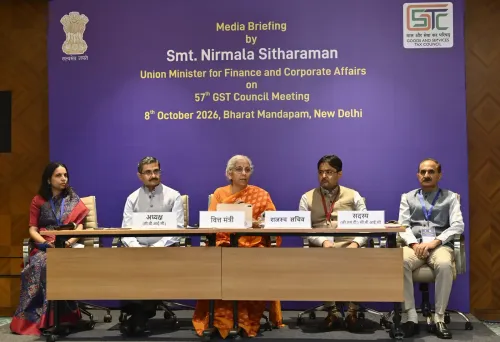
CBIC clarifies GST on delivery services cut to 5%, no new tax imposed
Synopsis
Viral posts claimed the government slapped a new GST on delivery services — CBIC called it flat-out wrong. The truth is the opposite: the 57th GST Council slashed the rate from 18% to 5%, and all e-commerce delivery services now pay a uniform lower tax. The episode highlights how quickly tax misinformation spreads, and why CBIC's public rebuttal matters.
Key Takeaways
CBIC on 10 October rejected viral social media claims of a new GST on delivery services as 'wrong and factually incorrect.' Delivery services — including food app deliveries — were taxed at 18% ; the 57th GST Council reduced this to 5% .
All delivery services through e-commerce platforms are now taxed uniformly at 5% .
Gross GST collections for April–September 2026 stood at ₹12.46 lakh crore , up 11.6% year-on-year.
Registered GST taxpayers have grown from 60 lakh in 2017 to 1.70 crore as of September 2026 .
No show-cause notices will be issued where the tax amount is below ₹10,000 , under new GST 2.0 relief measures.
The Central Board of Indirect Taxes and Customs (CBIC) on Saturday, 10 October firmly rejected viral social media claims that a fresh Goods and Services Tax (GST) has been imposed on delivery services, calling the reports 'wrong and factually incorrect.' The clarification came directly in response to a post circulating on X (formerly Twitter) and is backed by the 57th GST Council meeting's recommendations.
What CBIC Actually Said
Responding to the X handle @IndianGems_, the CBIC explained that delivery services — including those provided by food delivery applications — were previously taxed at 18 per cent. Following the 57th GST Council meeting's recommendation, that rate has now been reduced to 5 per cent. The board further clarified that all delivery services offered through e-commerce platforms are now taxed uniformly at this lower rate. 'So there is no new imposition of tax. Rather, there is a reduction in tax,' the CBIC stated, adding a pointed request to the account: 'You are requested to not spread incorrect news.'
GST 2.0 Reforms: The Broader Context
This clarification arrives against the backdrop of a wider set of GST 2.0 reforms announced earlier in the month. Since GST's introduction in 2017, registered taxpayers have grown from approximately 60 lakh to 1.70 crore as of September 2026 — a near three-fold increase that underscores the system's expanding reach. The GST system has cumulatively processed 3,053 crore invoice uploads and 833.82 crore e-way bills as of 30 September.
Gross GST collections for the April–September 2026 period reached ₹12.46 lakh crore, up 11.6 per cent year-on-year, according to official data — signalling robust compliance momentum even as the government moves to ease the burden on smaller participants.
Relief for Small Taxpayers and E-Commerce Sellers
Among the reform measures, the government has introduced a simplified registration mechanism for small taxpayers making supplies through e-commerce platforms. Notably, no show-cause notices will be issued if the tax amount involved is less than ₹10,000. Pending notices and appeals involving amounts below the ₹10,000 threshold will be decided as if that minimum limit had been in effect at the time the notice was originally issued — providing retrospective relief to a large number of small businesses.
What This Means for Consumers and Platforms
For everyday consumers ordering food or goods through apps, the net effect is a lower tax burden on delivery charges — not a higher one, contrary to what the viral posts claimed. E-commerce platforms will now apply a uniform 5 per cent GST on delivery services, replacing the earlier patchwork of rates. This comes amid the government's stated goal of making the GST framework more efficient and taxpayer-friendly. According to the official factsheet, these measures 'build on GST's success and mark another step in its continued improvement.'
With misinformation around tax policy capable of triggering consumer anxiety and market distortions, the CBIC's swift public rebuttal signals a more proactive approach to digital fact-checking — a trend likely to continue as GST reforms deepen.
Point of View
Consumer-friendly rate cut from 18% to 5% was misread as a new imposition, which means the GST Council's messaging failed before the trolls even started. With GST 2.0 reforms rolling out, the government needs a proactive public-information strategy, not just reactive rebuttals. Correcting falsehoods after they go viral is damage control — not communication.
NationPress
10 Oct 2026
Frequently Asked Questions
Is there a new GST imposed on delivery services in 2026?
No. The CBIC has confirmed there is no new GST on delivery services. On the contrary, the 57th GST Council recommended reducing the rate from 18% to 5%, making delivery through e-commerce platforms cheaper, not more expensive.
What is the current GST rate on food delivery and e-commerce delivery services?
The current GST rate on all delivery services provided through e-commerce platforms, including food delivery apps, is 5%. This is down from the earlier rate of 18%, following the 57th GST Council meeting's recommendation.
What are the GST 2.0 reforms announced by the government?
GST 2.0 reforms include a simplified registration process for small e-commerce sellers, a ₹10,000 minimum threshold below which no show-cause notices will be issued, and retrospective relief on pending notices involving amounts below that threshold. Gross GST collections for April–September 2026 reached ₹12.46 lakh crore, up 11.6% year-on-year.
Why did CBIC respond to a social media post about GST on delivery?
CBIC responded directly to the X handle @IndianGems_ after viral posts incorrectly claimed a new GST had been imposed on delivery services. The board called the claims 'wrong and factually incorrect' and urged the account not to spread incorrect information.
How has GST taxpayer registration grown since 2017?
Registered GST taxpayers have grown nearly three-fold — from approximately 60 lakh in 2017 to 1.70 crore as of September 2026. The GST system has also cumulatively processed 3,053 crore invoice uploads and 833.82 crore e-way bills as of 30 September 2026.