Guangdong courts Tsinghua talent to close AI gap with Beijing
Synopsis
Guangdong — birthplace of both DeepSeek's Liang Wenfeng and Moonshot AI's Yang Zhilin — lost both founders to other cities. Now the province is recruiting 40 Tsinghua CS students in a direct bid to stop the AI brain drain, as Beijing claims 19 of China's top 50 AI firms versus Guangdong's 10.
Key Takeaways
Guangdong province recruited nearly 40 computer science students from Tsinghua University in August 2026 to bolster its AI talent base.
Moonshot AI founder Yang Zhilin and DeepSeek founder Liang Wenfeng both have roots in Guangdong but launched their companies elsewhere.
According to the Hurun Research Institute , Beijing hosts 19 of China's top 50 AI companies; Shanghai has 14 ; Guangzhou and Shenzhen combined hold 10 .
Hangzhou has emerged as a rising AI hub, home to DeepSeek and Unitree Robotics .
Hefei and Wuhan are gaining ground in semiconductors, anchored by ChangXin Memory Technologies and Yangtze Memory Technologies Corp .
Experts cite the concentration of academic talent as the primary structural driver of Guangdong's relative underperformance in AI.
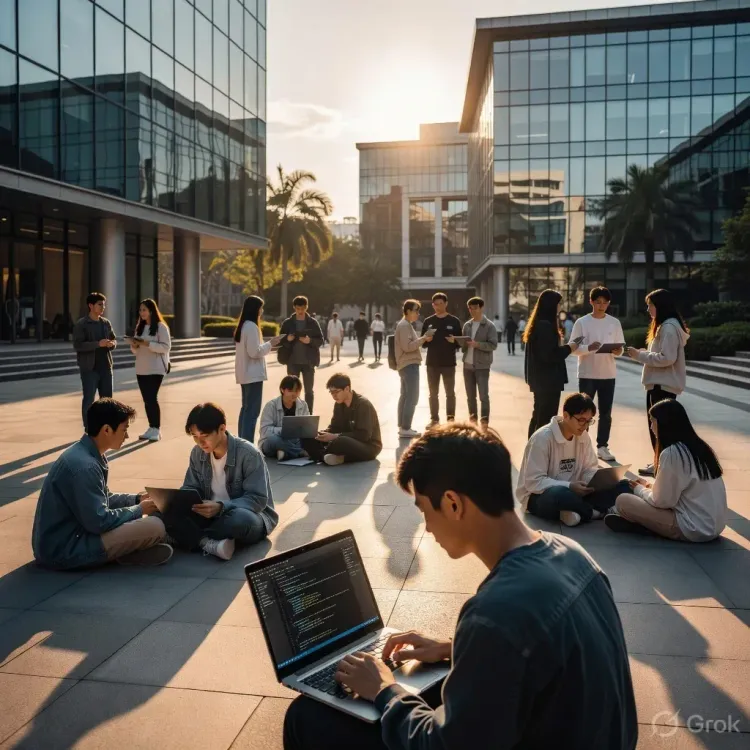
Guangdong province, China's southern manufacturing hub and home region of DeepSeek founder Liang Wenfeng and Moonshot AI founder Yang Zhilin, welcomed nearly 40 computer science students from Tsinghua University this week in a targeted bid to attract top-tier artificial intelligence talent from Beijing and narrow a widening competitive gap in the national AI race.
The talent that got away
Despite producing two of China's most prominent AI founders, Guangdong failed to retain either. Yang Zhilin graduated from Tsinghua University, earned his PhD at Carnegie Mellon University, returned to China, and launched Moonshot AI in Beijing in 2023. Liang Wenfeng attended Zhejiang University in eastern China, spent time in Chengdu in Sichuan province, and ultimately settled in Hangzhou, Zhejiang, where he founded both his quantitative hedge fund and DeepSeek.
Why it matters: the rankings gap
Industry data underscores the scale of Guangdong's challenge. According to the Hurun Research Institute, Beijing leads the country with 19 of China's top 50 AI companies, followed by Shanghai with 14. Guangzhou and Shenzhen — the province's two largest cities — account for just 10 combined. Experts point to the concentration of academic talent as a core structural factor behind this disparity.
The competitive backdrop: second-tier cities surge
The competitive landscape is shifting beyond the traditional Beijing–Shanghai axis. Hangzhou has emerged as a breakout hub, home to star firms including DeepSeek and robotics company Unitree Robotics. Meanwhile, Hefei and Wuhan are building momentum anchored by semiconductor giants ChangXin Memory Technologies and Yangtze Memory Technologies Corp, signalling that China's AI and chip ecosystem is decentralising rapidly.
What's next
Guangdong's outreach to Tsinghua University students represents an early-stage effort to reverse the talent drain through direct recruitment rather than waiting for organic cluster formation. Whether the province's manufacturing base and proximity to global supply chains — including chipmaker Nvidia's regional distribution networks — can be leveraged as a differentiator remains an open question. The success of this initiative will likely determine whether Guangdong can convert industrial scale into AI leadership before the gap widens further.
Point of View
A dynamic that mirrors the US experience with Stanford's gravitational pull on Silicon Valley. What mainstream coverage underplays is the role of second-tier cities like Hangzhou and Hefei, which are quietly becoming the real battleground for China's next AI and chip champions, often with more targeted state backing and lower operating costs than Guangdong's megacities. For global investors and supply-chain strategists, the decentralisation of China's AI talent away from Guangdong — a province deeply integrated into global hardware supply chains — raises a nuanced question about whether software and hardware excellence will converge or continue to diverge geographically inside China.
NationPress
1 Oct 2026
Frequently Asked Questions
Why is Guangdong recruiting AI talent from Tsinghua University?
Guangdong is recruiting nearly 40 Tsinghua University computer science students to address a structural talent deficit that has left the province with only 10 of China's top 50 AI companies, compared to Beijing's 19 . The province has historically struggled to retain top AI founders despite producing them.
Did DeepSeek and Moonshot AI originate in Guangdong?
DeepSeek founder Liang Wenfeng and Moonshot AI founder Yang Zhilin both have ties to Guangdong , but neither launched their company there. Yang founded Moonshot AI in Beijing in 2023 , while Liang established DeepSeek in Hangzhou , Zhejiang .
Which Chinese cities lead in AI company concentration?
According to the Hurun Research Institute , Beijing leads with 19 of China's top 50 AI companies, followed by Shanghai with 14 , and Guangzhou plus Shenzhen combined with 10 . Hangzhou is rapidly emerging as a fourth major hub.
What AI and chip companies are based in Hangzhou, Hefei, and Wuhan?
Hangzhou is home to DeepSeek and robotics firm Unitree Robotics . Hefei and Wuhan are building semiconductor ecosystems around ChangXin Memory Technologies and Yangtze Memory Technologies Corp , respectively.
What is the main reason Guangdong lags behind Beijing in AI?
Experts point to the concentration of academic talent as the primary structural factor. Beijing hosts elite institutions like Tsinghua University , which naturally anchor AI talent and startup formation in the capital rather than in Guangdong's manufacturing-oriented cities.