Historic: Sawan Barwal Breaks 48-Year Marathon Record on Debut
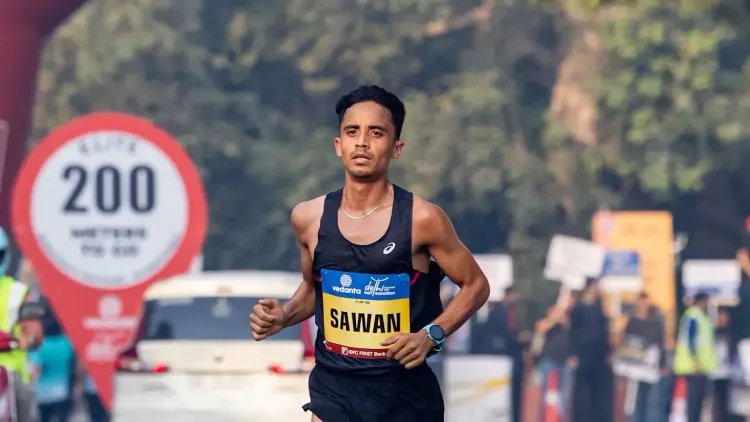
Synopsis
Sawan Barwal, a 27-year-old runner from Himachal Pradesh, shattered India's 48-year-old national marathon record on his debut at the 2026 Rotterdam Marathon, clocking 2:11:58 — erasing Shivnath Singh's 1978 benchmark. Now, he has his sights locked firmly on the 2028 Los Angeles Olympics.
Key Takeaways
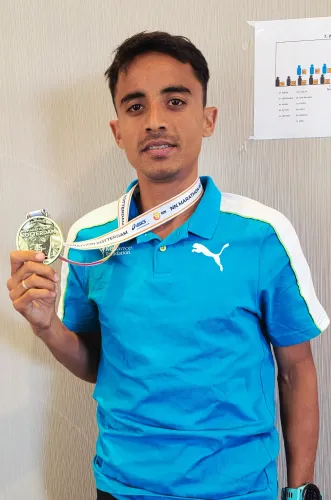
Sawan Barwal , 27, from Joginder Nagar, Himachal Pradesh , broke India's national marathon record on his debut at the 2026 Rotterdam Marathon .
Barwal clocked 2 hours, 11 minutes, and 58 seconds , surpassing the previous record of Shivnath Singh set in 1978 — a mark that had stood for 48 years .
The runner battled extreme cold, wind, dizziness, and near-loss of balance in the final kilometres, relying on mental strength to finish.
Barwal has outlined a structured roadmap targeting the 2028 Los Angeles Olympics as his primary long-term goal, with the Asian Games as a key intermediate milestone.
He described the record as just a starting point, expressing hope that his achievement will inspire a new generation of Indian distance runners.
Barwal credited improved coaching, facilities, and international exposure in modern Indian athletics for enabling the long-overdue record to finally be broken.
New Delhi, April 25: Indian long-distance runner Sawan Barwal has rewritten history by breaking a 48-year-old national marathon record on his very first full marathon appearance at the 2026 Rotterdam Marathon, clocking an impressive 2 hours, 11 minutes, and 58 seconds. The 27-year-old from Joginder Nagar, Himachal Pradesh, shattered the previous mark set by legendary Indian runner Shivnath Singh in 1978 — one of the longest-standing records in Indian athletics history. The achievement has sent shockwaves through India's athletics community and reignited hope for a medal at the 2028 Los Angeles Olympics.
A Debut That Defied Decades
Barwal's record-breaking run was not without its challenges. The final kilometres of the race were particularly brutal, with biting cold and strong winds making conditions extremely difficult. The cold and wind made it very difficult, especially after he poured water on himself to stay cool, causing his body to react badly, leaving him dizzy and losing balance a couple of times, he revealed in an interview with Olympics.com.
Despite the physical distress, the Himachal Pradesh athlete drew on sheer mental resilience to push through. He described it as more of a mental battle than a physical one at that point, saying he kept reminding himself that he had come too far to stop, with finishing the race becoming his only goal.
Remarkably, Barwal admitted he was not even thinking about the record as he crossed the finish line. The race had taken everything out of him, and it was only moments after finishing that he realised he had broken Shivnath Singh's record — a moment he described as feeling special not just personally but for Indian athletics as a whole.
From Mountain Trails to Marathon Glory
Barwal's athletic journey has been a gradual evolution across multiple disciplines — from middle-distance track events like the 1500m and 5000m to longer road races before finally stepping up to the full marathon. He described the transition as one of the most demanding shifts an athlete can make, noting that shorter track events require speed and explosive strength while the marathon demands patience, rhythm, and endurance.
The mental recalibration required was equally significant. He explained that the biggest challenge is changing your mindset from thinking in minutes to thinking in hours, and that building endurance while maintaining speed is the toughest balance to achieve.
His move to the marathon was a natural progression guided by coaches and shaped by his own physical strengths rather than an ambition to chase records. The record was not on his mind when he made the decision — the focus was on performing well and improving step by step.
Why the Record Stood for 48 Years
The longevity of Shivnath Singh's 1978 record is a reflection of both the extraordinary nature of that achievement and the systemic gaps in Indian marathon running for decades. Barwal offered a candid assessment, noting that earlier, marathon running in India lacked the same level of exposure, scientific training, or international competition opportunities available today.
This comes amid a broader transformation in Indian athletics infrastructure, with the Athletics Federation of India and government-backed sports schemes gradually improving access to elite coaching, sports science, and international exposure for distance runners. The emergence of athletes like Barwal is being seen as a direct dividend of these investments over the past decade.
Notably, India has historically underperformed in endurance events at the global level despite producing talented distance runners from hilly and tribal regions. Barwal's breakthrough signals that the pipeline of talent, when combined with modern training methods, can finally yield world-competitive results.
Eyes on LA 2028 Olympics
With the record now firmly in his name, Barwal has outlined a clear and structured roadmap toward the 2028 Los Angeles Olympics. He confirmed that the marathon will be a major focus going forward, especially with LA 2028 in mind, and that having started with a good performance, he wants to build consistency in the event.
His short-term priorities include full recovery and further improving his personal best timing. In the medium term, he is targeting strong performances at marquee events including the Asian Games and other high-profile international road races, with the long-term goal of representing India at the Olympics and aiming for a strong finish.
He was also quick to frame his record-breaking debut in a larger context, describing it as just a starting point with a lot more still to achieve. His optimism extends beyond personal glory, expressing hope that with better facilities, coaching, and exposure, more Indian runners will be motivated to go even faster in the future.
A Watershed Moment for Indian Distance Running
Barwal's achievement arrives at a pivotal moment for Indian athletics. The country has long struggled to produce marathon runners capable of competing at the Olympic level, where sub-2:06 timings are often required for medal contention. While 2:11:58 still places Barwal some distance from the global elite, the trajectory — a debut performance breaking a nearly five-decade-old national record — is extraordinary by any measure.
Athletics experts have pointed out that Indian distance runners from high-altitude regions like Himachal Pradesh, Uttarakhand, and Jharkhand carry a natural physiological advantage in endurance events, similar to East African runners from Kenya and Ethiopia who dominate global marathon circuits. Unlocking this potential through structured, science-backed training could position India as a genuine force in long-distance running over the next decade.
As Sawan Barwal begins his recovery and prepares for the next phase of his marathon career, Indian athletics fans and officials alike will be watching closely — hoping that Rotterdam 2026 marks not just a record, but the beginning of a golden era for Indian distance running on the world stage.
Point of View
International exposure, and institutional support for endurance athletes. Barwal's breakthrough also reveals the untapped reservoir of talent in India's high-altitude regions that has long been overlooked in favour of cricket and combat sports. The real test now is whether the Athletics Federation of India and government sports bodies will build sustained infrastructure around Barwal to convert this historic debut into Olympic hardware by 2028.
NationPress
16 Sept 2026
Frequently Asked Questions
What record did Sawan Barwal break at the 2026 Rotterdam Marathon?
Sawan Barwal broke India's 48-year-old national marathon record by clocking 2 hours, 11 minutes, and 58 seconds at the 2026 Rotterdam Marathon. The previous record was set by Shivnath Singh in 1978.
Who is Sawan Barwal and where is he from?
Sawan Barwal is a 27-year-old Indian long-distance runner from Joginder Nagar in Himachal Pradesh. He competed across middle-distance track events before transitioning to the full marathon.
What is Sawan Barwal's target after breaking the national marathon record?
Sawan Barwal has set his primary long-term goal as representing India at the 2028 Los Angeles Olympics in the marathon event. In the medium term, he aims to compete strongly at the Asian Games and other major international races.
Why did India's marathon national record last for 48 years?
Barwal attributed the record's longevity to a lack of scientific training, limited international competition exposure, and insufficient infrastructure for marathon runners in India for decades. Shivnath Singh's 1978 mark was described as ahead of its time.
What were the conditions like during Sawan Barwal's record-breaking marathon debut?
Barwal faced severe cold and strong winds in the final kilometres of the Rotterdam Marathon, causing him to feel dizzy and lose balance multiple times. He credited mental strength for helping him push through to the finish line.