New Zealand's Mitchell-Phillips stand showed grit: Matt Henry
Synopsis
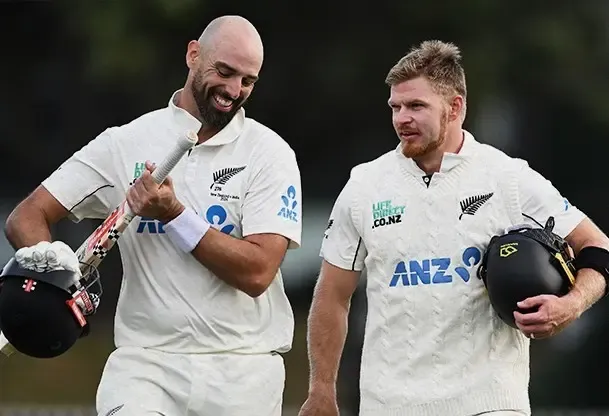
Daryl Mitchell and Glenn Phillips resisted India for 43 overs to save the first Test, finishing unbeaten as New Zealand reached 239/5. Matt Henry says the draw showed the batting line-up's growing grit ahead of the second Test in Christchurch.
Key Takeaways
Daryl Mitchell and Glenn Phillips batted for 43 overs on day five to help New Zealand draw the first Test against India .
Mitchell made 49 not out off 186 balls and Phillips finished on 26 not out off 126 balls , with New Zealand at 239/5 .
India declared on 720/9 at the Basin Reserve in Wellington .
Matt Henry said wicketkeeper Tom Blundell stood up to the stumps because edges were not carrying to slip on the slow pitch.
Henry backed Jacob Duffy , who took one wicket and conceded 201 runs , ahead of the second Test at Hagley Oval .
New Zealand batters Daryl Mitchell and Glenn Phillips showed the side's growing grit by batting out 43 overs to draw the first Test against India, fast bowler Matt Henry said on Wednesday, 25 November. The pair's resistance at the Basin Reserve in Wellington took the hosts to 239/5 in their second innings.
Mitchell finished unbeaten on 49 off 186 balls, while Phillips made 26 not out off 126 deliveries. Henry was speaking ahead of the second Test at Hagley Oval in Christchurch, which is scheduled to start on Friday.
Mitchell and Phillips hold firm
The two batters spent the final day's closing stretch absorbing pressure after India had declared on 720/9. Their stand helped New Zealand secure a draw on a pitch described as benign.
Henry called the performance “another tick in the box I suppose with our grittiness of our batting line-up”. He also pointed to a Test win in England as an earlier example of the batters digging in under pressure.
“For us it was a bit of absorbing in the last game which was okay, I think we handled it well and we came away with the draw which gives us a lot of confidence,” Henry said.
Early handshake and bowling workload
The teams agreed to end the first Test with an hour still left. Henry linked the decision to the resistance shown by Mitchell and Phillips and the workload already carried by the bowlers.
“They had some pretty heavy loads to get to that point here and it's a big series coming up and still a lot of cricket to play,” he said. Henry added that he was not reading too much into the decision to shake hands.
He acknowledged that India had batted well but said New Zealand could take positives from its patience with the ball and its batting under pressure. The ability to save the game despite tired legs and minds was particularly impressive, he said.
Why Tom Blundell stood up to the stumps
New Zealand also adjusted its bowling tactics at the Basin Reserve, with wicketkeeper Tom Blundell standing up to the stumps against the pace bowlers. Henry said the slow surface meant edges were not carrying to the slip fielders, prompting the hosts to look for another way to create dismissals.
Keeping Blundell close to the stumps was intended to keep batters in their crease while the bowlers targeted the wicket, Henry explained. New Zealand also tried short-ball plans during India's innings.
Henry said a surface offering more bounce could allow bowlers to operate wider and bring the slips into play. The choice of tactic, in his account, reflected the conditions available in Wellington rather than a single fixed approach.
Henry backs Jacob Duffy before second Test
Henry defended fellow fast bowler Jacob Duffy, who conceded 201 runs and took one wicket in Wellington. He said Duffy had accepted attacking short-ball assignments on an unhelpful pitch without worrying about his personal figures.
“He's trying to have an impact on the game,” Henry said, praising Duffy's willingness to adopt different plans for the team. He added that he had no concerns about the bowler's skill.
Attention now turns to Christchurch, where Henry said he hoped for bounce at Hagley Oval when the second Test begins on Friday.
Point of View
But India's 720/9 declaration also leaves New Zealand with bowling questions before the next Test. Henry's defence of Duffy highlights a tension between judging individual figures and assessing the difficult roles bowlers are asked to perform. The challenge in Christchurch will be to turn tactical flexibility into wickets while retaining the resilience shown in Wellington.
NationPress
25 Nov 2026
Frequently Asked Questions
How did New Zealand save the first Test against India?
Daryl Mitchell and Glenn Phillips batted for 43 overs on the final day to help New Zealand reach 239/5 and secure a draw. Mitchell finished on 49 not out and Phillips on 26 not out.
What did Matt Henry say about the Mitchell-Phillips stand?
Henry said the stand was another sign of growing grit in New Zealand's batting line-up. He said the draw gave the team confidence.
Why did Tom Blundell stand up to the stumps against the pacers?
Henry said Blundell stood up to keep batters in their crease on a slow pitch where edges were not carrying to slip. The tactic was intended to create another route to wickets.
What did Matt Henry say about Jacob Duffy's bowling?
Henry backed Duffy after he took one wicket and conceded 201 runs in Wellington. He praised the pacer for accepting attacking short-ball plans without focusing on his personal figures.
When and where is the second India-New Zealand Test?
The second Test is scheduled to start on Friday at Hagley Oval in Christchurch.