Ravi Shastri recalls Richie Benaud's broadcasting advice: 'Paid for content, not words'
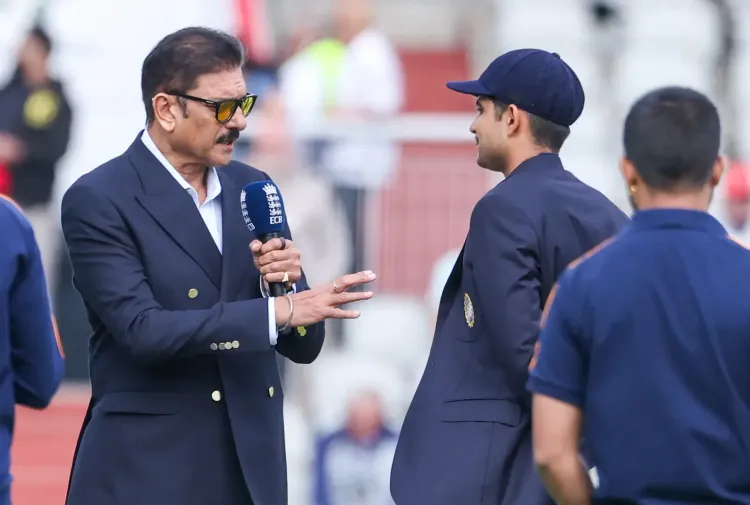
Synopsis
Ravi Shastri has revealed the advice that defined his commentary style: Richie Benaud told him after a full English summer that a broadcaster is paid not for the number of words spoken but for their content — and that if he couldn't add to the picture on screen, he should simply stay silent. It's a philosophy that has quietly governed elite cricket broadcasting for decades.
Key Takeaways
Ravi Shastri began his cricket broadcasting career in 1994 , working alongside Richie Benaud , Ian Chappell , Greg Chappell , Geoffrey Boycott , and David Gower .
Benaud's advice — 'you are paid for not the number of words you speak but the content of your speech' — became Shastri's guiding principle in commentary.
Shastri worked a full English summer for Test Match Special and the BBC before receiving that feedback from Benaud.
Benaud also drew the distinction between radio (paint a picture for the listener) and television (add to what the viewer sees, or stay silent).
Shastri shared the anecdote in an interview with Sky Sports ' Ian Smith , reflecting on the passion required to sustain a decades-long career in the game.
Former India head coach and commentator Ravi Shastri has revealed how legendary Australian broadcaster Richie Benaud shaped his approach to cricket commentary, crediting a single piece of feedback from Benaud as the guiding principle behind his decades-long broadcasting career. Shastri shared the anecdote in a candid interview with Sky Sports' Ian Smith.
How Shastri's Broadcasting Journey Began
Shastri traced his commentary roots back to 1994, when he began working alongside some of the most respected voices in the sport. He recalled being thrown straight into the company of broadcasting heavyweights at the very outset of his media career.
'I had started in '94. And straight away you were working with the big boys. You had the Craigies, the Chappellis, you had Richie,' Shastri said, referring to commentators including Richie Benaud, Ian Chappell, Greg Chappell, Geoffrey Boycott, and David Gower. He described each as bringing a distinct quality — Benaud for broadcasting discipline, Greg Chappell for marketing and selling the game, Ian Chappell for unfiltered frankness.
Benaud's Career-Defining Advice
The most formative moment, Shastri recalled, came at the end of a full English summer during which he had worked for Test Match Special and the BBC, with veteran broadcaster Tony Lewis also among his colleagues. Seeking honest feedback, Shastri approached Benaud directly.
'I asked Richie at the end of it, Richie, how do you think it went? He said, Ravi, you don't have to worry. Just remember you are paid for not the number of words you speak but the content of your speech,' Shastri recounted.
Benaud's follow-up was equally pointed: 'If the picture doesn't tell the story, if you can't add to the picture, then shut up.' Shastri said those words crystallised the fundamental difference between radio and television commentary for him — radio demands painting a picture for the listener, while television requires a commentator to add to what the viewer is already seeing, or stay silent.
The Discipline of Staying in the Game
Shastri also reflected on the sustained passion required to remain connected to cricket for so long, both as a player and as a broadcaster. He noted that the longevity he and Ian Smith share in the commentary box is rooted in a genuine love for the game rather than professional convenience.
'The only way we can hang in here if we are passionate about the game. If you're not passionate about the game, you don't love the game, you won't be here this long showing that kind of enthusiasm for every game day after day,' he said.
He acknowledged that players of Smith's and his own stature could have pursued other ventures, but that the pull of cricket proved impossible to resist. 'It's captured us,' he said simply.
A Broadcasting Career Shaped by Icons
This comes amid renewed interest in the craft of cricket broadcasting, as a new generation of ex-players transitions into the commentary box. Shastri's reflections underscore how much of elite commentary technique is transmitted not through formal training but through mentorship — absorbing the habits and philosophies of figures like Benaud, whose minimalist, authoritative style defined global cricket coverage for over four decades.
Benaud, who passed away in April 2015, is widely regarded as the most influential voice in cricket broadcasting history. His philosophy — that silence is as powerful a tool as speech — clearly left a lasting mark on at least one of his successors. As Shastri continues to call major tournaments, that lesson appears as relevant today as it was when it was first offered on the boundary of an English cricket ground in the mid-1990s.
Point of View
Who as a commentator has been both celebrated and criticised for his verbosity, credits this lesson so centrally — it raises the question of how differently careers unfold when early mentors are exceptional. As broadcast cricket becomes noisier and more opinion-saturated, Benaud's standard looks more demanding, not less.
NationPress
10 Nov 2026
Frequently Asked Questions
What was Richie Benaud's broadcasting advice to Ravi Shastri?
Richie Benaud told Shastri that a commentator is paid not for the number of words spoken but for the content of those words. He added that if a commentator cannot add to the picture on screen, they should stay silent — a principle that helped Shastri understand the core difference between radio and television commentary.
When did Ravi Shastri start his cricket commentary career?
Shastri began his broadcasting career in 1994, when he started working alongside established commentators including Richie Benaud, Ian Chappell, Greg Chappell, Geoffrey Boycott, and David Gower. He also worked for Test Match Special and the BBC during a full English summer in the mid-1990s.
Where did Shastri share these recollections about Benaud?
Shastri shared these memories in an interview with Sky Sports' Ian Smith. The conversation covered his early broadcasting years, the mentors who influenced him, and the passion needed to sustain a long career in the sport.
What did Shastri learn from other commentators he worked with early in his career?
Shastri credited Greg Chappell with teaching him how to market and sell the game, Ian Chappell for his uncompromising frankness, and Richie Benaud for the discipline behind broadcasting. He described Geoffrey Boycott and David Gower as each bringing their own distinct style to the commentary box.
What is the difference between radio and television commentary, according to Shastri?
Drawing on Benaud's advice, Shastri explained that radio commentary requires painting a vivid picture for listeners who cannot see the action, while television commentary demands that a broadcaster only speak when they can genuinely add to what the viewer is already watching — otherwise, silence is the better choice.