Suchika Tariyal wins bronze at Asian Games MMA debut after weight-rule loss in semis
Synopsis
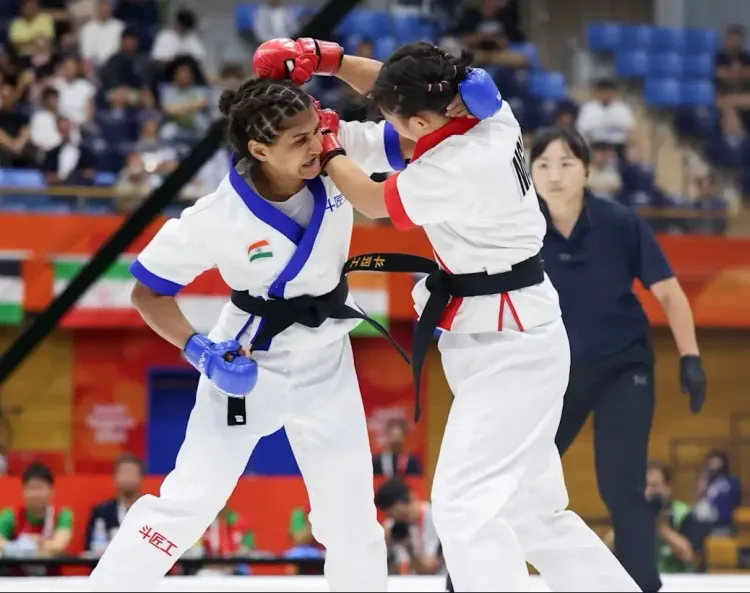
Suchika Tariyal made history at Nagoya 2026 — but the story behind her MMA bronze is as much about a rulebook as it is about sport. Her semifinal was declared a draw on re-arbitration, and then handed to Singapore's Hui Hoon Teo because Suchika was 700 grams heavier. Coach Nikhil Kunder is clear: on the scorecards, India's fighter won. The medal is historic; the manner deeply contested.
Key Takeaways
Suchika Tariyal won India's first-ever Asian Games medal in MMA — a bronze — at Nagoya 2026 .
Her semifinal against Singapore's Hui Hoon Teo was initially ruled a defeat; following an Indian protest, it went to arbitration and was rescored as a draw .
Under AMMA rules , Singapore opted for the lesser-weighed contestant criterion over counter-arbitration; Suchika was 700 grams heavier and lost on that basis.
Coach Nikhil Kunder maintained that 'on the technicalities and scoring of the fight, Suchika won.' Suchika, 36 , had beaten Mongolia's Altanchimeg Baigalmaa 2-0 in the quarterfinals to reach the last four.
MMA is making its Asian Games debut at Aichi-Nagoya, making the bronze a landmark for Indian combat sports.
Suchika Tariyal claimed a historic bronze medal at the 2026 Asian Games in Nagoya after her semifinal bout against Singapore's Hui Hoon Teo was settled by a controversial weight-based criterion — not by performance — following arbitration that declared the contest a draw. Coach Nikhil Kunder said the outcome did not reflect what happened inside the cage, insisting that on technical merit, Suchika had won the fight.
How the Semifinal Decision Unfolded
Suchika was initially awarded a defeat against Teo, prompting the Indian camp to immediately file a formal protest. The bout was subsequently sent to arbitration, where three judges were appointed to rescore the contest from scratch.
'We were confident that Suchika had won the fight. According to the rule, when arbitration happens, we select three judges. Those three judges get a chance to score the bout again. After they scored the bout again, it was declared a draw,' Kunder said.
The Weight Criterion That Decided It
Once the bout was declared a draw, the rules of the Asian Mixed Martial Arts Association (AMMA) came into play. Under the AMMA framework, when a bout ends in a draw following arbitration, the opposing team has the option to either pursue counter-arbitration or invoke the lesser-weighed contestant rule.
'Singapore chose not to pursue counter-arbitration and instead went with the lesser-weighed contestant. Unfortunately, Suchika was 700 grams heavier than her. And on those grounds, this match has been awarded to her opponent,' Kunder explained.
He maintained that the result was a procedural outcome rather than a sporting one. 'But if you look at the technicalities and scoring of the fight, Suchika won,' he said.
A Landmark Medal for Indian MMA
Despite the semifinal controversy, the bronze medal itself is a landmark for Indian combat sports. Suchika, 36, becomes the first Indian to win an Asian Games medal in MMA — a sport making its debut at the Aichi-Nagoya Games. Her path to the podium included a commanding 2-0 quarterfinal victory over Mongolia's Altanchimeg Baigalmaa.
Suchika's sporting background spans multiple disciplines — judo, kurash, and fighting Jiu-Jitsu — making her transition to MMA's biggest multi-sport stage all the more remarkable. This is the first time MMA has featured at the Asian Games, adding further weight to the historic nature of her achievement.
What the Controversy Highlights
The outcome has thrown a spotlight on the AMMA's tiebreaker rules, which critics argue can produce outcomes that are disconnected from in-bout performance. Notably, the weight differential in question — 700 grams — is marginal in combat sports terms, yet proved decisive under the current ruleset. This comes amid broader conversations in combat sports globally about whether administrative criteria should override athletic assessment in determining winners.
With MMA now an Asian Games discipline, calls for a review of such tiebreaker mechanisms are likely to intensify ahead of the next edition.
Point of View
A design choice that sits uneasily with the spirit of competitive sport. A 700-gram difference — well within normal fluctuation even post-weigh-in — deciding a semifinal outcome is the kind of rule that works quietly when no one is watching and becomes a controversy the moment a medal is at stake. As MMA embeds itself in the Asian Games programme, the federation will face pressure to revisit a tiebreaker that, as this case shows, can produce results the scorecards themselves do not support.
NationPress
21 Sept 2026
Frequently Asked Questions
Why did Suchika Tariyal lose her MMA semifinal at the Asian Games 2026?
Suchika Tariyal's semifinal against Singapore's Hui Hoon Teo was first ruled a defeat for India, then sent to arbitration after a protest, where three judges rescored it as a draw. Under AMMA rules, Singapore then invoked the lesser-weighed contestant criterion, and since Suchika was 700 grams heavier, the bout was awarded to her opponent.
What is the AMMA lesser-weighed contestant rule?
Under Asian Mixed Martial Arts Association (AMMA) rules, when a bout is declared a draw following arbitration, the opposing team can choose between counter-arbitration or invoking the lesser-weighed contestant rule, which awards the win to the lighter fighter. Singapore chose the weight criterion over counter-arbitration in Suchika's semifinal.
What medal did Suchika Tariyal win at the 2026 Asian Games?
Suchika Tariyal won a bronze medal in MMA at the 2026 Asian Games in Nagoya — India's first-ever Asian Games medal in the sport. MMA is making its debut as an Asian Games discipline at the Aichi-Nagoya edition.
What did coach Nikhil Kunder say about the controversial result?
Coach Nikhil Kunder said he and the team were confident Suchika had won the fight on technical merit. He explained the arbitration and weight-rule process in detail and stated: 'If you look at the technicalities and scoring of the fight, Suchika won.'
Who did Suchika Tariyal beat to reach the MMA semifinal at Asian Games 2026?
Suchika Tariyal defeated Mongolia's Altanchimeg Baigalmaa 2-0 in the quarterfinals to secure her place in the last four. The 36-year-old has a multi-discipline combat sports background spanning judo, kurash, and fighting Jiu-Jitsu.