GST taxpayer base hits 1.65 crore as AI, data analytics sharpen tax enforcement

Synopsis
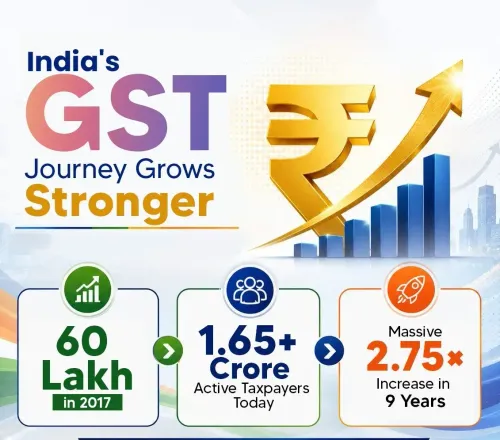
India's GST taxpayer base has nearly tripled from 66.5 lakh to 1.65 crore since 2017, and the Finance Ministry says AI and data analytics are now the backbone of enforcement — targeting high-risk evaders while easing pressure on compliant businesses. With collections surging to ₹22.27 lakh crore in 2025-26, the numbers suggest the technology pivot is working.
Key Takeaways
GST-registered taxpayers rose from 66.5 lakh in 2017 to 1.65 crore as of May 2026 .
Gross GST collections grew from ₹7.4 lakh crore in 2017-18 to ₹22.27 lakh crore in 2025-26.
AI, machine learning, and data analytics are now deployed in GST registration and scrutiny to flag high-risk taxpayers.
Collections in April–May 2026 alone reached ₹4.37 lakh crore , signalling continued momentum.
GST replaced 17 central and state taxes and 13 cesses when introduced on 1 July 2017 .
The Finance Ministry on Tuesday, 30 June said advanced technologies including artificial intelligence (AI), machine learning, and data analytics are now central to Goods and Services Tax (GST) administration, enabling authorities to detect potential tax evasion while simultaneously easing compliance requirements for honest taxpayers. The announcement comes as the number of GST-registered taxpayers crossed 1.65 crore as of May 2026, up from 66.5 lakh when the regime launched in 2017.
How Technology Is Reshaping GST Enforcement
According to the ministry, AI and data analytics are being deployed across critical processes such as GST registration and scrutiny, where they analyse data patterns and flag risk indicators. This allows tax authorities to concentrate enforcement on high-risk taxpayers while reducing the regulatory burden on compliant businesses — a targeted approach that marks a significant shift from blanket scrutiny.
The ministry noted that technology-driven monitoring has made tax collections more predictable, supporting stronger revenue buoyancy and enhancing fiscal transparency at the macroeconomic level. Officials indicated that this transition towards a data-led administration has been underway across the nine years since GST's introduction.
GST Revenue Growth: The Numbers
The revenue trajectory underscores the regime's maturation. Gross GST collections, which stood at approximately ₹7.4 lakh crore in 2017-18, have risen consistently year on year. Collections climbed from ₹13.76 lakh crore in 2021-22 to ₹22.27 lakh crore in 2025-26. In the first two months of the current financial year alone — April and May 2026 — collections reached ₹4.37 lakh crore, indicating sustained momentum.
Background: GST's Nine-Year Journey
Introduced on 1 July 2017, GST replaced a fragmented indirect tax structure comprising 17 central and state taxes and 13 cesses with a unified national regime under the 'one nation, one tax' framework. The reform was implemented following extensive consultations between the Centre and states, and was designed to create a common national market. The near-tripling of the registered taxpayer base since launch is cited by the ministry as evidence of the expanding formal economy.
What This Means for Taxpayers and Revenue
For compliant businesses, the shift to AI-driven risk profiling means fewer routine interventions and a lighter compliance load. For tax authorities, it translates into more precise enforcement — directing resources where evasion risk is genuinely elevated. Notably, this is also a signal that the government is leaning on technology rather than manpower to sustain revenue growth as the taxpayer base scales.
As GST enters its tenth year, the Finance Ministry's emphasis on technology-led administration suggests further automation of scrutiny and registration processes is on the horizon.
Point of View
But the more consequential claim is the shift to AI-driven enforcement. If risk profiling is working, it should show up in evasion detection rates and dispute resolution timelines — data the ministry has not yet made public. Revenue buoyancy is real, but it is also partly a function of inflation lifting nominal collections. The true test of technology-led administration is whether it narrows the compliance gap without generating fresh grievances among small businesses already stretched by GST's complexity.
NationPress
29 Sept 2026
Frequently Asked Questions
How many taxpayers are registered under GST as of 2026?
As of May 2026 , the number of GST-registered taxpayers stands at 1.65 crore , up from 66.5 lakh when the regime was introduced in July 2017. The Finance Ministry attributes this growth to the expanding formal economy.
How is AI being used in GST enforcement?
AI, machine learning, and data analytics are deployed in GST registration and scrutiny processes to analyse data patterns and identify risk indicators. This allows authorities to focus enforcement on high-risk taxpayers while reducing compliance requirements for honest businesses.
What are the latest GST collection figures?
Gross GST collections reached ₹22.27 lakh crore in 2025-26 , up from ₹13.76 lakh crore in 2021-22 and approximately ₹7.4 lakh crore in 2017-18. In April and May 2026 alone, collections totalled ₹4.37 lakh crore .
When was GST introduced and what did it replace?
GST was introduced on 1 July 2017 , replacing a complex structure of 17 central and state taxes and 13 cesses with a unified 'one nation, one tax' regime. It was implemented after extensive consultations between the Centre and states.
How does AI-driven GST administration benefit compliant businesses?
By using risk profiling to identify high-risk taxpayers, the system reduces routine scrutiny of compliant businesses, lowering their regulatory burden. The Finance Ministry says this targeted approach improves enforcement efficiency while supporting fiscal transparency.