How Ambedkar's Vision of Constitutional Morality Can Reinforce Global Multilateralism
Synopsis
Discover how B.R. Ambedkar's principles of constitutional morality can play a pivotal role in enhancing multilateralism in today's fragmented political landscape. This insightful discussion reflects on the relevance of his vision for the United Nations and global cooperation.
Key Takeaways
Constitutional morality is essential for effective governance.
Ambedkar's vision can rejuvenate multilateralism .
The Indian Constitution reflects the spirit of the UN Charter .
Ambedkar emphasized the importance of social justice .
Morality is crucial for implementing the UN's objectives.
New York, April 15 (NationPress) The notion of constitutional morality introduced by B.R. Ambedkar has the potential to enhance multilateralism in a world fraught with conflicts and political disarray, as per P. Harish, India's Permanent Representative. During the observance of Ambedkar Jayanti on Tuesday, he articulated that the architect of the Indian Constitution’s vision, when applied to multilateralism, could aid in reforming and revitalizing the UN.
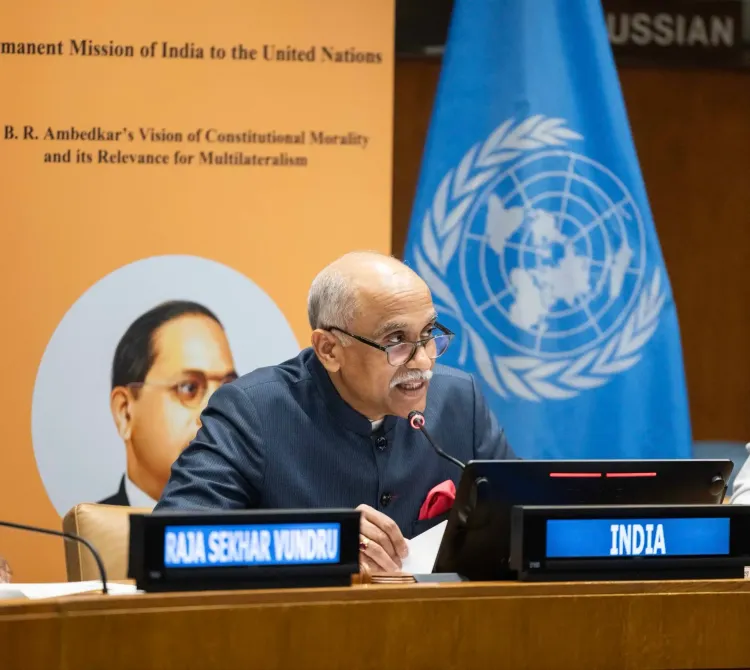
The Jayanti celebration, commemorating Ambedkar's 135th birthday, featured a discussion titled “Dr. B.R. Ambedkar’s Vision of Constitutional Morality and Its Relevance for Multilateralism.”
Raja Sekhar Vundru, a scholar well-versed in Ambedkar's work, emphasized that having experienced two world wars and witnessing the establishment of the UN, he understood the significance of multilateralism.
Vundru, who serves as the additional chief secretary of the Haryana government, is also the author of “Ambedkar, Gandhi, and Patel: The Making of India's Electoral System.” He pointed out that the Indian Constitution drafted by Ambedkar embodies the spirit of the UN’s Charter in its pursuit of peace.
Ambedkar’s principles of constitutional morality can foster multilateralism and adherence to the UN Charter.
Santosh Raut, a visiting professor at Harvard Divinity School, remarked that Ambedkar considered the Constitution a tool for social justice and economic transformation, concepts that resonate with the UN’s objectives in these fields.
Morality serves as the driving force that enables the actualization of the essence of documented texts such as the UN Charter, a foresight that Ambedkar had articulated, according to the scholar of Buddhism.
Point of View
The potential for effective reform within institutions like the UN emerges, advocating a collective effort for peace and justice.
NationPress
19 Sept 2026
Frequently Asked Questions
What is constitutional morality according to B.R. Ambedkar?
Constitutional morality, as articulated by B.R. Ambedkar, refers to the adherence to the principles and values enshrined in the Constitution, promoting justice, equality, and fraternity.
How can Ambedkar's ideas enhance multilateralism?
Ambedkar's concepts can enhance multilateralism by fostering cooperation and unity among nations, promoting adherence to international laws like the UN Charter.
What is the significance of Ambedkar Jayanti?
Ambedkar Jayanti celebrates the birth of B.R. Ambedkar, recognizing his contributions to the Indian Constitution and social justice.
Who is Raja Sekhar Vundru?
Raja Sekhar Vundru is a scholar of Ambedkar's work and the additional chief secretary of the Haryana government, known for his insights on India's electoral system.
What role does morality play in governance?
Morality underpins ethical governance, guiding legal frameworks and ensuring that policies align with values of justice and equality.