Is India’s History Really as Ancient as the Vedas?

Synopsis
Discover the profound insights shared by Acharya Mithilesh Nandini Sharan at Shabdotsav 2026, where he emphasizes India's ancient history dating back to the Vedas. This article delves into the misconceptions surrounding India's historical narrative and the significance of ancient values in modern understanding.
Key Takeaways
India's history is as ancient as the Vedas.
The term 'history' originated from the Indian sub-continent.
Vedas are the oldest literary texts globally.
Integrating ancient values is crucial for modern understanding. 'Shanta Rasa' is a central theme in Indian historical texts.
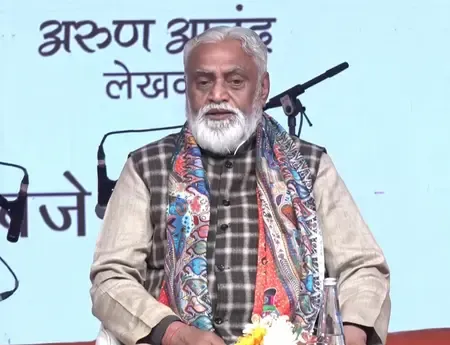
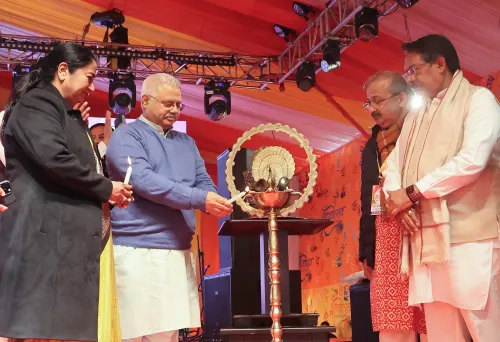
New Delhi, Jan 3 (NationPress) Acharya Mithilesh Nandini Sharan asserted that India boasts a legendary and profound history tracing back to the era of the Vedas, adding that the very term ‘history’ has its roots in the Indian sub-continent. This statement was made on Saturday during the ongoing 'Shabdotsav 2026' at Delhi’s Major Dhyan Chand stadium.
When questioned about the claim that India's history has not been documented, Acharya Mithilesh Nandini Sharan, who heads the Hanuman Niwas Peeth in Ayodhya Dham, firmly refuted it, calling it falsehood and misinformation.
The esteemed Hindu scholar emphasized that this misconception has been repeatedly circulated in an effort to distort the truth. He highlighted that the term 'history' is a contribution from India, maintaining that the nation’s historical narrative is as ancient as the Vedas.
During his address, he elaborated that the Vedas are recognized as the oldest literary compositions globally, and mentioned that the concept of 'history' has been utilized in India since the Upanishadic era, thus evidencing the long-standing tradition of historical documentation.
Acharya Mithilesh Nandini Sharan urged the audience to integrate ancient values into contemporary perspectives to truly grasp India’s cultural depth and richness.
He pointed out that the central theme of Indian history is 'Shanta Rasa', citing the Ramayana and the Shrimad Bhagavad Gita as examples where this core sentiment is prevalent.
In discussing the societal traditions, he noted that in India, a son's marriage is deemed challenging without an understanding of his history, illustrating that history extends beyond mere literature into social realities.
Responding to claims labeling the Vedas as fictitious, he characterized such assertions as a form of mental delusion. He stressed the importance of comprehending the essence of imagination, explaining that every creation begins as an idea before materializing into reality.
He further clarified that those who dismiss the Vedas as imaginary are unaware that 'Kalpa' is a systematic discipline and one of the six supplementary sciences associated with the Vedas. The methodologies established through Kalpa indicate that the imaginative processes of ancient sages were both scientific and methodical.
Acharya Mithilesh Nandini Sharan concluded by stating that no scientist has successfully disproven the principles laid out in the Vedas. He remarked, “When science fails to invalidate a concept, it is unjust to label it as mere imagination or myth, which amounts to misinformation.”
Point of View
The discourse presented by Acharya Mithilesh Nandini Sharan at Shabdotsav 2026 highlights the importance of recognizing India's rich historical legacy. His emphasis on integrating ancient wisdom into contemporary society reflects a broader need to respect and validate our cultural roots while fostering a deeper understanding of our national identity.
NationPress
19 Sept 2026
Frequently Asked Questions
What did Acharya Mithilesh Nandini Sharan say about India's history?
He asserted that India's history is as ancient as the Vedas and emphasized the origins of the term 'history' in the Indian sub-continent.
How did he respond to claims that the Vedas are imaginary?
He described such claims as a form of mental illness and emphasized the scientific and systematic nature of the Vedas.
What is 'Shanta Rasa'?
It is described as the central element of Indian history, with examples from texts like the Ramayana and the Shrimad Bhagavad Gita.
Why did he highlight the importance of ancient values?
He believes that integrating these values into modern thought is essential to understanding the cultural richness of India.
What is the significance of the term 'Kalpa' in relation to the Vedas?
Kalpa is a discipline and one of the six auxiliary sciences of the Vedas, demonstrating that the imaginative processes of sages were systematic.