Is 27 lakh bighas of encroached land in Assam a concern for the government?

Synopsis
Assam's eviction drive continues as Chief Minister Sarma reveals that nearly 27 lakh bighas of land is illegally occupied. The government plans to regularize land rights for indigenous communities to reduce the area needing eviction.
Key Takeaways
Assam's eviction campaign targets illegal land encroachment.
Approximately 26 to 27 lakh bighas of land is currently under illegal occupation.
The government aims to regularize land rights for indigenous communities.
The Supreme Court has instituted safeguards for due process in evictions.
Eviction proceedings are contingent on confirming encroachment.
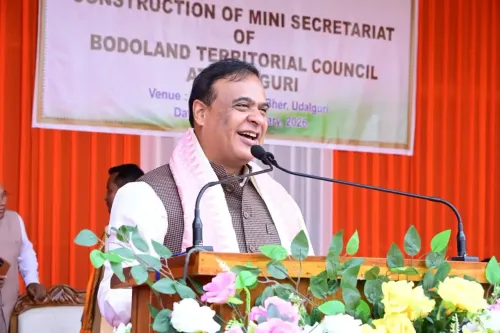
Guwahati, Feb 11 (NationPress) Assam's Chief Minister Himanta Biswa Sarma announced on Wednesday that the state administration will persist with its eviction campaign aimed at reclaiming government and forest land. He revealed that almost 26 to 27 lakh bighas of land statewide is currently occupied illegally.
In a recent press briefing, Sarma explained that an eviction operation was conducted in Karimganj district on February 10, as part of the government’s relentless efforts to recover encroached territories.
However, he noted that the total area requiring eviction will significantly decrease once land rights are regularized for qualified indigenous and tribal groups.
“Currently, approximately 26 to 27 lakh bighas of land is under encroachment. Once forest pattas are granted to indigenous residents, their land will be formalized, reducing the eviction efforts to about 20 lakh bighas,” stated the Chief Minister.
He emphasized that the government is adopting a tailored strategy, differentiating between alleged illegal encroachers and indigenous or tribal individuals who are entitled to land rights under existing regulations, especially in forest regions.
In related news, the Supreme Court on February 10 permitted the Assam government to form a committee tasked with identifying unauthorized occupants in the Doyang Reserved Forest and neighboring villages in Golaghat district, while instituting safeguards to ensure due process prior to any eviction.
The apex court acknowledged that forests are among the nation’s most crucial natural resources and noted that encroachment on these lands poses a serious threat to environmental governance.
The court mandated that the proposed committee must notify alleged unauthorized occupants, granting them an opportunity to justify their occupation before any enforcement actions are taken.
The Bench clarified that eviction procedures can commence only after confirming the encroachment.
If it is determined that the land lies within revenue limits and outside the designated forest area, the revenue department will dictate the next steps.
Conversely, if unauthorized occupation is verified within a reserve forest, a formal order must be issued and delivered, giving the occupant 15 days to vacate.
The eviction operations are part of the Assam government’s broader strategy to reclaim land it deems illegally occupied, while simultaneously working to issue land pattas to qualified indigenous and tribal families.
tdr/rad
Point of View
The ongoing eviction drive in Assam highlights the complex interplay between land rights, indigenous communities, and environmental governance. The state's approach aims to balance recovery of encroached land while granting rights to eligible tribal families, reflecting a nuanced policy direction.
NationPress
29 Sept 2026
Frequently Asked Questions
What is the current status of land encroachment in Assam?
According to Assam's Chief Minister, approximately 26 to 27 lakh bighas of land is currently under illegal occupation.
How does the government plan to address encroachment?
The government is conducting eviction drives while also working to regularize land rights for eligible indigenous and tribal communities, which may reduce the area needing eviction.
What role does the Supreme Court play in this matter?
The Supreme Court has allowed the Assam government to form a committee to identify unauthorized occupants in protected forest areas, ensuring due process in eviction actions.
What is the differentiated approach mentioned by the Chief Minister?
The government distinguishes between illegal encroachers and indigenous residents entitled to land rights, particularly in forested areas.
What measures are being taken to protect forest land?
The Supreme Court has mandated that a committee must notify alleged unauthorized occupants and allow them to justify their occupation before any eviction is executed.