Did Baloch Fighters Just Launch a Major Assault on Pakistani Forces in Balochistan?
Synopsis
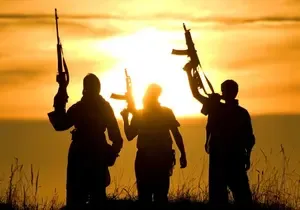
In a bold escalation, the Baloch Liberation Army (BLA) has launched the second phase of 'Operation Herof', targeting Pakistani military installations across multiple districts in Balochistan. With intense armed clashes reported, the BLA emphasizes a collective struggle against the occupying forces, urging the local populace to join the fight for independence.
Key Takeaways
BLA initiates second phase of 'Operation Herof' .
Multiple districts in Balochistan face armed clashes .
Heavy gunfire reported in Quetta and surrounding areas .
BLA claims significant military engagements and casualties .
Human rights concerns persist amid escalating violence .
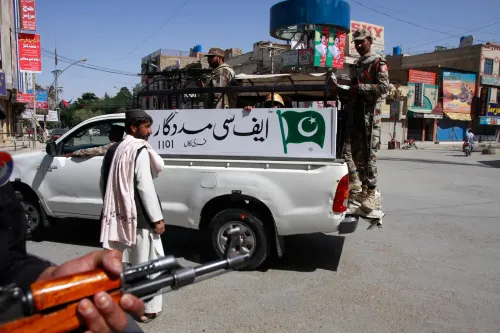
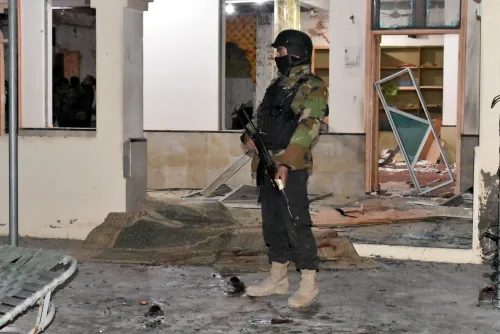
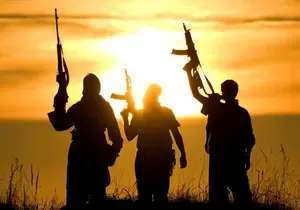
Quetta, Jan 31 (NationPress) The Baloch Liberation Army (BLA) declared the initiation of the second phase of 'Operation Herof' across Balochistan this past Saturday, resulting in armed confrontations, explosions, and assaults targeting Pakistani military installations throughout various districts, as reported by local media.
Characterizing it as a “proclamation of resolute resistance”, BLA spokesperson Jeeyand Baloch stated that this new phase focuses on opposing “the occupying state and all its military and administrative frameworks.”
He emphasized that by aligning with Baloch fighters, the people of Balochistan would “overcome the enemy in every city, street, and neighborhood,” asserting that the operation intends to illustrate that “there is no refuge for the occupier in Balochistan.”
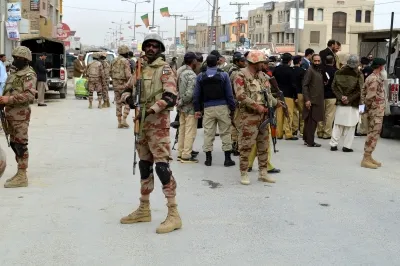
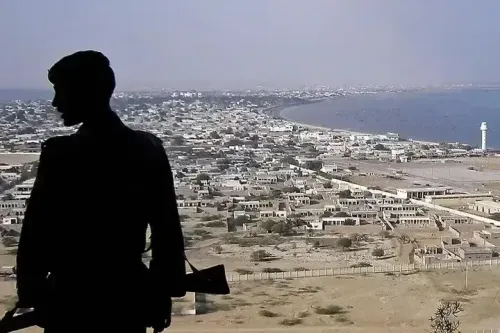
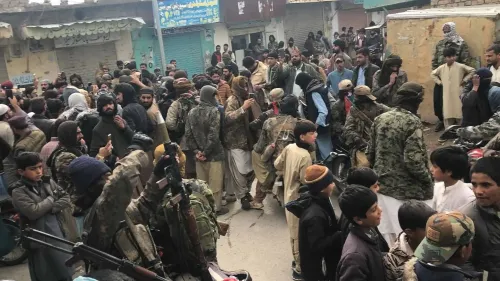
According to residents and local sources, the security climate has remained extremely tense in numerous regions of the province, including Quetta, Nushki, Kalat, Mastung, Dalbandin, Kharan, Gwadar, Pasni, Tump, Buleda, and Dhadar, amidst reports of intense gunfire, explosions, and assaults directed at Pakistani police and military sites.
In the provincial capital Quetta, residents reported gunfire and explosions across various areas, notably within the highly sensitive Red Zone.
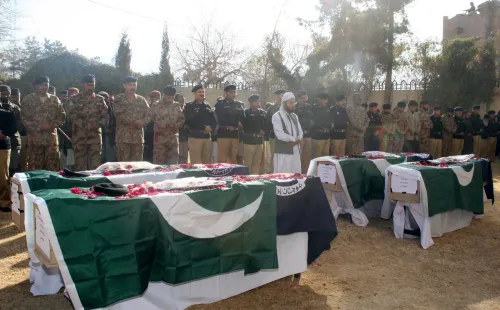
Reports indicate that armed assailants targeted a Pakistani police mobile unit on Sariab Road in Quetta, resulting in the deaths of two personnel and the vehicle being set ablaze, with gunfire reported from the vicinity of the railway station.
In a subsequent statement to media outlets, the BLA confirmed that during the second phase of 'Operation Herof', they initiated “simultaneous, coordinated assaults” across ten cities within the province, including Quetta, Nushki, Mastung, Dalbandin, Kalat, Kharan, Gwadar, Pasni, Tump, and Buleda.
Spokesperson Jeeyand Baloch asserted that the group targeted “military and administrative structures,” disrupted “enemy forces’ movements,” and “repelled” Pakistani troops in various locations.
The statement further noted that “Fidayeen attacks” were directed at camps belonging to the Pakistani army and Inter-Services Intelligence (ISI) in Quetta, Pasni, Gwadar, Noshki, and Dalbandin, claiming that the group’s Majeed Brigade had “successfully infiltrated army camps and secured substantial portions of them,” with “intense combat” ongoing.
The BLA claimed that “dozens” of Pakistani military personnel had been “neutralized” thus far, promising that further details would be provided to the media shortly.
In a separate communication released via the BLA’s media department, commander-in-chief Bashir Zeb Baloch urged the people of Balochistan to “emerge from their homes and combat Pakistani forces.”
He stated, “This struggle does not belong to any single individual but to collective consciousness. When a nation stands united, the enemy cannot avoid defeat despite its power. The Baloch nation is urged to step out and become part of Operation Herof,” as quoted by The Balochistan Post.
People in Balochistan are presently engaged in a struggle for their independence from Pakistan.
Numerous human rights organizations in Balochistan have consistently highlighted the oppression by Pakistani forces in the province, encompassing violent raids on the residences of Baloch leaders and civilians, unlawful detentions, enforced disappearances, the 'kill and dump' policy, arrests under the Maintenance of Public Order Ordinance, and the filing of fabricated police cases.
Point of View
It is crucial to approach the topic with a balanced perspective, acknowledging the long-standing grievances of the Baloch people while also recognizing the broader implications for regional stability. Our commitment is to provide clear and objective reporting on these developments.
NationPress
16 Sept 2026
Frequently Asked Questions
What triggered the BLA's 'Operation Herof'?
The BLA's 'Operation Herof' was initiated as a response to ongoing grievances against Pakistani military actions in Balochistan, which the group views as an occupation.
How many cities are involved in this operation?
The BLA has reported conducting coordinated attacks across ten cities, including Quetta, Nushki, and Gwadar.
What is the main goal of the BLA's operations?
The BLA aims to disrupt Pakistani military and administrative structures, asserting the Baloch people's right to self-determination.
What has been the local response to the BLA's call to action?
The local response has been mixed, with some supporting the BLA's call for resistance while others express concerns over the violence.
How are human rights organizations responding?
Human rights organizations continue to document abuses and highlight the repression faced by Baloch civilians amid the conflict.