What Is the Latest on Typhoon Fengshen in China?
Synopsis
China's national observatory has issued a yellow alert for Typhoon Fengshen, the 24th of the year, expecting heavy rains and strong winds in southern regions. As it approaches Vietnam, preparations are underway to mitigate potential flooding and landslides.
Key Takeaways
Yellow alert issued for Typhoon Fengshen.
Strong winds and heavy rain expected in southern China.
Gales forecasted across multiple regions.
Vietnam prepares for the storm's landfall as a tropical storm.
Risks of flooding and landslides are heightened.
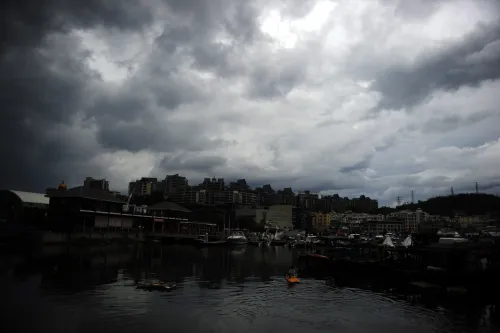
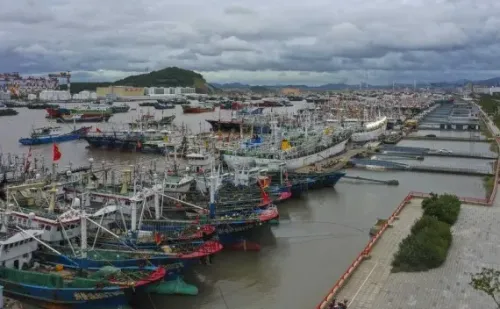
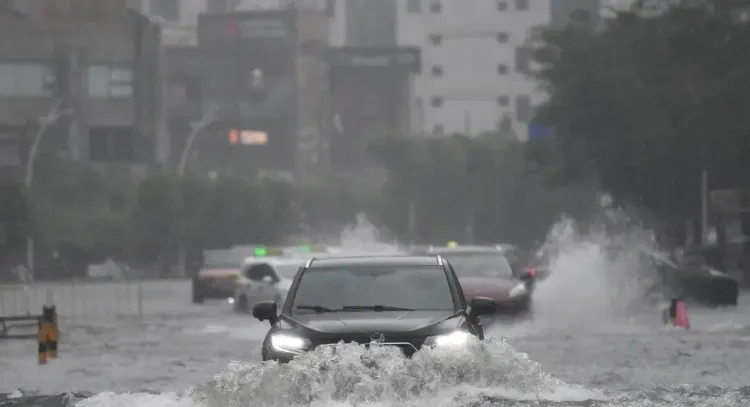
Beijing, Oct 22 (NationPress) The national observatory of China has issued a yellow alert for typhoon Fengshen on Wednesday, marking it as the 24th typhoon of the year. This storm is anticipated to unleash strong winds and heavy rainfall across several regions in the south of the country.
As of 9 a.m. Wednesday, Fengshen was situated over the South China Sea, approximately 170 km west-northwest of Yongxing Dao in Sansha City, Hainan Province. The maximum wind speed near its center was reported at 33 metres per second, as noted by the National Meteorological Centre (NMC).
The typhoon is predicted to move southwestward at a pace of 10 km per hour and is expected to maintain its intensity through Wednesday morning, followed by a gradual weakening.
As a result of Fengshen, strong gales are forecasted to impact areas including parts of the East China Sea, the Taiwan Strait, the Bashi Channel, the waters east of Taiwan, coastal regions of southern Zhejiang, Fujian, Taiwan, Hainan Island, and segments of the South China Sea, as well as the Beibu Gulf from 2 p.m. Wednesday until 2 p.m. Thursday, as reported by the NMC.
At the same time, heavy rainstorms are likely in certain parts of Hainan Island and Taiwan during this timeframe.
China employs a four-tier, color-coded warning system for typhoons, with red being the most severe, followed by orange, yellow, and blue, as per Xinhua news agency.
The typhoon is expected to make landfall on Vietnam's central coast as a tropical storm on Thursday before rapidly losing strength, according to the centre.
On Monday, Vietnamese Prime Minister Pham Minh Chinh issued a directive to ministries, agencies, and localities in central Vietnam to implement urgent actions as Typhoon Fengshen approaches.
Fengshen is the 12th storm anticipated to strike Vietnam this year, with forecasts indicating heavy rainfall in the central provinces from Wednesday through Sunday.
The storm is also projected to create significant risks of flooding, landslides, and flash floods, according to the National Centre for Hydro-Meteorological Forecasting.
Residents of Laos are likewise advised to prepare for extensive heavy rain as tropical storm Fengshen nears, raising concerns about potential landslides and flash floods.
The storm is expected to traverse Vietnam before entering Laos, bringing light to moderate thunderstorms nationwide, accompanied by heavy to very heavy rainfall and strong winds in specific regions from October 23 to 24, as stated in a report from the Department of Meteorology and Hydrology under the Lao Ministry of Agriculture and Environment.
Point of View
We emphasize the importance of staying informed and prepared as Typhoon Fengshen approaches. The safety of citizens is our priority, and we encourage everyone in the affected regions to heed warnings and take the necessary precautions.
NationPress
30 Sept 2026
Frequently Asked Questions
What areas are affected by Typhoon Fengshen?
Typhoon Fengshen is expected to affect southern regions of China, including Hainan, as well as parts of Vietnam and Laos, bringing heavy rainfall and strong winds.
What precautions should residents take?
Residents in the affected areas should secure loose items, stay indoors during the storm, and follow updates from local authorities for safety instructions.
How does the typhoon warning system work in China?
China uses a four-tier color-coded warning system, where red indicates the most severe warnings, followed by orange, yellow, and blue.