Why Did ED Attach Assets Worth Rs 1.58 Crore in a Money Laundering Case Linked to a Former Railway Engineer?
Synopsis
In a significant move, the ED has provisionally attached assets worth Rs 1.58 crore linked to the late Ved Prakash Shrivastava, a former railway engineer, as part of a money laundering investigation. This action aims to curb the illicit flow of funds and preserve the integrity of public resources.
Key Takeaways
The ED has attached assets worth Rs 1.58 crore linked to a former railway engineer.
The action is part of a broader investigation into alleged corruption.
Proceeds of crime were assessed at approximately Rs 1.66 crore.
Funds were reportedly laundered through family members' accounts.
The case emphasizes the importance of transparency in public service.
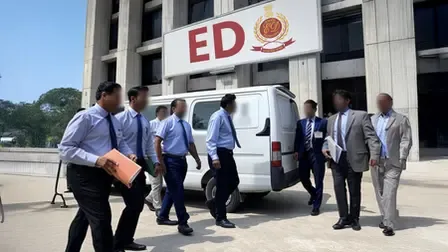
Bhopal, Feb 6 (NationPress) The Directorate of Enforcement (ED), Bhopal Zonal Office, has provisionally attached two residential flats and 22 movable properties, including fixed deposits and bank balances, amounting to approximately Rs 1.58 crore.
The seized assets are associated with the late Ved Prakash Shrivastava, a former Divisional Engineer of Western Railways in the Rajkot Division of Gujarat, and his wife Vibha Shrivastava.
This action was taken on February 5, 2026, under the provisions of the Prevention of Money Laundering Act (PMLA), 2002, as stated in an ED press release.
The investigation was initiated following an FIR lodged by the Central Bureau of Investigation (CBI), Anti-Corruption Branch, Jabalpur, against the late Ved Prakash Shrivastava and his wife, for allegedly gaining disproportionate assets by misusing his official position.
The CBI submitted a charge sheet on May 22, 2023, to the Special Court for CBI cases in Jabalpur, under Sections 109 and 13(1)(e) in conjunction with Section 13(2) of the Prevention of Corruption Act, 1988, and Section 109 of the Indian Penal Code, 1860.
The total proceeds of crime in this case have been estimated to be around Rs 1.66 crore.
According to the ED's investigation, unaccounted cash generated from corrupt activities was initially retained and utilized outside the banking system for daily expenses, as evidenced by minimal cash withdrawals from bank accounts.
Portions of these proceeds of crime were subsequently deposited into bank accounts of family members. The funds were converted into fixed deposits, investments, and used to acquire immovable properties, including residential flats registered in the names of family members who had no independent source of income, the release indicated.
The attachment encompasses the disproportionate assets reportedly acquired through layering and diffusion of the money trail.
This action is aimed at preventing any further dissipation of the alleged proceeds of crime and follows the confirmation of the money laundering angle established by the CBI's predicate offence.
Point of View
I see this action by the ED as a crucial step in the fight against corruption. The investigation sheds light on the serious issue of public servants misusing their positions for personal gain. It's imperative that such cases are pursued rigorously to uphold the integrity of our institutions and restore public trust.
NationPress
29 Sept 2026
Frequently Asked Questions
What triggered the ED's investigation?
The investigation was initiated based on an FIR filed by the CBI alleging that the former railway engineer and his wife acquired disproportionate assets by misusing their official positions.
What assets were attached by the ED?
The ED provisionally attached two residential flats and 22 movable properties, including fixed deposits and bank balances, amounting to approximately Rs 1.58 crore.
What is the significance of the Prevention of Money Laundering Act?
The Prevention of Money Laundering Act allows authorities to attach assets acquired through unlawful means, helping to combat corruption and financial crimes.
What were the findings regarding the proceeds of crime?
The total proceeds of crime in this case were assessed at approximately Rs 1.66 crore, with evidence suggesting that unaccounted cash was used outside the banking system.
How does this case reflect on public service ethics?
This case underscores the pressing need for accountability among public servants and highlights the consequences of unethical behavior in positions of power.