Axis My India Exit Poll: UDF sweeps Kerala, NDA leads Assam, NRC+ holds Puducherry
Synopsis
Axis My India's exit poll projects a dramatic anti-incumbency wave in Kerala, with UDF set to unseat Pinarayi Vijayan's LDF government by winning up to 90 seats. Simultaneously, NDA is on course for a landslide in Assam and NRC+ looks set to hold Puducherry — a sweep that, if confirmed, would reshape the political map across three regions in one go.
Key Takeaways
UDF projected to win 78–90 seats in Kerala's 140-member Assembly , potentially ending the LDF 's tenure under Pinarayi Vijayan .
UDF vote share stands at 44% vs LDF's 39% and NDA's 14% in Kerala.
NDA projected to win 88–100 seats in Assam's 126-member Assembly , with vote share up 4% from 2021 to 48% .
Himanta Biswa Sarma leads as most preferred CM in Assam at 48% support.
NRC+ alliance projected to retain Puducherry with 16–20 seats ; N Rangasamy leads CM preference at 42% .
Actor-politician Vijay secures 17% CM preference in Puducherry, signalling an emerging political presence.
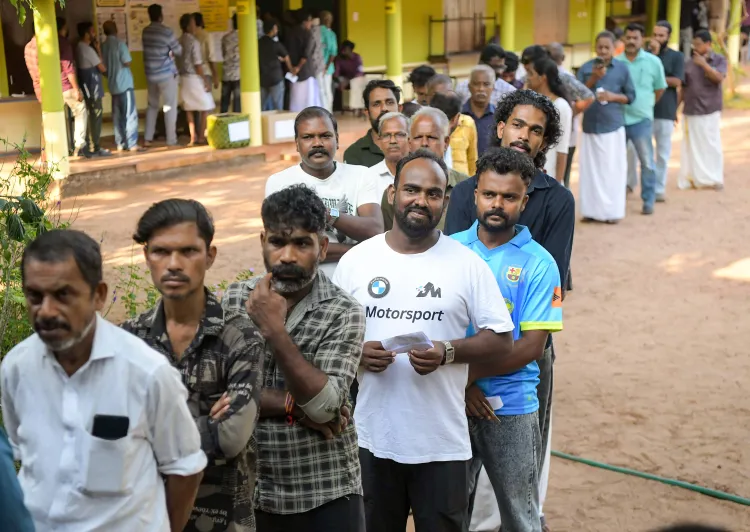
The Axis My India exit poll, released on Wednesday, 29 April, projects a sweeping victory for the United Democratic Front (UDF) in Kerala, a decisive mandate for the National Democratic Alliance (NDA) in Assam, and a retention of power by the NRC+ alliance in Puducherry. The three-state survey, based on a combined total of over 50,000 interviews, signals significant political shifts across two major state assemblies and one Union Territory.
Kerala: UDF Poised for a Sweeping Win
In the 140-member Kerala Legislative Assembly, the United Democratic Front is projected to win between 78 and 90 seats, comfortably crossing the majority mark. The Left Democratic Front (LDF), which has governed the state under Chief Minister Pinarayi Vijayan, is estimated to secure between 49 and 62 seats, while the National Democratic Alliance is expected to remain marginal at 0 to 3 seats.
Vote share projections reinforce this trend: UDF leads at 44 per cent, followed by LDF at 39 per cent and NDA at 14 per cent. Regionally, the UDF has shown strong performance in Kochi and Malabar, while the LDF has managed to hold ground in Travancore.
Notably, despite Pinarayi Vijayan remaining the most preferred choice for Chief Minister at 33 per cent, a significant 26 per cent of voters expressed a desire for change — a sentiment that appears to have benefited the UDF considerably. The Kerala findings are based on 24,419 interviews across all constituencies.
Assam: NDA Eyes Landslide in 126-Seat House
In Assam, the exit poll indicates a decisive mandate for the NDA, led by the Bharatiya Janata Party (BJP). The alliance is projected to win between 88 and 100 seats in the 126-member Assembly, far exceeding the majority threshold of 64 seats. The Congress-led alliance is expected to secure between 24 and 36 seats, while other parties may capture 0 to 3 seats.
The NDA's projected vote share stands at 48 per cent, marking a 4 per cent increase from 2021, compared to 38 per cent for the Congress-led alliance. Regionally, the NDA has demonstrated dominance in Bodoland Territorial Council, with 13 to 15 seats, and in Central Assam, with 31 to 35 seats.
Chief Minister Himanta Biswa Sarma remains the most popular choice for the top post, commanding 48 per cent support, while Congress leader Gaurav Gogoi trails at 32 per cent. Development and state government schemes emerged as key drivers of voter behaviour, with 28 per cent citing development as their primary motivation and 14 per cent highlighting benefits from government programmes. The Assam survey covered 24,228 interviews across all constituencies.
Puducherry: NRC+ Alliance Set to Retain Power
In the 30-member Puducherry Assembly, the NRC+ alliance — comprising All India N R Congress (AINRC), Bharatiya Janata Party (BJP), All India Anna Dravida Munnetra Kazhagam (AIADMK), and LJK — is projected to retain power with between 16 and 20 seats. The Congress-led alliance, fronted by the Dravida Munnetra Kazhagam (DMK), is projected to win between 6 and 8 seats, while the TVK+ alliance is likely to capture 2 to 4 seats.
The NRC+ alliance leads on vote share at 40 per cent, followed by the Congress-led alliance at 30 per cent and TVK+ at 17 per cent. N Rangasamy of AINRC remains the most popular choice for Chief Minister at 42 per cent support. Notably, actor-turned-politician Vijay has emerged as a contender, securing 17 per cent support for the top post.
Voter motivations varied sharply: 30 per cent of NRC+ supporters cited the good work of the state government, while an overwhelming 71 per cent of TVK+ voters expressed a desire for change. The Puducherry findings are based on 2,250 interviews across all constituencies.
What These Projections Signal
If the Axis My India projections hold, the results would mark a historic anti-incumbency sweep in Kerala — ending the LDF's tenure — while consolidating the BJP's foothold in Assam and reinforcing the NRC+ bloc's grip on Puducherry. Exit polls, however, carry margins of error and have historically diverged from final tallies in closely contested states. Actual vote counts will determine the final outcome.
Point of View
Not a narrow correction. In Assam, the NDA's projected 4-percentage-point vote share gain over 2021 suggests Himanta Biswa Sarma has converted administrative visibility into electoral capital. The Puducherry subplot is worth watching: Vijay's 17% CM preference in a territory he has barely campaigned in is a leading indicator of how quickly his TVK can convert celebrity into votes. Exit polls have a mixed track record in smaller assemblies, but the directional consensus across all three states points one way.
NationPress
15 Sept 2026
Frequently Asked Questions
What does the Axis My India exit poll project for Kerala?
The Axis My India exit poll projects the United Democratic Front to win between 78 and 90 seats in Kerala's 140-member Assembly, well above the majority mark. The Left Democratic Front is estimated at 49–62 seats, while the NDA is expected to win just 0–3 seats.
How many seats is NDA projected to win in Assam?
The NDA is projected to win between 88 and 100 seats in Assam's 126-member Assembly, far exceeding the majority threshold of 64 seats. Its vote share is projected at 48%, up 4% from the 2021 election.
Who is projected to be the Chief Minister in Assam according to the exit poll?
Himanta Biswa Sarma is the most preferred choice for Chief Minister in Assam, with 48% support according to the Axis My India exit poll. Congress leader Gaurav Gogoi trails at 32%.
What is the projected outcome in Puducherry?
The NRC+ alliance is projected to retain power in Puducherry with 16–20 seats in the 30-member Assembly. N Rangasamy of All India N R Congress leads CM preference at 42%, while actor-politician Vijay has emerged with 17% support.
How reliable are exit polls in Indian state elections?
Exit polls provide directional projections based on voter interviews but carry margins of error and have historically diverged from final results, particularly in closely contested or smaller assemblies. The Axis My India survey covered over 50,000 interviews across the three states, but actual vote counts remain the definitive measure.