Government Warns of Cyber Fraud: Fake BSNL Notices Targeting Phone Users
Synopsis
The Union government has issued a crucial warning against a rising cyber fraud involving forged notices from BSNL and TRAI, alerting users about fake SIM card blockages. Stay informed to avoid falling prey to these scams.
Key Takeaways
Beware of fake notices claiming to be from BSNL or TRAI.
Do not share personal information or respond to suspicious messages.
Report any fraudulent communications to the authorities.
The government is enhancing cybercrime prevention measures.
Stay informed and vigilant to protect yourself from scams.
New Delhi, March 17 (NationPress) The Union government issued a warning on Tuesday regarding a cyber fraud scheme orchestrated by scammers who are sending fraudulent notices purportedly from the Bharat Sanchar Nigam Limited (BSNL) and the Telecom Regulatory Authority of India (TRAI). These notices falsely alert mobile users about the potential suspension of their SIM cards.
The Press Information Bureau (PIB) issued a fact-check confirming that these messages are indeed fabricated. They urged the public to remain vigilant and avoid falling victim to these scams, which could lead to identity theft as scammers attempt to gather sensitive information.
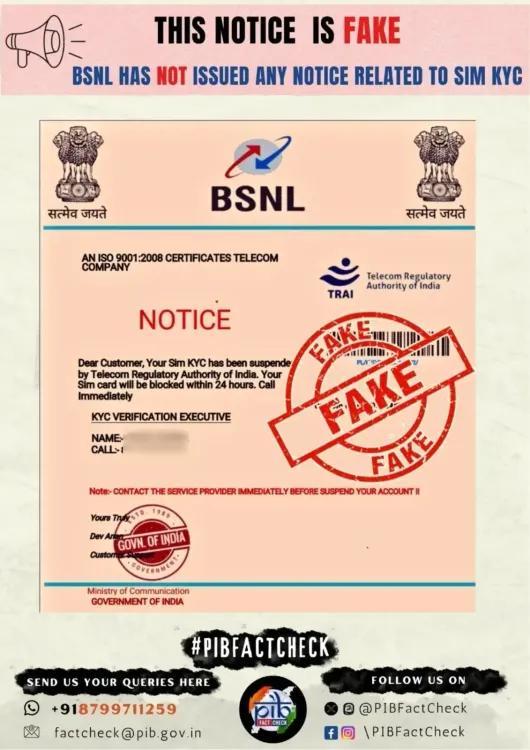
The fraudulent communications mimic BSNL's official format, claiming that 'TRAI' requires customers to contact a KYC Verification Executive and provide personal information.
The message typically states, "Dear Customer, Your SIM KYC has been suspended by the Telecom Regulatory Authority of India. Your SIM card will be blocked within 24 hours. Call Immediately."
The PIB clarified that BSNL has not issued any such KYC alerts. They emphasized, "BSNL Corporate does not send such notices. Please do not disclose your personal or banking information to anyone," as part of their advisory.
In related news, the Union Home Ministry informed the Lok Sabha that a total of 86,420 cybercrime incidents were reported in 2023. Data from the National Crime Records Bureau (NCRB) revealed a rise from 65,893 cases in 2022, and 52,974 in 2021.
The Minister of State (MoS) for Home Affairs, Bandi Sanjay Kumar, mentioned that the Ministry has allocated ₹116.5 crore under the Cyber Crime Prevention against Women and Children (CCPWC) Scheme to assist states and Union Territories (UTs) in establishing cyber forensic and training laboratories.
Currently, cyber forensic laboratories have been set up in 33 states/UTs including regions such as Madhya Pradesh, Dadra and Nagar Haveli, Daman and Diu, and Maharashtra. Furthermore, there are seven Central Forensic Science Laboratories (CFSLs) and 27 state laboratories operational nationwide to aid in cybercrime investigations.
Prior to 2014, four CFSLs in Chandigarh, Hyderabad, Delhi, and Kolkata had digital forensics capabilities. Post-2014, three additional CFSLs, including digital forensic divisions, were established in Pune, Bhopal (Madhya Pradesh), and Kamrup (Assam).
Point of View
It is imperative to highlight the increasing prevalence of cyber fraud and the importance of public awareness. The government's proactive stance in issuing warnings and providing resources to combat these scams reflects a commitment to safeguarding citizens. Awareness and vigilance are crucial in the digital age.
NationPress
2 Oct 2026
Frequently Asked Questions
What are the fake notices about?
The fake notices falsely claim that the user's SIM card will be blocked unless they provide personal information for KYC verification.
How can I verify the authenticity of a notice?
You can verify the authenticity by contacting BSNL or TRAI directly through their official channels.
What should I do if I receive such a notice?
Do not respond or provide any personal information. Report the notice to the authorities immediately.
Has the government taken any measures against cybercrime?
Yes, the government has allocated funds for cyber forensic labs and has reported significant cases of cybercrime in recent years.
Where can I find more information on cyber safety?
You can visit the official websites of the Ministry of Home Affairs or the Cyber Crime Prevention against Women and Children (CCPWC) scheme.