Gujarat Cabinet passes resolution marking PM Modi's 25 years in public service
Synopsis
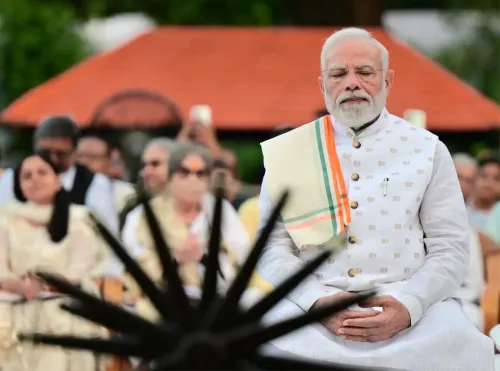
The Gujarat Cabinet has unanimously passed a resolution marking 25 years since Narendra Modi became Chief Minister of Gujarat on 7 October 2001. The resolution is as much a political tribute as a policy document — tracing a line from Gujarat's post-earthquake recovery to the ambition of Viksit Bharat 2047, and arguing that what started in one state now shapes the nation.
Key Takeaways
The Gujarat Cabinet unanimously passed a resolution on 9 October 2026 congratulating PM Narendra Modi on 25 years in public service .
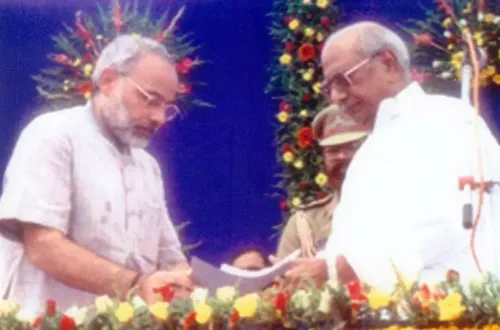
Modi became Gujarat Chief Minister on 7 October 2001 and served for 13 years before becoming Prime Minister in 2014 .
Gujarat's installed power capacity grew from 8,750 MW (2001-02) to 71,965 MW (2025-26), according to the resolution.
The Sauni scheme supplied Narmada water to 109 reservoirs , 234 lakes , and 1,616 check dams in Saurashtra.
Over 69 lakh farmer families in Gujarat received more than ₹23,000 crore across 23 instalments under PM-Kisan .
The resolution frames Gujarat's development trajectory as a foundation for Viksit Bharat 2047 .
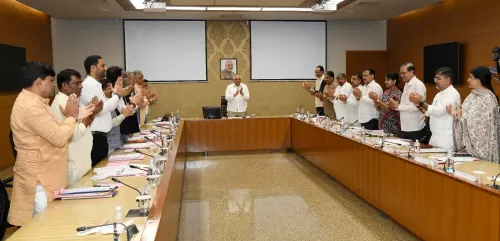
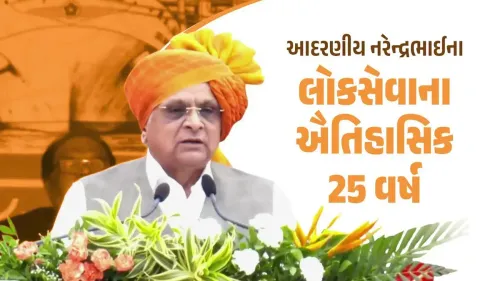
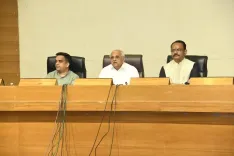
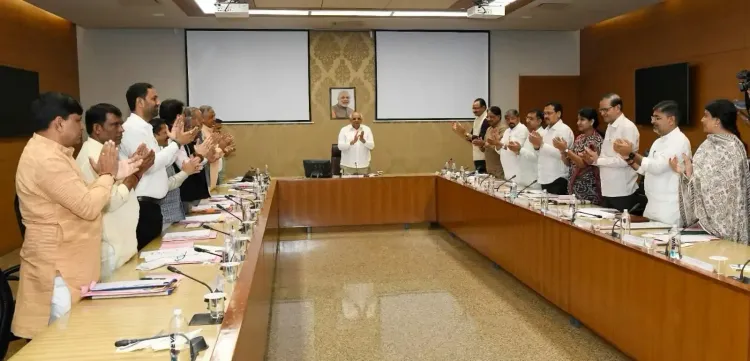
The Gujarat Cabinet on Friday, 9 October 2026, unanimously passed a resolution congratulating Prime Minister Narendra Modi on completing 25 years in public service, marking the anniversary of his assumption of office as Gujarat Chief Minister on 7 October 2001. The resolution, passed at a Cabinet meeting chaired by Chief Minister Bhupendra Patel in Gandhinagar, cited achievements across power generation, water management, infrastructure, and welfare during Modi's tenure in the state and at the Centre.
What the Resolution Said
The resolution recalled the formidable challenges Gujarat faced when Modi took charge — the aftermath of a devastating earthquake, recurring droughts, electricity and water shortages, and inadequate infrastructure. It credited initiatives under his leadership with transforming the state's development trajectory over the following decade and a half.
State government spokesperson and minister Jitu Vaghani, addressing the media after the meeting, said: 'PM Modi had placed service rather than power at the centre of governance, guided by the principle of 'Nation First'.'
Power and Water: The Numbers
Gujarat's installed power generation capacity grew from 8,750 MW in 2001-02 to 71,965 MW in 2025-26, according to the resolution. The Jyotigram Yojana extended three-phase electricity supply to 18,000 villages, while renewable energy milestones — including the solar park at Charanka and the hybrid renewable energy park in Kutch — were cited as significant achievements.
On water infrastructure, the Cabinet highlighted the Narmada project and the Sujalam-Sufalam and Sauni schemes. The Sauni scheme reportedly channelled Narmada water to 109 reservoirs, 234 lakes, and 1,616 check dams in the Saurashtra region.
Infrastructure and Economic Development
The resolution credited Modi's tenure with expanding roads, railways, airports, ports, and digital connectivity across Gujarat. The Vibrant Gujarat Global Summit, launched in 2003, was highlighted as a cornerstone of the state's industrial development strategy — an initiative that has since become a globally recognised investment platform.
Notably, several welfare and governance programmes pioneered in Gujarat were later scaled nationally: the state's Nirmal Gujarat campaign evolved into the Swachh Bharat Mission, and the Kanya Kelavani initiative was cited as a precursor to Beti Bachao, Beti Padhao.
Welfare Schemes and PM-Kisan Outreach
Among the welfare measures highlighted were the Pradhan Mantri Kisan Samman Nidhi (PM-Kisan) scheme, housing initiatives, women's empowerment programmes, tribal welfare measures, and healthcare coverage under Ayushman Bharat. According to the resolution, more than 69 lakh farmer families in Gujarat have received over ₹23,000 crore through 23 instalments under PM-Kisan.
Looking Ahead
The resolution concluded by describing Gujarat's development experience under Modi as a foundational template for the broader vision of 'Viksit Bharat 2047'. This comes amid a series of events and tributes across BJP-governed states marking the occasion, underscoring the political significance the party attaches to the milestone.
Point of View
And the timing — precisely on the 25th anniversary of Modi's swearing-in — signals a coordinated BJP messaging effort ahead of upcoming electoral cycles. The figures cited are striking: an eightfold increase in power capacity and ₹23,000 crore in direct farmer transfers are verifiable data points that give the tribute substantive weight. What the resolution does not address is the distributional quality of that growth — whether the electricity access gains translated into sustained rural livelihoods, or whether the Vibrant Gujarat investment pledges converted into comparable employment. The more analytically significant claim — that Gujarat's state schemes became the blueprint for national programmes — is worth scrutinising: it credits a single leadership model for policy innovations that had multiple institutional authors.
NationPress
10 Oct 2026
Frequently Asked Questions
Why did the Gujarat Cabinet pass a resolution about PM Modi?
The Gujarat Cabinet passed the resolution on 9 October 2026 to mark 25 years since Narendra Modi assumed office as Gujarat Chief Minister on 7 October 2001. It was a formal tribute citing achievements in power, water, infrastructure, and welfare during his tenure.
How long did Narendra Modi serve as Gujarat Chief Minister?
Narendra Modi served as Gujarat Chief Minister for 13 years, from October 2001 until he became Prime Minister of India in May 2014.
What did Gujarat's power sector achieve under the initiatives cited in the resolution?
According to the resolution, Gujarat's installed power generation capacity grew from 8,750 MW in 2001-02 to 71,965 MW in 2025-26. The Jyotigram Yojana also extended three-phase electricity supply to 18,000 villages.
What is the Sauni scheme mentioned in the resolution?
The Sauni scheme is a Gujarat water infrastructure initiative that channelled Narmada river water to 109 reservoirs, 234 lakes, and 1,616 check dams in the Saurashtra region, addressing chronic water scarcity in the area.
Which national programmes does the resolution trace back to Gujarat initiatives?
The resolution credits Gujarat's Nirmal Gujarat campaign as a precursor to the national Swachh Bharat Mission, and the state's Kanya Kelavani initiative as a forerunner to Beti Bachao, Beti Padhao, arguing that Gujarat served as a policy laboratory for national programmes.