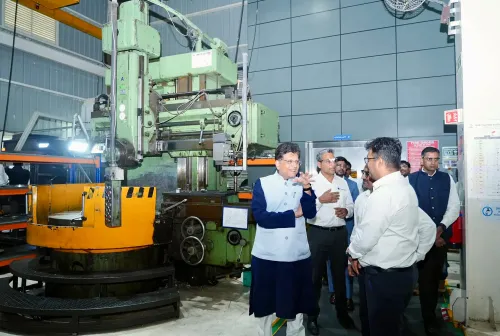
India poised to capture $250 bn specialty chemicals opportunity by 2030

Synopsis
India's specialty chemicals sector is at an inflection point.
India is well positioned to claim a significant share of a $200–250 billion specialty chemicals opportunity by 2030, according to a new report by consulting firm Redseer Strategy Consultants released on Monday, 11 May 2025. The report identifies orchestration-led business models as holding relevance to $130–150 billion of the current global specialty chemicals market, a figure projected to expand sharply as formulations grow more complex and supply chains continue to fragment.
India's Competitive Edge
The Redseer report underscores that India's strength in process chemistry, formulation capabilities, and execution at scale places it in a strong position to participate in this structural market shift. While the US and Europe continue to dominate innovation and applied R&D, and China remains the manufacturing backbone for intermediates, India has carved out a distinct advantage in formulation-driven manufacturing and process engineering.
This comes amid a broader reconfiguration of global chemical supply chains, accelerated by geopolitical tensions and the post-pandemic push for supply diversification — trends that have consistently benefited Indian specialty chemical producers over the past five years.
A Market Approaching $1 Trillion
The global specialty chemicals market is nearing $1 trillion in size, the report noted. Competitive advantage, it argues, is shifting away from pure manufacturing scale toward formulation ownership, supplier coordination, qualification management, and application-level expertise. Specialty chemicals now resemble hundreds of highly specialised micro-markets, each shaped by distinct regulatory requirements, customer specifications, qualification cycles, and switching barriers.
Notably, EBITDA margins in trading-led models typically remain at 3–5 per cent, while R&D-backed models can cross 10 per cent — a gap that underscores the commercial case for moving up the value chain.
The Rise of Orchestration-Led Players
According to the report, the increasing complexity of formulations and end-use industry demands for faster execution and greater reliability are making coordination itself a commercially valuable capability. This shift is creating space for a new category of players positioned between suppliers, laboratories, manufacturers, and end industries.
These companies manage qualification workflows, coordinate fragmented supplier ecosystems, support formulation development, and help customers secure consistent supply across geographies — a model that aligns closely with capabilities several Indian firms have been building.
Mukesh Kumar, Associate Partner at Redseer Strategy Consultants, said: