India Central to US Indo-Pacific Strategy, Says INDOPACOM Chief
Synopsis
US INDOPACOM Commander Admiral Samuel Paparo told Congress that India is among America's most active military partners, citing MQ-9B drone deals, Quad exercises, and India's stabilising role across the Indian Ocean — a remarkable elevation of New Delhi's status in Washington's China containment strategy.
Key Takeaways
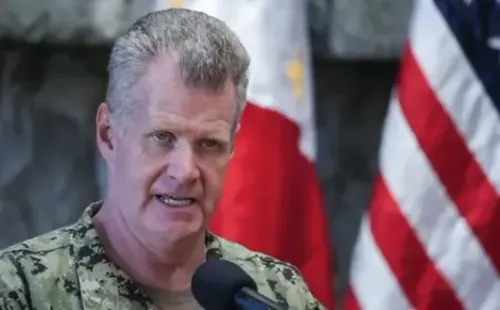
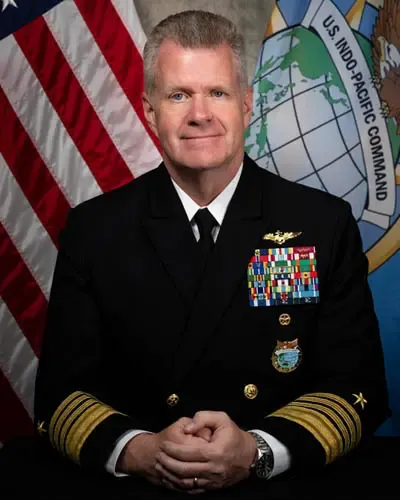
Admiral Samuel Paparo , Commander of US Indo-Pacific Command , testified before US lawmakers in April 2025 that India is among America's most active and closely coordinated military partners.
The US-India defence relationship has seen transformative growth through complex military exercises, defence sales, and strategic dialogue under the Major Defence Partnership framework.
India's planned acquisition of MQ-9B drones through Foreign Military Sales , valued at approximately $3.99 billion , was specifically cited as a marker of deepening bilateral defence ties.
Paparo highlighted India's regional stabilising role , including investments in Sri Lanka and agreements with Mauritius to keep strategic infrastructure free of adversarial influences.
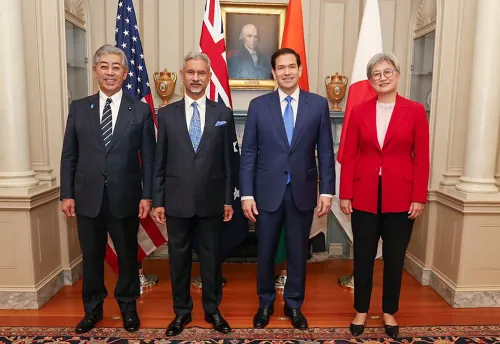
India's participation in the Quad — with the US, Japan, and Australia — and the Malabar naval exercise were described as central to building interoperability against China's military rise .
Representative Adam Smith underlined that alliances like the one with India are critical to US deterrence credibility in the Indo-Pacific.
Washington, April 25: India has emerged as a cornerstone of United States military strategy in the Indo-Pacific, with Admiral Samuel Paparo, Commander of US Indo-Pacific Command (INDOPACOM), telling US lawmakers this week that the US-India defence relationship is on an unmistakably upward trajectory and ranks among Washington's most active military partnerships. His testimony signals that New Delhi's strategic value to the US has never been higher — and the timing could not be more consequential.
Paparo's Testimony: A Relationship Transformed
Testifying before US lawmakers, Admiral Paparo described the US-India security partnership as having undergone transformative growth through increasingly complex military exercises, expanding defence sales, and high-level strategic dialogue under the Major Defence Partnership framework.
He highlighted deepening cooperation in critical domains including maritime security and underwater domain awareness, with a specific reference to India's planned acquisition of MQ-9B drones through Foreign Military Sales (FMS) — a deal that reflects the qualitative leap in bilateral defence ties.
Paparo called India a stabilising force in the region, noting it continues to be a source of stability within South Asia while simultaneously expanding its strategic partnerships and defence cooperation footprint across the Indian Ocean Region.
India's Regional Role: From Sri Lanka to Mauritius
Beyond bilateral ties with the US, Admiral Paparo underscored India's growing regional influence, citing New Delhi's investments in Sri Lanka and strategic agreements with Mauritius aimed at bolstering maritime cooperation. These moves, he noted, are designed to ensure that critical strategic infrastructure remains free of adversarial influences — a clear reference to China's expanding port and infrastructure network across the Indian Ocean, often described as the String of Pearls strategy.
This is not incidental. China's Hambantota Port deal with Sri Lanka in 2017, widely seen as a debt-trap arrangement, alarmed regional powers. India's counter-investments in the same neighbourhood represent a deliberate strategic recalibration that the US now openly endorses.
Quad, Malabar, and Multilateral Momentum
Paparo also spotlighted India's participation in the Quad — the four-nation grouping comprising the United States, India, Japan, and Australia — as a force multiplier in the Indo-Pacific. The Malabar naval exercise, involving all four Quad members, has become a central mechanism for building interoperability and projecting joint capability across the region.
He described alliances and partnerships as Washington's greatest asymmetric advantage over China — a statement that elevates India's role beyond a bilateral partner to a structural pillar of US grand strategy in Asia.
China Threat, Pakistan Tensions, and India's Deterrence Focus
The broader strategic context driving this engagement is China's accelerating military modernisation and its deepening ties with Russia and North Korea, which Paparo warned pose a complex challenge to regional stability. Lawmakers echoed this concern, with Representative Adam Smith stressing that alliances are critical to deterrence. He said: We need to maintain those relationships. We need to let those folks know that we are there and they can depend on us.
Paparo also acknowledged India's persistent tensions with Pakistan, noting that recent military exchanges have extended beyond traditionally disputed areas. Despite this pressure on two fronts, he said India's primary strategic focus remains on maintaining deterrence and credible warfighting capability within the region writ large — a posture that aligns directly with US interests in the Indo-Pacific.
Why This Matters: The Bigger Strategic Picture
This testimony arrives at a pivotal moment. The Indo-Pacific has become the defining theatre of 21st-century geopolitical competition, with China's People's Liberation Army Navy (PLAN) now the world's largest by vessel count. The US, unable to match China's regional presence alone, is doubling down on a coalition model — and India, with its geographic position astride the Indian Ocean, its growing blue-water naval capability, and its democratic credentials, is the irreplaceable anchor of that coalition.
Notably, India's defence exports have surged from under Rs 1,000 crore in 2016-17 to over Rs 21,000 crore in 2023-24, reflecting a domestic defence industrial base that increasingly complements its strategic partnerships. The MQ-9B drone acquisition, valued at approximately $3.99 billion, will give India persistent maritime surveillance capability — directly addressing the underwater domain awareness gap Paparo referenced.
As the Quad matures and US-India defence co-production agreements expand under the iCET (Initiative on Critical and Emerging Technologies) framework, expect New Delhi's centrality to US Indo-Pacific strategy to deepen further in the months ahead, with the next Quad Leaders' Summit likely to set the tone for the alliance's next phase.
Point of View
Trade deals, diplomatic cover — precisely because Washington needs it more than it admits. The irony is that India, long accused of strategic ambiguity through its non-alignment posture, has managed to become indispensable to the world's most powerful military alliance without formally joining it. That is not a contradiction — it is masterful statecraft.
NationPress
18 Sept 2026
Frequently Asked Questions
What did US INDOPACOM Commander Admiral Paparo say about India?
Admiral Samuel Paparo told US lawmakers that the US-India defence relationship is on an upward trajectory and is among his most active military partnerships. He described India as a stabilising force in South Asia and highlighted growing cooperation in maritime security, drone acquisitions, and the Quad framework.
Why is India important to the US Indo-Pacific strategy?
India is geographically positioned astride the Indian Ocean, giving it unmatched strategic relevance in countering China's expanding naval and infrastructure footprint. The US views India as an anchor partner in the Quad alongside Japan and Australia, and as a critical node in maintaining balance across the Indo-Pacific.
What is the MQ-9B drone deal between India and the US?
India is set to acquire MQ-9B armed drones from the United States through Foreign Military Sales, in a deal valued at approximately $3.99 billion. These drones will significantly enhance India's maritime surveillance and underwater domain awareness capabilities in the Indian Ocean.
What is the Quad and why does it matter for India?
The Quad is a strategic grouping of the United States, India, Japan, and Australia focused on maintaining a free and open Indo-Pacific. It conducts joint naval exercises like Malabar and coordinates on maritime security, logistics, and emerging technologies to collectively counter China's regional influence.
How does the US-India partnership impact China's strategy in the Indo-Pacific?
A stronger US-India partnership directly complicates China's ability to dominate the Indian Ocean Region and the broader Indo-Pacific. India's investments in Sri Lanka and Mauritius, combined with Quad coordination, create a coalition of democratic nations that limits China's strategic infrastructure ambitions across the region.