Seoul protest: 500 rally outside US Embassy over South Korea sovereignty row
Synopsis
South Korea's political divisions spilled onto the streets of Gwanghwamun again, with 500 progressive protesters accusing the US of meddling in domestic affairs — from a K-pop chairman's exit ban to intelligence-sharing disputes — while 6,000 conservatives simultaneously rallied nearby to defend Yoon Suk Yeol's martial law gambit. The dual demonstrations signal that US-South Korea tensions are now a live domestic political issue.
Key Takeaways
An estimated 500 protesters from civic group Candlelight Action rallied outside the US Embassy in Seoul's Gwanghwamun district on 3 May 2025 .
Key grievances included the US request to lift an exit ban on Hybe chairman Bang Si-hyuk , restrictions on North Korea intelligence-sharing, and opposition to ambassador nominee Michelle Park Steel .
Protesters also accused Washington of targeting President Lee Jae Myung over his refusal to back US policy on Iran and his push for wartime operational control transfer.
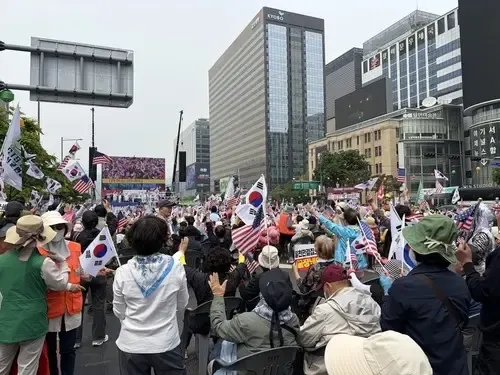
A separate conservative rally of around 6,000 people, led by pastor Jeon Kwang-hoon , defended former President Yoon Suk Yeol's 2024 martial law attempt in the same district.
No clashes were reported; police issued two warnings and protesters complied with instructions.
A progressive civic group staged a protest rally outside the US Embassy in Seoul on Saturday, 3 May 2025, with an estimated 500 demonstrators accusing Washington of interfering in South Korea's domestic affairs. The rally, held in the central Gwanghwamun district, reflects deepening tensions between the two longstanding allies over a series of recent diplomatic flashpoints.
Key Grievances of the Protesters
Participants from the civic group Candlelight Action gathered outside the embassy compound holding placards condemning the US for allegedly undermining South Korean sovereignty. A central grievance was Washington's reported request that Seoul lift an exit ban on Bang Si-hyuk, chairman of K-pop entertainment powerhouse Hybe, which protesters characterised as undue interference in a domestic legal matter.
Demonstrators also charged that the US is "attacking" President Lee Jae Myung because he has reportedly refused to provide support for what they described as a US war against Iran and is seeking an early transfer of wartime operational control from the United States to South Korean command.
Additionally, protesters denounced Washington for allegedly restricting intelligence-sharing with Seoul on North Korea. According to Yonhap News Agency, the US took issue with what it sees as Unification Minister Chung Dong-young's unilateral disclosure of shared intelligence on an unidentified North Korean nuclear facility. Protesters also objected to the nomination of Michelle Park Steel, a conservative former Republican lawmaker, as the new US ambassador to South Korea.
How the Rally Unfolded
The Candlelight Action participants had been marching from Jonggak Station before stopping in front of the embassy compound. Police issued two loudspeaker warnings directing protesters to continue marching; no clashes were reported as demonstrators complied with instructions.
Conservative Counter-Mobilisation
Hours earlier, a separate demonstration drew around 6,000 participants affiliated with a conservative group led by hard-line activist pastor Jeon Kwang-hoon, also in Gwanghwamun. This group justified ousted former President Yoon Suk Yeol's short-lived imposition of martial law in 2024, arguing it was a right a leader could exercise "if the country is in trouble."
Background: A Nation Still Divided
This comes amid a prolonged period of political turbulence in South Korea. In February 2026, both conservative groups and Candlelight Action had staged rival rallies — one in anger, one in celebration — after a court sentenced former President Yoon Suk Yeol to life in prison over his bid to impose martial law in 2024. Saturday's dual demonstrations underscore that the country's political fault lines remain sharply drawn, with US-South Korea relations now becoming a new axis of contestation. How President Lee navigates Washington's expectations while managing domestic sentiment will be closely watched in the weeks ahead.
Point of View
An intelligence disclosure dispute, an ambassador nomination. That specificity suggests organised political messaging rather than spontaneous outrage. Meanwhile, the conservative counter-mobilisation around Yoon Suk Yeol's legacy shows that the martial law controversy is far from settled in public memory. For Washington, the optics of being the common villain in a South Korean street protest — however small — is a reputational cost it will want to manage carefully as it navigates the Lee government's more independent foreign policy posture.
NationPress
2 Oct 2026
Frequently Asked Questions
Why did protesters rally outside the US Embassy in Seoul?
Protesters from the civic group Candlelight Action accused the United States of interfering in South Korea's domestic affairs on multiple fronts, including requesting the lifting of an exit ban on Hybe chairman Bang Si-hyuk, restricting North Korea intelligence-sharing, and nominating a conservative former Republican lawmaker as ambassador.
Who is Bang Si-hyuk and why is his exit ban significant?
Bang Si-hyuk is the chairman of Hybe, the South Korean entertainment conglomerate behind global K-pop acts including BTS. His exit ban is a domestic legal matter, and protesters argue that Washington's reported request to lift it constitutes undue interference in South Korea's judicial processes.
What is the wartime operational control dispute between the US and South Korea?
Wartime operational control (OPCON) refers to the authority to command South Korean forces during a conflict, which currently rests with the US-led Combined Forces Command. President Lee Jae Myung is reportedly seeking an early transfer of this control to South Korea, a move that reportedly puts him at odds with Washington.
Who is Michelle Park Steel and why do protesters object to her nomination?
Michelle Park Steel is a conservative former Republican lawmaker nominated by the US as its new ambassador to South Korea. Protesters object to her nomination, reportedly viewing it as a politically loaded choice given South Korea's current progressive-led government.
What happened at the separate conservative rally on the same day?
Around 6,000 conservative demonstrators, led by pastor Jeon Kwang-hoon, rallied separately in Gwanghwamun, defending former President Yoon Suk Yeol's 2024 martial law imposition as a legitimate exercise of presidential authority.