What is the Significance of India Handing Over a Multi-Ethnic Trilingual School to the Lankan Government?
Synopsis
In a landmark event, India has officially transferred a multi-ethnic trilingual school to Sri Lanka, promoting unity and education among diverse communities. This initiative marks a crucial step in India-Sri Lanka relations and enhances educational opportunities for various ethnic groups. Discover the impact of this collaboration!
Key Takeaways
Multi-ethnic trilingual school aims to unite diverse ethnic groups.
Inaugurated by Harini Amarasuriya and Santosh Jha .
Financial backing from India exceeds Sri Lankan Rupees 320 million .
Supports the Lankan government's reconciliation efforts.
Part of broader development initiatives including housing projects.
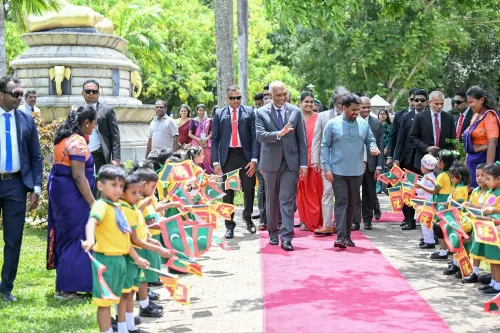
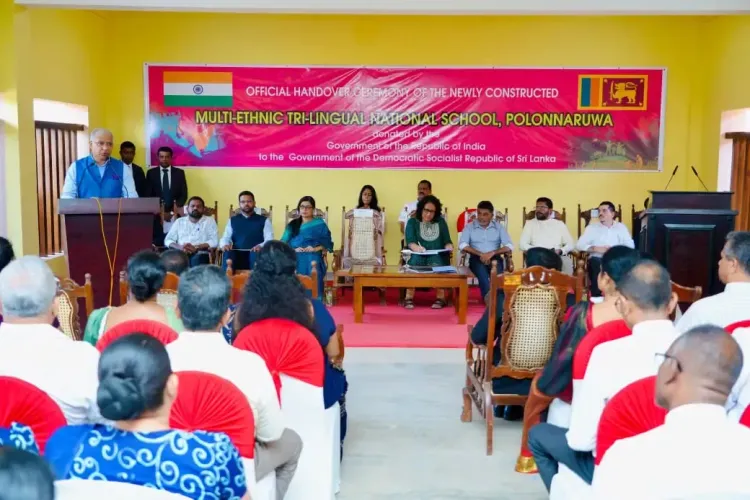
Colombo, Oct 31 (NationPress) In a major advancement in the collaboration between India and Sri Lanka, a multi-ethnic trilingual school funded by an Indian grant was officially transferred to the Sri Lankan government on Friday. This institution, located in the Polonnaruwa district of North Central Province, aims to foster unity and understanding among diverse ethnic groups.
The school was inaugurated by Sri Lankan Prime Minister and Minister of Education, Harini Amarasuriya, alongside Indian High Commissioner Santosh Jha.
Notable Sri Lankan officials were present, including T B Sarath, Deputy Minister of Housing, Construction and Water; as well as senior representatives from various ministries.
This educational facility will allow Sinhala, Tamil, and Muslim students to engage in learning within a rich, multi-cultural framework. The initiative aligns with the Sri Lankan government’s objectives to enhance reconciliation and social cohesion.
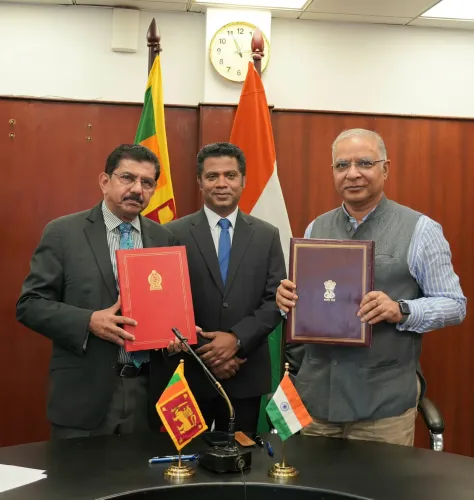
As highlighted by the Indian High Commission in Colombo, a Memorandum of Understanding (MoU) was established in February 2017 between the two countries. This agreement facilitated the school's development as a High Impact Community Development Project, aiming to provide quality educational resources. The financial backing from India for this project exceeds Sri Lankan Rupees 320 million.
The MoU was signed by the then Indian High Commissioner Taranjit Singh Sandhu and Sunil Hettiarachchi, the former Secretary of Sri Lanka's Ministry of Education. The project encompasses the construction of classrooms, laboratories, and a library, along with the acquisition of necessary furniture and equipment.
Earlier this month, Sri Lankan President Anura Kumara Dissanayake participated in the launch of the Indian Housing Project Stage 2 Phase IV. This initiative aims to construct 60,000 houses, with this current phase focusing on 4,700 homes.
Over 2,000 beneficiaries and their families attended the event, which was also graced by Sri Lanka's Minister of Plantation and Community Infrastructure, Samantha Viddyarathna, and various other dignitaries.
In a statement on X, the Indian High Commission remarked: "The Indian Housing Project Stage 2 Phase IV was launched in the presence of President H.E. Anura Kumara Dissanayake, HC Santosh Jha, Minister of Plantation & Community Infrastructure Hon. S Viddyarathna, and Minister of Fisheries, along with Deputy Ministers of Plantation, Tourism, and Youth Affairs."
"This project represents one of the largest development initiatives by India abroad, encompassing a commitment to build 60,000 houses for beneficiaries in Sri Lanka, with grant assistance exceeding INR 18 billion. To date, approximately 50,000 houses have been constructed, with Phase IV Stage 2 designated to assist 4,700 beneficiaries."
Point of View
I believe this development signifies a vital step towards fostering mutual respect and understanding among Sri Lanka's diverse communities. Such initiatives reflect a long-term commitment to peace and cooperation, aligning with the nation's broader reconciliation efforts.
NationPress
14 Oct 2026
Frequently Asked Questions
What is the purpose of the multi-ethnic trilingual school?
The school aims to provide quality education to Sinhala, Tamil, and Muslim students in a multi-cultural environment, promoting unity and social cohesion.
Who inaugurated the school?
The school was inaugurated by Sri Lankan Prime Minister Harini Amarasuriya and Indian High Commissioner Santosh Jha.
How much financial assistance was provided by India?
India provided over Sri Lankan Rupees 320 million for the establishment of the school.
When was the MoU for the school signed?
The Memorandum of Understanding was signed in February 2017.
What other initiatives is India involved in with Sri Lanka?
India is also involved in the Indian Housing Project, aimed at constructing 60,000 houses for beneficiaries in Sri Lanka.