UN Forecasts India's Economy to Grow 6.4% in 2026 and 6.6% in 2027
Synopsis
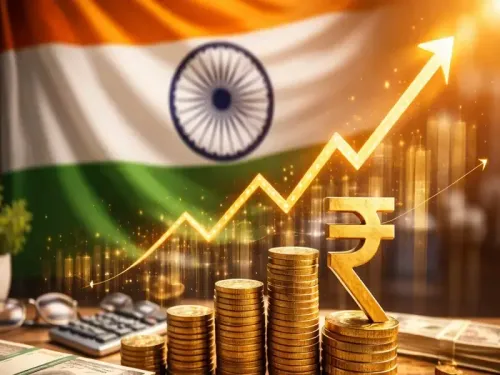
India is set for impressive economic growth, with projections of 6.4% in 2026 and 6.6% in 2027 according to a new UN report. This growth is driven by strong rural consumption, tax cuts, and strategic exports, despite challenges from U.S. tariffs.
Key Takeaways
India's economy is projected to grow by 6.4% in 2026 and 6.6% in 2027.
Strong rural consumption and tax cuts are key growth drivers.
Economic activities slowed due to a decline in U.S. exports.
Inflation rates are forecasted at 4.4% and 4.3% for 2026 and 2027, respectively.
India's production-linked incentive scheme is fostering green industrial development.
New Delhi, April 21 (NationPress) A recent report from the United Nations (UN) reveals that India’s economy is anticipated to grow by 6.4 percent in 2026 and 6.6 percent in 2027. The findings from the United Nations Economic and Social Commission for Asia and the Pacific (ESCAP) indicate that the economies in South and South-West Asia experienced a growth of 5.4 percent in 2025, a rise from 5.2 percent in 2024, largely fueled by India's impressive growth rate of 7.4 percent that same year.
The report highlights that India's robust growth is supported by strong rural consumption, tax reductions on goods and services, and proactive export strategies in anticipation of U.S. tariffs.
However, economic activities slowed down in the second half of calendar year 2025 as exports to the U.S. dropped by 25 percent due to the implementation of 50 percent tariffs in August 2025. Despite this, the service sector remained a significant contributor to growth, as noted by the United Nations.
Inflation rates in India are predicted to be 4.4 percent in 2026 and slightly lower at 4.3 percent in 2027, according to the report.
The analysis also observed that foreign direct investment (FDI) inflows into developing economies in Asia and the Pacific fell amid ongoing trade tensions and geopolitical risks, following a 0.6 percent increase in 2024. In 2025, FDI to the region declined by 2 percent, even as global FDI flows surged by 14 percent.
The report stated, "In the Asia-Pacific area, the largest amounts of greenfield FDI during the first three quarters were drawn to India, Australia, the Republic of Korea, and Kazakhstan, with investments amounting to $50 billion, $30 billion, $25 billion, and $21 billion, respectively."
Furthermore, the increase in remittances from Asian and Pacific workers abroad has helped mitigate the impacts of challenging domestic employment conditions, thus supporting household spending. About 40 percent of these remittances in India and the Philippines are allocated for essential expenses such as healthcare.
However, as the world's leading remittance recipient, with $137 billion in 2024, India could face significant losses due to a 1 percent tax on all remittances imposed by the U.S. starting January 2026, as per the report.
The report commended India's production-linked incentive scheme, recognizing it as an effective macroeconomic policy that promotes green industrial growth by incentivizing domestic manufacturing of solar photovoltaic cells, batteries, and green hydrogen.
This initiative has not only reduced import reliance but also fostered new industrial stakeholders who are invested in sustaining this transition, the report concluded.
Point of View
It is crucial to recognize the significance of the UN's report on India's economic trajectory. The projected growth rates reflect a resilient economy that is adapting to global challenges while leveraging domestic strengths. This development should be viewed as a promising sign for both investors and policymakers.
NationPress
19 Sept 2026
Frequently Asked Questions
What is the expected economic growth rate for India in 2026?
India's economy is projected to grow by 6.4 percent in 2026, according to the UN report.
What factors are driving India's economic growth?
The growth is largely driven by strong rural consumption, tax cuts on goods and services, and proactive export strategies.
How will inflation affect India's economy in the coming years?
Inflation in India is forecasted to be 4.4 percent in 2026 and 4.3 percent in 2027, which may influence consumer spending.
What challenges does India face regarding foreign direct investment?
FDI inflows to developing Asian and Pacific economies have declined due to trade tensions and geopolitical uncertainty.
How has the remittance tax in the U.S. impacted India?
India, the world's largest remittance recipient, may face significant losses due to a new 1 percent tax on all remittances imposed by the U.S.