India's Energy Supply Grows Steadily with Renewables on the Rise
Synopsis
As India's energy supply expands significantly, the country is witnessing a remarkable surge in renewable resources. The latest statistics highlight a 2.95% increase in total primary energy supply, with solar energy leading the charge. Discover how these developments shape India's energy landscape going forward.
Key Takeaways
2.95% growth in total primary energy supply.
Renewable energy potential at 47,04,043 megawatt .
Solar energy leads with 71% share.
Per capita energy consumption CAGR at 1.89% .
Financial support for the energy sector surged over six times.
New Delhi, March 30 (NationPress) The Indian economy has demonstrated a robust growth in its total primary energy supply (TPES) for FY2024-25, marking an increase of 2.95% compared to the previous year, totaling 9,32,816 KToE (kilo tonnes of oil equivalent), as reported by the government on Monday.
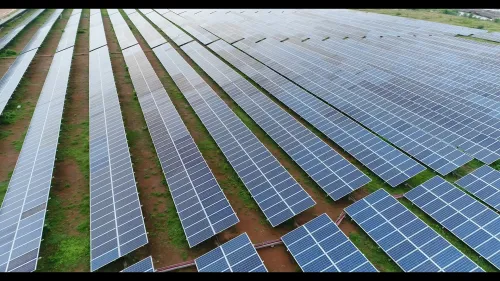
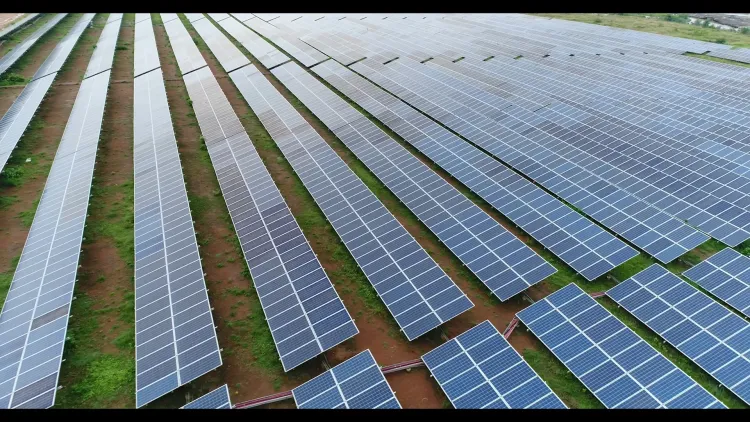
The nation boasts significant potential for renewable energy generation, currently estimated at 47,04,043 megawatt as of March 31, 2025. Notably, solar energy has shown remarkable growth, soaring from 748,990 megawatt in FY2023-24 to 33,43,378 megawatt in FY2024-25, comprising the largest share (approximately 71%), followed by wind power at 11,63,856 megawatt and large hydro at 1,33,410 megawatt, according to the "Energy Statistics India 2026" publication from the National Statistics Office (NSO).
Over 70% of the total renewable energy generation potential is concentrated in six states: Rajasthan, Maharashtra, Gujarat, Andhra Pradesh, Karnataka, and Madhya Pradesh.
Per capita energy consumption has risen from 15,296 megajoule/person during FY2015-16 to 18,096 megajoule/person in FY2024-25, demonstrating a compound annual growth rate (CAGR) of 1.89%, as indicated by the report.
Furthermore, financial support for the Indian energy sector has seen consistent growth. From Rs 1,688 crore in 2021, it surged to Rs 10,325 crore by 2025, reflecting an increase of more than six times.
The overall generation of electricity from renewable resources (both Utility and Non-Utility) has also experienced notable growth over time.
Electricity generation rose from 1,89,314 GWH in FY2015-16 to 4,16,823 GWH in FY2024-25, achieving a CAGR of 9.17%.
Among all energy supply sources, coal remains the predominant source, contributing the largest share to total energy supply.
Coal (including lignite) energy supply increased from 3,87,761 Ktoe in FY2015-16 to 5,52,315 Ktoe in FY2024-25. Other sources, including crude oil and natural gas, have also demonstrated steady growth over the years. The total final consumption (TFC) of energy across various end-use sectors has similarly shown a consistent upward trend.
Point of View
Highlighting the country's commitment to sustainable development. While coal remains a dominant energy source, the notable growth in solar and other renewables indicates a promising future for cleaner energy alternatives.
NationPress
28 Sept 2026
Frequently Asked Questions
What is the total primary energy supply in India for FY2024-25?
The total primary energy supply in India for FY2024-25 is 9,32,816 KToE .
How much has solar energy increased in India?
Solar energy in India has increased from 748,990 megawatt in FY2023-24 to 33,43,378 megawatt in FY2024-25.
What percentage of renewable energy potential is concentrated in six states?
Over 70% of India's total renewable energy potential is concentrated in six states.
What is the CAGR of India's per capita energy consumption?
The compound annual growth rate (CAGR) of India's per capita energy consumption is 1.89% .
How has the financial support for the energy sector changed?
Financial support for the energy sector has increased from Rs 1,688 crore in 2021 to Rs 10,325 crore in 2025.