India Witnesses Awe-Inspiring Blood Moon During Total Lunar Eclipse
Synopsis
On March 3, skywatchers in India experienced a mesmerizing total lunar eclipse, known as the Blood Moon. This rare event not only captivated viewers but also intertwined with cultural traditions, marking a significant moment for both astronomy enthusiasts and local festivities.
Key Takeaways
Total lunar eclipse is also known as Blood Moon .
The event began at 3:20 p.m. and concluded by 6:47 p.m.
Visibility in India peaked between 6:33 p.m. and 6:40 p.m.
Cultural observances included Sutak Kaal .
This was the last total lunar eclipse until late 2028.
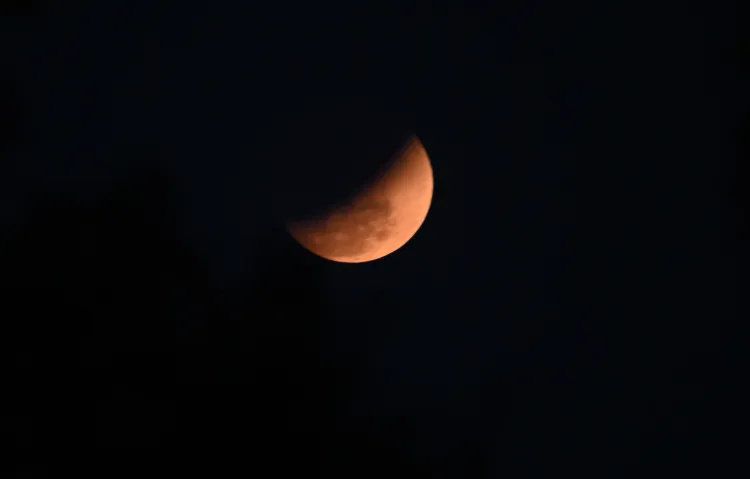
Bhopal/New Delhi, March 3 (NationPress) Enthusiasts across the globe experienced a breathtaking “total lunar eclipse”, widely referred to as a “Blood Moon” due to the Moon's vivid red appearance during the peak phase.
In India, this celestial phenomenon was highly anticipated as “Chandra Grahan”, marking the year’s first lunar eclipse and coinciding with significant cultural events, including preparations for the Holi festival in various traditions.
A lunar eclipse transpires when the Earth aligns itself perfectly between the Sun and the Moon, casting its shadow over the lunar surface.
During a total lunar eclipse, the Moon entirely enters the Earth’s umbral shadow, allowing sunlight to filter through the atmosphere. This scattering results in shorter blue wavelengths being filtered out, while longer red wavelengths cast a beautiful coppery glow over the Moon—hence the term “Blood Moon”.
For observers in India, the eclipse commenced at 3:20 p.m. with the penumbral stage, as the Moon gradually slipped into the Earth's outer shadow. The partial phase ensued, leading to totality. However, because the eclipse began in the afternoon, the Moon was below the horizon during much of the early stages.
Visibility began only after moonrise around 6:26 p.m., allowing viewers to witness the later phases, including the concluding moments of totality and the maximum eclipse effect. The peak visibility window in India occurred between 6:33 p.m. and 6:40 p.m., when the Moon appeared dramatically red against the eastern horizon. The entire eclipse wrapped up by 6:47 p.m., with the total event lasting approximately 3 hours and 27 minutes, while totality itself persisted for about 58 minutes worldwide.
In many regions of India, particularly in central and western areas such as Indore, the Moon emerged during or just after the peak phase, providing a stunning view of the eclipsed Moon bathed in red-orange hues against the dusky sky.
Northeastern parts and islands may have experienced more of the totality phase. No specialized equipment was necessary—viewers could see it with the naked eye, although binoculars or telescopes could enhance details like subtle lunar features.
Culturally, the event led to the observance of ‘Sutak Kaal’, a traditional inauspicious phase in Hindu customs. Sutak began around 6:20–6:23 a.m. (or later in some panchangs, such as 9:39 a.m.) and concluded with the eclipse's end around 6:46–6:47 p.m. During this interval, many refrained from auspicious endeavors, temple visits were limited in places like Tirupati, and individuals engaged in rituals such as fasting or consuming sattvic foods.
This total lunar eclipse was the final occurrence until late 2028, rendering it a rare spectacle. Enthusiasts shared captivating images of the Blood Moon, illustrating the fusion of science and tradition.
Point of View
The recent total lunar eclipse observed in India serves as a remarkable intersection of science and cultural heritage. As communities celebrated this celestial event, it not only showcased the beauty of our universe but also highlighted the rich traditions that accompany such astronomical occurrences.
NationPress
19 Sept 2026
Frequently Asked Questions
What is a Blood Moon?
A Blood Moon is a term used to describe a total lunar eclipse, where the Earth's shadow causes the Moon to appear a striking reddish color.
How often do lunar eclipses occur?
Lunar eclipses can happen a few times a year, but total lunar eclipses, like the Blood Moon, are less frequent.
How can I view a lunar eclipse?
Lunar eclipses can be viewed with the naked eye, but binoculars or telescopes can enhance the experience by revealing lunar details.
When is the next total lunar eclipse?
The next total lunar eclipse will occur in late 2028, making this event a rare opportunity for enthusiasts.