How Much Did Liquor Shop Auctions Earn for J&K Government?
Synopsis
In a remarkable financial achievement, the Jammu and Kashmir government has amassed Rs 2,152 crore from liquor shop auctions over two years. As the government refrains from opening new shops, this article delves into the revenue breakdown across regions and the historical context of liquor sales in the region.
Key Takeaways
Jammu and Kashmir government generated Rs 2,152 crore from liquor shop auctions.
No new liquor shops will be opened this financial year.
The Jammu region contributed the majority of the revenue.
Liquor licenses are issued to domiciles only as per the J&K Excise Act.
Historical context includes the impact of separatist violence on local businesses.
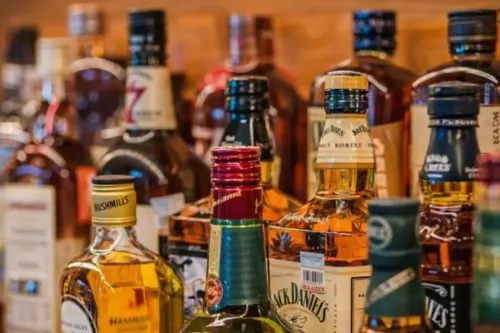
Jammu, Feb 8 (NationPress) The government of Jammu and Kashmir has successfully generated a substantial revenue of Rs 2,152 crore from the auction of liquor shops over the last two financial years, with no plans to introduce new liquor outlets in the ongoing financial year.
According to official reports, the revenue for the year 2023–24 amounted to Rs 1,03,462.49 lakh, while for 2024–25, the revenue reached Rs 1,11,816.07 lakh.
The majority of this revenue came from the Jammu region, which contributed Rs 1,96,830.06 lakh over the two years, whereas the Kashmir region accounted for Rs 18,448.50 lakh, as stated by officials.
Additionally, the government has confirmed that no new JKEL-2 liquor licenses will be issued this financial year.
In terms of district-specific revenue, Jammu district generated Rs 48,350.15 lakh in 2023–24, which increased to Rs 50,913.93 lakh in 2024–25. Udhampur's revenue was Rs 11,322 lakh in 2023–24 and rose to Rs 12,061.50 lakh in 2024–25, while Kathua recorded revenue of Rs 10,653 lakh and Rs 11,272 lakh respectively.
In the Kashmir region, Srinagar reported revenues of Rs 5,489.67 lakh in 2023–24, increasing to Rs 6,557.66 lakh in 2024–25.
Anantnag saw its revenue rise from Rs 1,403.50 lakh to Rs 1,999.50 lakh, while Baramulla's revenues were Rs 872.23 lakh in 2023–24 and Rs 1,139.84 lakh in 2024–25.
It was noted by officials that all liquor licenses are granted strictly to residents of Jammu and Kashmir in alignment with the J&K Excise Act, 1958, and the Excise Policy that is updated periodically.
Historically, it is important to remember that the onset of separatist violence in the early 1990s led to the closure of all cinema halls, liquor stores, and beauty parlors in the Kashmir Valley.
This resulted in countless individuals who depended on these businesses losing their jobs, putting their families through significant hardship without the ability to protest against the terrorist demands.
As security conditions have improved over time, some cinema halls, beauty parlors, and liquor shops have begun to reopen.
Point of View
It is crucial to recognize the significance of the Rs 2,152 crore revenue generated by the Jammu and Kashmir government from liquor shop auctions. This reflects both economic growth in the region and the government’s strategic decisions on liquor licensing. However, the historical context of the region's turbulent past and the impact on local livelihoods should not be overlooked. Balancing economic development with social responsibility remains a key challenge.
NationPress
2 Oct 2026
Frequently Asked Questions
How much revenue has the J&K government earned from liquor shop auctions?
The Jammu and Kashmir government has earned a total of Rs 2,152 crore from liquor shop auctions over the past two financial years.
Will new liquor shops be opened in Jammu and Kashmir this year?
No, the Jammu and Kashmir government has decided not to open any new liquor shops during the current financial year.
Which region contributed more to the liquor revenue?
The Jammu region contributed significantly more, generating Rs 1,96,830.06 lakh compared to Rs 18,448.50 lakh from the Kashmir region.
What regulations govern liquor licenses in Jammu and Kashmir?
All liquor licenses in Jammu and Kashmir are issued strictly to residents in accordance with the J&K Excise Act, 1958, and the relevant Excise Policy.
What historical context is associated with liquor sales in the region?
The liquor business in Kashmir faced severe restrictions during the early 1990s due to separatist violence, leading to the closure of many establishments.