Nandini milk price hike: Shivakumar defends ₹8/litre rise to aid farmers
Synopsis
Karnataka has raised Nandini milk prices by ₹8 per litre — less than the ₹12 farmers demanded — with curd up ₹14, effective 1 November 2026. Chief Minister Shivakumar's drought-and-farmer-welfare defence signals a government caught between rural livelihoods and urban consumer costs, with the KMF's financial health hanging in the balance.
Key Takeaways
Karnataka government and KMF have hiked Nandini milk retail prices by ₹8 per litre , effective 1 November 2026 .
Curd prices have been raised by ₹14 per litre under the same revision.
Shivakumar cited ongoing drought , declining milk production, and farmer financial stress as justification.
Farmers had originally demanded a hike of ₹12 per litre ; the government settled at ₹8 .
Shivakumar acknowledged the government cannot directly control curd prices, which will partly depend on fat content.
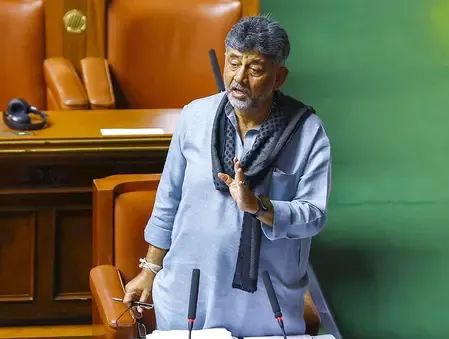
Karnataka Chief Minister D.K. Shivakumar on Saturday, 31 October 2026, defended the state government's decision to raise the retail price of Nandini milk by ₹8 per litre, saying the hike was essential to protect dairy farmers and ensure adequate care for cattle amid an ongoing drought. The increase, announced jointly by the Karnataka government and the Karnataka Milk Federation (KMF), takes effect from 1 November 2026.
What Has Been Announced
The revised pricing structure raises the retail price of Nandini milk by ₹8 per litre and the price of curd by ₹14 per litre, both effective 1 November 2026. Shivakumar noted that there had been an original demand to hike milk prices by ₹12 per litre, and that milk prices in neighbouring states were already significantly higher than Karnataka's revised rate.
Why the Government Acted
Speaking to reporters in Bengaluru, Shivakumar cited a combination of drought-induced decline in milk production and the financial strain on dairy farmers as the primary drivers behind the decision. 'The decision was necessary to protect farmers and cows. Milk production is also coming down due to drought. To protect cows, they need to be provided with good food. For farmers to provide proper feed to their cattle, they need to be financially sound,' he said.
The Chief Minister warned that without adequate income, farmers would be compelled to cut spending on cattle feed, which he said could adversely affect livestock health. 'We should protect Goumatas during this drought period. We have taken this decision after giving it careful thought for years,' he added.
On Curd Prices and Fat Content
Responding to concerns about rising prices of other dairy products, Shivakumar acknowledged that the government's direct pricing control was limited. 'We have controlled the prices of milk. Regarding fat content, if there is more fat, a rate will be fixed accordingly. This also needs to be kept in mind,' he said, indicating that curd pricing would be partially determined by fat content and market factors.
Broader Context
The hike comes at a time when Karnataka is grappling with drought conditions that have strained agricultural output across the state. Declining milk procurement volumes have put pressure on the KMF, which operates the widely recognised Nandini brand. This is not the first time the cooperative has revised prices in response to input cost pressures — previous hikes have drawn both farmer support and consumer pushback. Notably, the government's decision to hold the increase to ₹8 per litre rather than the demanded ₹12 reflects an attempt to balance farmer welfare with consumer affordability.
What Happens Next
The revised prices are set to come into force from 1 November 2026. Consumer groups and opposition parties are expected to scrutinise the impact on household budgets, particularly in urban centres where Nandini holds a dominant market share. The government's ability to hold curd prices in check through indirect mechanisms will be closely watched in the weeks ahead.
Point of View
Absent drought relief and structural feed subsidies, actually improves farmer income or merely delays the next crisis. Urban consumers, who have little say in cooperative pricing, will absorb the increase with no offsetting benefit.
NationPress
31 Oct 2026
Frequently Asked Questions
By how much has the Nandini milk price been increased in Karnataka?
The retail price of Nandini milk has been increased by ₹8 per litre, while curd prices have been raised by ₹14 per litre. Both revisions are effective from 1 November 2026.
Why did the Karnataka government hike Nandini milk prices?
Chief Minister D.K. Shivakumar said the hike was necessary to protect dairy farmers financially and to ensure adequate feed and care for cattle during an ongoing drought. He noted that declining milk production due to the drought made the revision unavoidable.
Was the milk price hike the full amount that farmers demanded?
No. Dairy farmers had reportedly demanded an increase of ₹12 per litre, but the government and KMF settled on a hike of ₹8 per litre, citing the need to balance farmer welfare with consumer affordability.
Will the government control curd prices as well?
Shivakumar indicated that the government's direct pricing control applies to milk, not curd. He said curd pricing would partly depend on fat content, suggesting indirect rather than direct regulation of dairy product prices beyond milk.
How do Karnataka's revised milk prices compare with neighbouring states?
According to Shivakumar, milk prices in neighbouring states were already significantly higher than Karnataka's revised rate, a point he used to justify the hike as a long-overdue correction rather than an outlier move.