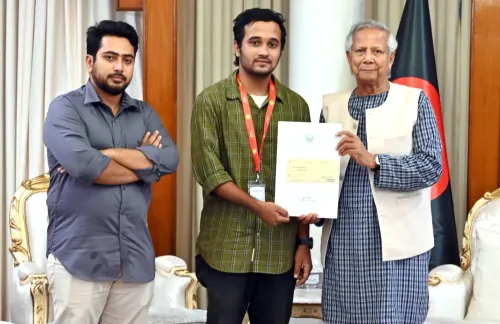
NCP convener Nahid Islam backs CJP protests, backs party linked to India threats
Synopsis
Bangladesh's NCP convener Nahid Islam has publicly backed protests in India citing 'electoral accountability' — but his party is allied with Jamaat-e-Islami, and a senior NCP leader reportedly threatened to seize India's Seven Sisters states and the Siliguri Corridor. Islam's simultaneous invocation of minority rights, even as Bangladesh's Hindu minority faces documented violence, exposes a sharp contradiction at the heart of NCP's public posture.
Key Takeaways
NCP convener Nahid Islam issued a statement from Dhaka on 10 October 2026 backing CJP -led protests in India.
The NCP has allied with the radical Islamist Jamaat-e-Islami ; its leader Hasnat Abdullah reportedly threatened to capture India's Seven Sisters and the Siliguri Corridor .
In December 2025 , Hindu youth Dipu Chandra Das , 27 , was reportedly lynched and burned by a mob in Mymensingh , Bangladesh, after a blasphemy accusation.
Youth Tipra Federation President Suraj Debbarma led protests in Agartala in December 2025 against NCP and Chief Adviser Muhammad Yunus over anti-India remarks.
Islam's remarks on minority rights have drawn scrutiny given Bangladesh's own record of attacks on its Hindu minority .
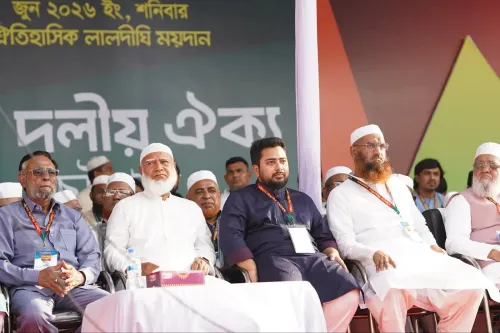
Bangladesh's National Citizen Party (NCP) convener Nahid Islam on Saturday, 10 October 2026, intervened in India's internal affairs by voicing support for protests led by the Cockroach Janta Party (CJP), citing what he called concerns over 'electoral accountability' in India. The statement, issued from Dhaka, comes from a figure whose party has allied with the radical Islamist Jamaat-e-Islami and whose senior leader has reportedly threatened to seize India's Seven Sisters states and the Siliguri Corridor.
Islam's Statement and Its Context
In his statement, Islam claimed solidarity with protesters in India over electoral processes. He also declared that 'no society is truly democratic while minorities live in fear' — a remark that drew immediate attention given Bangladesh's own record on minority rights. The NCP emerged as a key political force following the violent unrest of August 2024 that led to the ouster of former Prime Minister Sheikh Hasina, with NCP leaders playing a prominent role in those events.
Bangladesh's Hindu Minority Under Threat
Islam's remarks on minority rights have been met with sharp scrutiny in India, given documented attacks on Bangladesh's Hindu minority. In December 2025, Dipu Chandra Das, a 27-year-old Hindu youth employed at a garment factory in Bangladesh, was reportedly accused of blasphemy by a coworker. According to reports, a mob comprising radical and extremist elements stormed the factory, dragged him into the street, beat him to death, and subsequently tied his body to a tree and set it ablaze, in the district of Mymensingh. The incident drew widespread condemnation from Hindu community groups and human rights organisations.
NCP's Anti-India Remarks: A Pattern
Concerns over NCP's posture toward India are not new. In December 2025, Suraj Debbarma, President of the Youth Tipra Federation (YTF), led protests near the Bangladesh Assistant High Commission in Agartala, accusing NCP leader Hasnat Abdullah, Bangladesh's Chief Adviser Muhammad Yunus, and other leaders of making what he described as 'baseless and manufactured anti-India comments' and allegedly encouraging activities hostile to India.
Debbarma specifically cited reports that NCP leader Hasnat Abdullah had earlier claimed that the NCP would 'capture India's Seven Sisters and the Siliguri Corridor and make the region part of their country' — remarks that, if accurate, would represent a direct territorial provocation. Demonstrations were also reportedly held in front of the Indian High Commission in Dhaka, where participants allegedly raised anti-India slogans.
Why This Matters for India
The Siliguri Corridor, often called the 'Chicken's Neck', is a narrow strip of land connecting mainland India to its Northeastern states — a region of critical strategic importance. Any political rhetoric targeting it, however inflammatory in nature, attracts serious security and diplomatic attention in New Delhi. This comes amid already strained India-Bangladesh ties following the political transition in Dhaka in 2024, with the interim government's alignment with Jamaat-e-Islami regarded warily by Indian strategic analysts.
Islam's decision to publicly comment on India's electoral processes while his party's leaders stand accused of making territorial threats marks a notable escalation in rhetorical friction between the two neighbours. Observers note that the NCP's dual posture — invoking democratic values abroad while facing minority rights criticism at home — is likely to draw further scrutiny from Indian policymakers.
Point of View
It carries a different weight. His invocation of minority rights is particularly hard to square with the documented mob killing of Dipu Chandra Das in Bangladesh barely ten months ago. The NCP's pattern — democratic rhetoric for external audiences, silence or complicity on minority violence at home — is a posture New Delhi is watching with growing unease. India-Bangladesh ties, already under strain since the 2024 political transition, risk further deterioration if Dhaka's new political class continues to conflate electoral commentary on India with strategic signalling.
NationPress
11 Oct 2026
Frequently Asked Questions
Who is Nahid Islam and why is he in the news?
Nahid Islam is the convener of Bangladesh's National Citizen Party (NCP), a political force that rose to prominence during the violent unrest of August 2024 that ended Sheikh Hasina's government. He is in the news after publicly backing CJP-led protests in India and commenting on Indian electoral processes from Dhaka on 10 October 2026.
What did NCP leader Hasnat Abdullah reportedly say about India?
According to statements made by Youth Tipra Federation President Suraj Debbarma in December 2025, NCP leader Hasnat Abdullah reportedly claimed that the NCP would capture India's 'Seven Sisters' states and the Siliguri Corridor and make the region part of Bangladesh. The remarks were attributed to Debbarma's protest speech near the Bangladesh Assistant High Commission in Agartala.
What is the significance of the Siliguri Corridor?
The Siliguri Corridor, often referred to as the 'Chicken's Neck', is a narrow strip of land in West Bengal that serves as the only land connection between mainland India and its eight Northeastern states. Its strategic importance makes any rhetorical targeting of it a matter of serious security and diplomatic concern for New Delhi.
What happened to Dipu Chandra Das in Bangladesh?
Dipu Chandra Das, a 27-year-old Hindu youth working at a garment factory in Mymensingh, Bangladesh, was reportedly accused of blasphemy by a coworker in December 2025. According to reports, a mob of radical and extremist elements stormed his factory, dragged him to the street, beat him to death, and then tied his body to a tree and set it on fire.
Why is the NCP's alliance with Jamaat-e-Islami significant?
Jamaat-e-Islami is a radical Islamist party in Bangladesh with a history of opposition to secularism and a controversial record during the 1971 Liberation War. The NCP's alliance with it raises concerns in India about the ideological direction of Bangladesh's post-2024 political establishment, particularly given simultaneous anti-India rhetoric from NCP leaders.