New Kingdom tomb discovered in Luxor's West Bank by Dutch mission
Synopsis
A Dutch archaeological mission has uncovered a decorated New Kingdom tomb on Luxor's West Bank, belonging to a man named Paser. With intricate colourful paintings, a well-preserved courtyard, and multiple burial chambers, the find adds a vivid new chapter to Egypt's Theban Necropolis — and arrives just months after a Roman-era tomb with golden-tongued mummies was found in Minya.
Key Takeaways
A Dutch archaeological mission discovered a New Kingdom (1550 BC–1069 BC) tomb on the West Bank of Luxor , announced on 13 July .
Inscriptions identify the tomb's owner as Paser ; wall reliefs tentatively confirm the New Kingdom dating.
The tomb features an external courtyard, an inverted T-shaped rock-cut chapel, and several subterranean burial chambers.
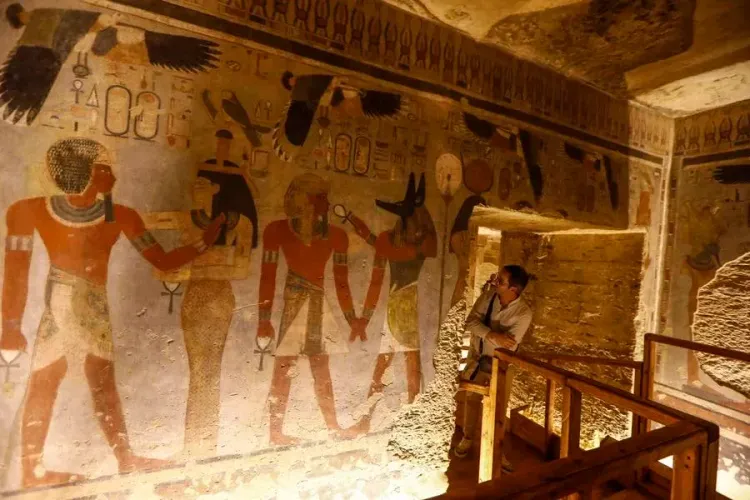
Colourful wall paintings depict Paser and his wife before an offering table and Paser paying homage to deities.
In April , a separate Spanish mission found a Roman-era tomb in Minya with mummies, wooden coffins, and three golden tongues .
A Pharaonic tomb belonging to an individual named Paser has been unearthed on the West Bank of Luxor, Egypt, by a Dutch archaeological mission operating within the Theban Necropolis. The Egyptian Ministry of Tourism and Antiquities announced the find on 13 July, with wall reliefs tentatively dating the structure to the New Kingdom period (1550 BC–1069 BC).
What the Tomb Contains
Hisham Elleithy, secretary-general of Egypt's Supreme Council of Antiquities (SCA), confirmed that inscriptions on the tomb's walls identify the owner as Paser. The archaeological team will undertake comprehensive documentation and analysis to determine who else may be buried at the site and to reconstruct their histories, with the aim of placing the tomb within its broader historical and cultural context, Elleithy said.
Mohamed Abdel-Badie, head of the Egyptian Antiquities Sector at the SCA, described the tomb's layout as comprising an external courtyard, an inverted T-shaped rock-cut chapel, and several subterranean burial chambers — a configuration consistent with private tomb architecture typical of the New Kingdom era.
Architectural and Artistic Details
The courtyard is reportedly well-preserved, featuring a mud-brick mastaba with a central niche designed to hold a funerary stela, and a staircase flanked by ramps leading to the tomb's primary entrance. Wall decorations bearing Paser's name are partially obscured by a thin layer of debris, according to Abdel-Badie.
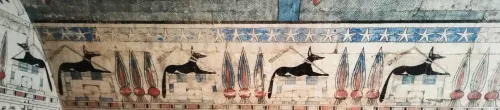
Excavated sections of the tomb reveal intricate, colourful paintings depicting the deceased paying homage to deities in shrines, alongside scenes portraying him and his wife before a traditional offering table. These artistic elements are characteristic of elite private burials during the New Kingdom, a period that includes the reigns of pharaohs such as Ramesses II and Tutankhamun.
Broader Context of Recent Discoveries
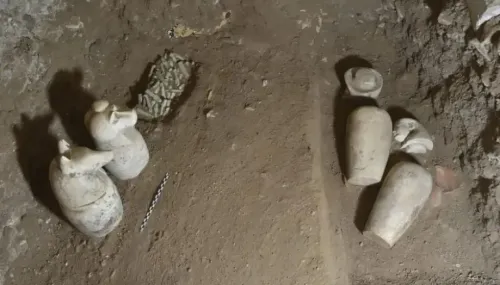
This find adds to a string of significant archaeological announcements from Egypt in recent months. In April, a Spanish archaeological mission uncovered a rare tomb dating from 30 BC to 395 AD in Egypt's central Minya province. That site yielded several Roman-era mummies — some wrapped in bandages decorated with geometric patterns — alongside wooden coffins, three golden tongues, one copper tongue, and evidence of gold chips applied to certain mummies.
Officials said the Minya discovery offers new insights into funerary practices during the Roman and Greek periods in the region. Taken together, the two finds underscore Egypt's continued archaeological productivity and the depth of its multi-layered burial heritage.
What Comes Next
The Dutch mission is expected to continue excavations at the Theban Necropolis site. Full scholarly documentation, including analysis of the wall reliefs and identification of all interred individuals, is ongoing. Results are anticipated to contribute to a richer understanding of New Kingdom private burial customs and the social hierarchies of ancient Thebes.
Point of View
But the details that matter most — who Paser was, his social rank, and whether the burial chambers hold undisturbed remains — will only emerge after full documentation. The pattern of announcing discoveries before analysis is complete is worth watching; it generates headlines but occasionally precedes revisions. The real story here will be told by the epigrapher's report, not the press release.
NationPress
12 Oct 2026
Frequently Asked Questions
Where was the New Kingdom tomb discovered in Egypt?
The tomb was discovered on the West Bank of Luxor, within the Theban Necropolis, by a Dutch archaeological mission. The Egyptian Ministry of Tourism and Antiquities announced the find on 13 July.
Who is the tomb's owner?
Inscriptions on the tomb's walls identify the owner as 'Paser.' Wall reliefs tentatively date the structure to the New Kingdom period (1550 BC–1069 BC), though comprehensive analysis is still ongoing.
What does the tomb look like inside?
The tomb comprises an external courtyard with a mud-brick mastaba, an inverted T-shaped rock-cut chapel, and several subterranean burial chambers. Colourful wall paintings depict Paser paying homage to deities and scenes of him and his wife before an offering table.
What is the Theban Necropolis?
The Theban Necropolis is a vast ancient burial ground on the West Bank of Luxor, home to hundreds of tombs of pharaohs, nobles, and officials from across Egyptian history. It includes famous sites such as the Valley of the Kings and the Valley of the Queens.
What other major tomb was recently found in Egypt?
In April, a Spanish archaeological mission uncovered a rare tomb in Egypt's Minya province dating from 30 BC to 395 AD. The site contained Roman-era mummies, wooden coffins, three golden tongues, one copper tongue, and evidence of gold chips used on some mummies.