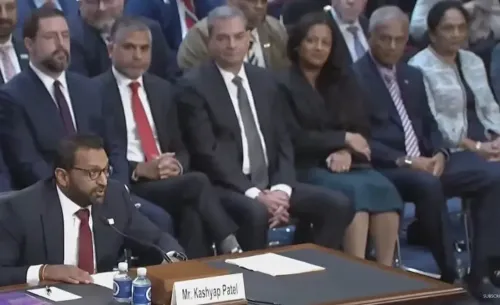
FBI Director Kash Patel Launches $250 Million Defamation Suit Against The Atlantic

Synopsis
In a significant legal move, FBI Director Kash Patel has filed a $250 million defamation lawsuit against The Atlantic, claiming the publication issued damaging and false statements about his professional conduct. This case highlights ongoing tensions surrounding Patel's leadership amid calls for investigation.
Key Takeaways
Kash Patel has filed a $250 million defamation suit against The Atlantic .
The lawsuit claims the publication made false allegations about his conduct.
The case emphasizes the legal standard of "actual malice" for public officials.
The Atlantic stands by its reporting and intends to defend against the lawsuit.
This lawsuit is part of a broader scrutiny of Patel's leadership.
Washington, April 21 (NationPress) FBI Director Kash Patel has initiated a $250 million defamation lawsuit against The Atlantic and one of its journalists, claiming that the publication released a "sweeping, malicious, and defamatory hit piece" intended to tarnish his reputation and oust him from his position.
In his lawsuit, submitted to the US District Court for the District of Columbia, Indian American Patel accuses The Atlantic Monthly Group LLC and reporter Sarah Fitzpatrick of disseminating untrue assertions regarding his behavior, which include accusations of "excessive drinking" and "unexplained absences" during his leadership of the Federal Bureau of Investigation.
Patel's legal action states that the article is "filled with false and clearly fabricated claims aimed at destroying Director Patel's reputation and driving him from his position." He is seeking a minimum of $250 million in damages, as well as additional remedies.
According to reports from The Washington Post, the article leaned on narratives "attributed to unnamed sources" who claimed Patel engaged in inappropriate actions throughout his tenure. The Post noted that it "has not independently verified The Atlantic's reporting."
Patel's lawsuit refutes these allegations, asserting that many incidents mentioned in the article — including claims that meetings were postponed due to drinking or that security personnel sought "breaching equipment" to access him — "are false."
The filing also contends that the publication acted with "actual malice," a legal criterion necessary in defamation cases involving public figures. It argues that the claims were "so demonstrably and obviously false, or easily disproven," that publishing them was reckless.
Patel's attorney, Jesse Binnall, stated: "Defamatory speech is not free speech, and it is an honor to represent Kash Patel in this lawsuit seeking accountability for the malicious falsehoods of The Atlantic article."
In response, The Atlantic stood by its reporting. Anna Bross, a spokesperson for the publication, remarked: "We affirm our reporting on Kash Patel, and we will robustly defend The Atlantic and our journalists against this baseless lawsuit."
The conflict arises amid increased scrutiny of Patel's leadership. Separate reports cited by Newsweek indicated that nearly 30,000 individuals had signed an online petition advocating for an investigation into his conduct following allegations made in recent media reports.
Patel has rebuffed these allegations and insists that the article relied on anonymous sources "with grievances and lacking firsthand knowledge of the facts."
Under US law, public officials must demonstrate that a publication acted with "actual malice" — meaning it knowingly disseminated false information or acted with reckless disregard for the truth — a standard established in the landmark Supreme Court case New York Times v. Sullivan.
Patel, who has been at the helm of the FBI since February 2025, is no stranger to litigation concerning media coverage. This current lawsuit marks at least the second defamation claim he has initiated since assuming office, including a separate case connected to comments made during a television news segment.
The case is anticipated to move forward in federal court in Washington.
Point of View
It’s crucial to remain unbiased when covering legal disputes involving influential figures. This case reflects the complexities of public perception and media accountability. It raises important questions about the balance between journalistic freedom and the potential consequences of reporting on public officials.
NationPress
1 Oct 2026
Frequently Asked Questions
What are the main allegations in Kash Patel's lawsuit?
Kash Patel alleges that The Atlantic published false claims about his behavior, including accusations of excessive drinking and unexplained absences during his tenure as FBI Director.
What amount is Kash Patel seeking in damages?
Kash Patel is seeking a minimum of $250 million in damages from The Atlantic and its journalist.
What legal standard must public officials meet in defamation cases?
Public officials must prove that a publication acted with 'actual malice,' meaning it knowingly published false information or acted with reckless disregard for the truth.
How has The Atlantic responded to the lawsuit?
The Atlantic has defended its reporting, stating it stands by its coverage of Kash Patel and will vigorously contest the lawsuit.
What is the context surrounding this lawsuit?
The lawsuit comes amid increased scrutiny of Patel's leadership, with public petitions calling for investigations into his conduct.