How Did PM Modi Counter Opposition Disruptions During RS Address?
Synopsis
In a spirited defense during the Rajya Sabha address, Prime Minister Modi faced down Opposition disruptions, asserting his government’s achievements and critiquing Congress’s history. His remarks were met with counter-chants, yet he pressed on, emphasizing progress and enduring resilience.
Key Takeaways
PM Modi showcased resilience against Opposition disruptions.
Highlighted significant government achievements in banking and public sector.
Critiqued Congress's historical governance.
Emphasized the need for a progressive approach towards national issues.
Maintained a defiant tone amidst challenges.
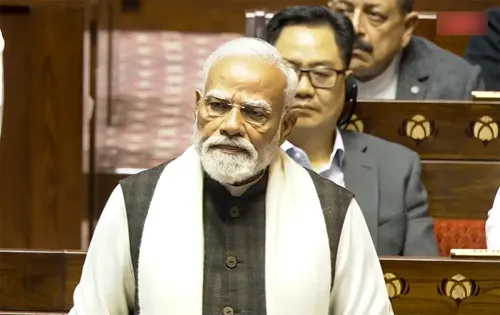
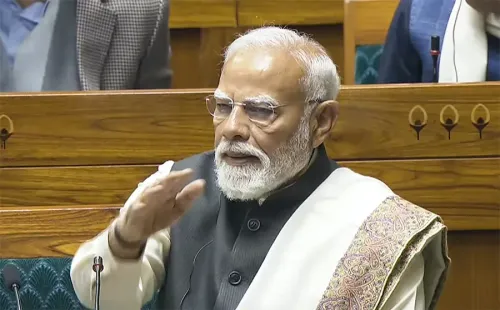
New Delhi, Feb 5 (NationPress) Prime Minister Narendra Modi arrived at Parliament on Thursday, clearly ready for an offensive from the Opposition. If the Congress aimed to obstruct his participation in the Motion of Thanks on the President's address, as they did in the Lower House the previous day, they were thwarted in the Rajya Sabha.
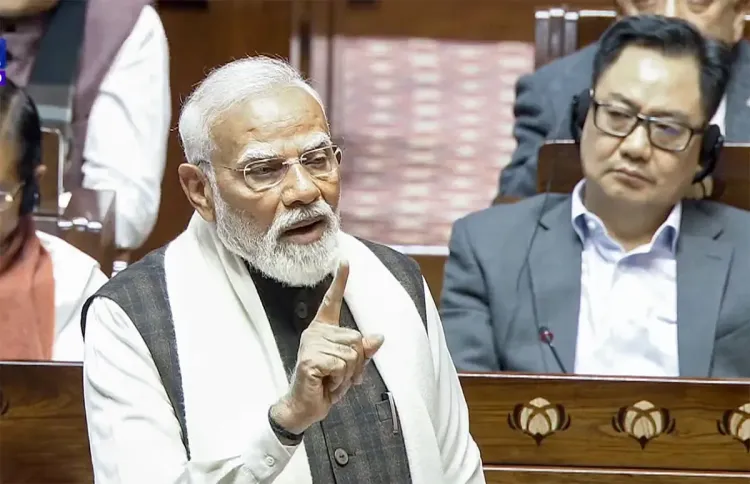
"I appreciate my colleagues in the Congress who have previously incited me. I've faced interruptions five to six times over the last decade. They are aware that I don't cease once I begin speaking," the Prime Minister remarked, eliciting laughter from the assembly as he wrapped up a nearly 100-minute address.
"I had informed them earlier, there's one person standing. Now they have come to understand that they can't always have their way. I hope this newfound sense prevails with them," he continued with a grin.
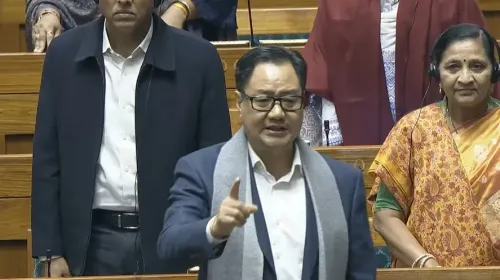
His speech commenced amidst loud chants from the Opposition benches, with Congress President and Rajya Sabha Leader of Opposition Mallikarjun Kharge's voice being particularly prominent.
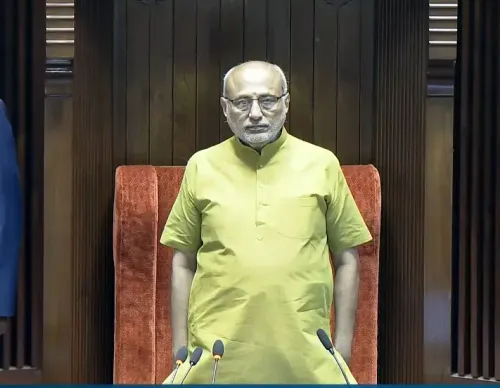
The Prime Minister urged Rajya Sabha Chairman C.P. Radhakrishnan to advise Kharge, aged 83, to chant slogans while seated, allowing younger party members to stand.
However, this remark sparked immediate retaliation from the Opposition, intensifying the atmosphere into one of slogans and interruptions, culminating in a walkout.
After a brief period of disorder, the Prime Minister's voice emerged as he compared a government of the past that was largely ineffective to one that delivers results, even amidst challenges.
Despite the uproar, he began outlining India's journey towards Viksit Bharat, while the Opposition raised slogans like "Let LoP speak" and "Dictatorship won't be tolerated." Undeterred, he took brief pauses during the escalating noise before continuing uninterrupted following the Congress walkout.
He highlighted his government's reforms in banking, launching a fierce critique against the Congress and later, the Trinamool Congress.
Focusing on achievements in the banking sector, PM Modi noted that non-performing assets (NPAs) have dropped to below one percent.
In contrast to previous administrations, he claimed that public sector undertakings (PSUs) are now achieving record profits and acting as catalysts for the 'Make-in-India' initiative, fostering job creation and international expansion.
Pointing fingers at the Trinamool Congress, he asserted that "some parties" are seeking to protect illegal immigrants who are taking jobs from the youth, encroaching on Adivasi (tribal) lands, inciting violence, and jeopardizing women's safety through legal means.
Meanwhile, he emphasized the deteriorating law and order situation in West Bengal.
Addressing criticisms of the recent agreements, he stated that today these evoke positive trade agreements, whereas in the past, they were marred by scandals like the notorious Bofors deal, which allegedly led to personal gain.
There was a mix of aggression, sarcasm, and emotion when the Prime Minister responded to the Opposition's long-standing ridicule, asserting that their repeated attempts of "Modi Teri Kabra Khudegi (dig a grave for PM Modi)" would ultimately be in vain.
He affirmed that for 25 years of their daily insults, he has remained resolute, making significant decisions, including the abrogation of Article 370, combating terrorism in the Northeast, conducting surgical strikes against Pakistani terror bases, taking strong actions against Maoists, and abolishing outdated river-sharing agreements with Pakistan.
He emphasized that the Opposition cannot tolerate his enduring presence in power, perceiving the Prime Minister's position as their "family legacy."
Calling out their lectures on the Constitution, PM Modi accused the Opposition of insulting an Adivasi woman in the highest constitutional office, referring to President Droupadi Murmu.
He condemned attacks on BJP leaders, recalling the tragic experience of nominated Rajya Sabha member C. Sadanandan Master from Kerala, who lost both legs in a brutal political assault 31 years ago, allegedly orchestrated by the CPI-M.
Additionally, he denounced Rahul Gandhi's "traitor" comment directed at Union Minister of State for Railways Ravneet Singh Bittu during a Wednesday encounter at the Parliament entrance, calling it an affront to the Sikh community.
Despite the Opposition's initial attempts to disrupt his address, the Prime Minister set a vigorous tone in his response, continuing to defend national policy and security decisions, demographic advantages, while critiquing the Congress' historical governance.
Point of View
It is essential to acknowledge the unfolding dynamics in Parliament. Prime Minister Modi’s ability to address the Opposition while highlighting his government's achievements is indicative of a leader who is firmly in control. While the Opposition continues to challenge, the resilience displayed by Modi is a testament to his political strategy and commitment to governance. The evolving scenario reflects the ever-changing landscape of Indian politics, where every address becomes a pivotal moment.
NationPress
19 Sept 2026
Frequently Asked Questions
What was the main focus of PM Modi's speech?
PM Modi's speech focused on defending his government's achievements, critiquing Congress's past governance, and addressing disruptions from the Opposition.
How did the Opposition respond to PM Modi's address?
The Opposition attempted to disrupt the address with slogans and raised voices but eventually staged a walkout.
What key achievements did PM Modi highlight?
PM Modi highlighted significant reforms in the banking sector, reduced non-performing assets, and the success of public sector undertakings.
What accusations did PM Modi make against the Congress?
PM Modi accused the Congress of obstructing progress and failing to protect the interests of the youth and Adivasi communities.
What was PM Modi's tone during the address?
PM Modi's tone was assertive and defiant, showcasing determination in defending his policies against the Opposition's challenges.