South Korea, Australia military chiefs vow to expand Indo-Pacific cooperation
Synopsis
South Korea and Australia's top military commanders held their first-ever phone call on 21 July, agreeing to expand joint exercises and personnel exchanges amid North Korean nuclear threats and Indo-Pacific instability. The call follows an April diplomatic summit that linked defence ties to energy security — with Australia as Seoul's largest LNG supplier and Seoul as a key diesel source for Canberra — signalling a partnership evolving from alliance ritual into structural integration.
Key Takeaways
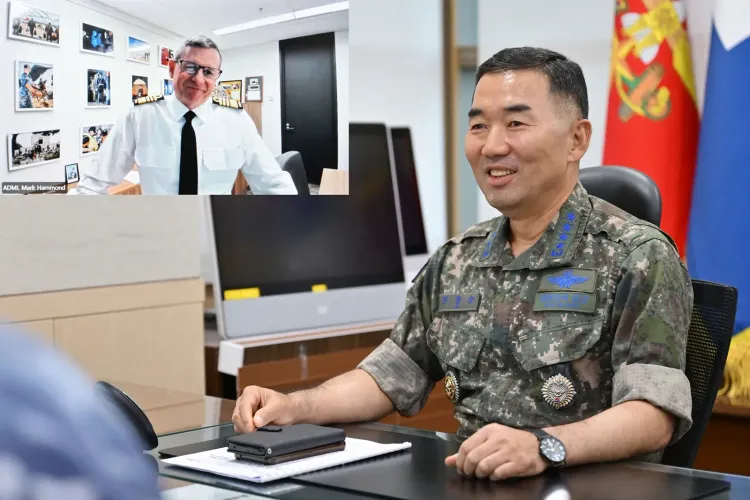
JCS Chairman General Jin Yong-sung and Admiral Mark Hammond held their first phone call on 21 July , agreeing to expand bilateral military cooperation.
Both commanders discussed North Korea's nuclear and missile threats and the broader Indo-Pacific security environment .
Cooperation will be deepened through joint exercises and personnel exchanges .
On 30 April , foreign ministers Cho Hyun and Penny Wong adopted a joint statement in Seoul covering defence, energy security, and regional issues.
Australia is South Korea's largest LNG supplier ; South Korea is a major supplier of diesel to Australia.
A South Korean defence firm has established its first overseas manufacturing hub in Australia , deepening industrial defence ties.
The top military commanders of South Korea and Australia held a telephone conversation on Tuesday, 21 July, agreeing to deepen bilateral defence ties and expand military exchanges amid a shifting security landscape in the Indo-Pacific region. The call marks a further consolidation of a partnership that spans decades of strategic alignment.
Key Developments
Joint Chiefs of Staff (JCS) Chairman General Jin Yong-sung of South Korea held his first phone call with Admiral Mark Hammond, Chief of the Australian Defence Force. The two commanders exchanged assessments of the regional security environment, with particular focus on North Korea's nuclear and missile threats. General Jin expressed appreciation for Australia's enduring contributions to peace and stability on the Korean Peninsula, recognising Canberra's role as a participating nation in the 1950–53 Korean War and a core security partner.
Admiral Hammond, in response, pledged to further strengthen mutual trust between their armed forces and to pursue future-oriented military exchanges. Both officers agreed to expand cooperation through joint exercises and personnel exchanges as a means of effectively countering the evolving security environment.
Diplomatic Groundwork Already Laid
The military dialogue builds on a diplomatic foundation established earlier this year. On 30 April, South Korea's Foreign Minister Cho Hyun and Australian counterpart Penny Wong convened in Seoul, adopting a joint statement covering high-level exchanges, economic security, defence cooperation, and regional security issues.
The two governments expressed shared concern over the situation in the Middle East and its downstream effects on energy and commodity supply chains. They reaffirmed a commitment to maintaining stable supplies of diesel, liquefied natural gas (LNG), and condensate, and pledged to notify and consult each other on any potential disruptions.
Energy Security and Defence Industry Links
The bilateral relationship carries significant economic weight. Australia is South Korea's largest LNG supplier and a key source of condensate and critical minerals. South Korea, in turn, is one of Australia's major suppliers of diesel and refined petroleum products — an interdependence that makes energy security a shared strategic priority.
The April diplomatic talks also addressed expanding cooperation in the defence industry, building on the momentum generated by a South Korean defence firm's establishment of its first overseas manufacturing hub in Australia — a development that signals the partnership is moving beyond traditional security dialogue into industrial collaboration.
Broader Strategic Context
This comes amid heightened Indo-Pacific security concerns, with North Korea's accelerating weapons programme and ongoing Middle East instability creating compounding pressures on regional supply chains and defence postures. Australia and South Korea are both US treaty allies, and their bilateral deepening reflects a broader pattern of like-minded democracies in the region knitting together sub-alliances to hedge against multiple threat vectors.
Notably, this is the first phone call between the two current military chiefs, suggesting the expanded cooperation framework is still in its early formalisation phase. How quickly joint exercises and personnel exchanges are operationalised will be the clearest indicator of whether the commitment translates into structural military integration.
Point of View
LNG dependency, and now a defence manufacturing foothold on Australian soil. What this call signals is a move from periodic diplomatic courtesy to structured security architecture. The real question is whether joint exercises remain symbolic or evolve into interoperability with teeth. In an Indo-Pacific where the US alliance system is under stress, Seoul and Canberra are quietly building bilateral load-bearing capacity — and that is worth watching more closely than the communiqué language suggests.
NationPress
20 Oct 2026
Frequently Asked Questions
What did South Korea and Australia's military chiefs agree to on 21 July?
General Jin Yong-sung and Admiral Mark Hammond agreed to expand military exchanges and cooperation, including joint exercises and personnel exchanges, to address the evolving Indo-Pacific security environment. They also discussed North Korea's nuclear and missile threats during the call.
Why are South Korea and Australia considered close security partners?
Australia participated in the 1950–53 Korean War alongside South Korea and is recognised as a core security partner by Seoul. Both nations are US treaty allies and share concerns over North Korean threats and Indo-Pacific stability.
What energy ties exist between South Korea and Australia?
Australia is South Korea's largest LNG supplier and a key provider of condensate and critical minerals. South Korea, in turn, is one of Australia's major suppliers of diesel and refined petroleum products, making energy security a central pillar of the bilateral relationship.
What was agreed at the April 2025 foreign ministers' meeting in Seoul?
Foreign Ministers Cho Hyun and Penny Wong adopted a joint statement on 30 April covering high-level exchanges, economic security, defence cooperation, and regional security. They committed to maintaining stable energy supplies and pledged to consult each other on potential disruptions.
What is the significance of a South Korean defence firm's hub in Australia?
A South Korean defence firm has established its first overseas manufacturing hub in Australia, marking a shift in the bilateral relationship from traditional security dialogue to active industrial defence collaboration — a development both governments have cited as a foundation for deeper cooperation.