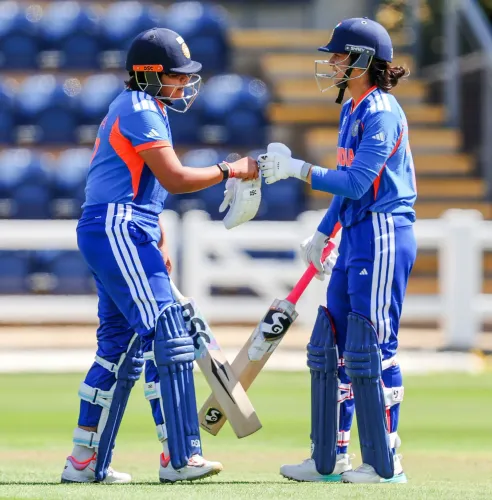
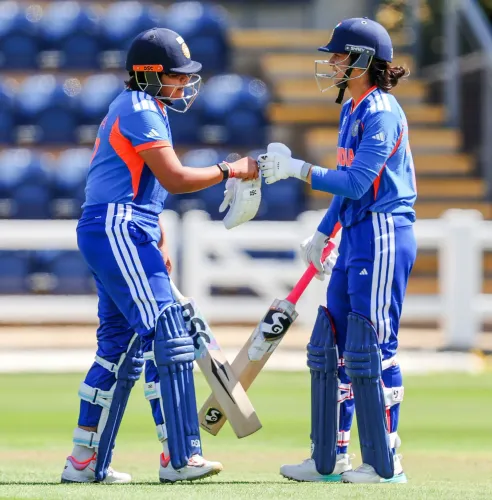
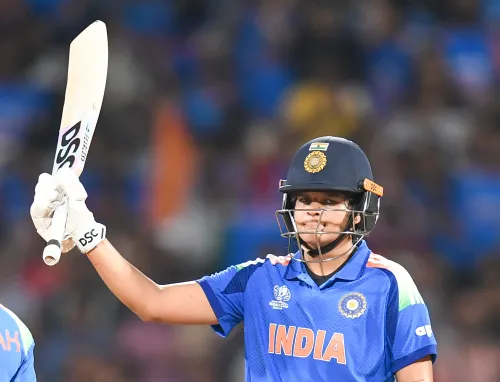
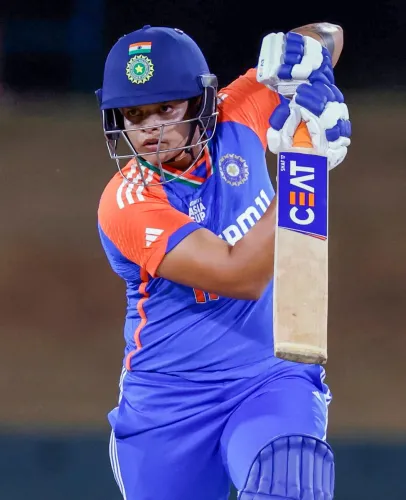
Shafali Verma's mindset shift powers India into must-win Women's T20 WC clash vs Australia

Synopsis
Shafali Verma's admission — that over-planning nearly cost her the tournament — is the most revealing pre-match insight of India's Women's T20 World Cup campaign. Her shift from ball-by-ball pre-plotting to pure reaction batting has unlocked her form at exactly the right moment, with a semi-final berth on the line against six-time champions Australia.
Key Takeaways
Shafali Verma credits a post- Pakistan match mindset reset for her improved form at the Women's T20 World Cup .
She has moved away from ball-by-ball pre-planning to a watch-and-react approach, prioritising singles and selective aggression.
Captain Harmanpreet Kaur has assigned Shafali a defined Power-play bowling role with the new ball.
Shafali defended India's fielding, citing 30 minutes of dedicated catching and ground fielding drills before the Bangladesh game.
India's recent T20 series win in Australia is cited as a key confidence booster ahead of the must-win fixture on 27 June .
A victory against Australia will confirm India's place in the semi-finals .
India opener Shafali Verma has attributed a deliberate decision to strip back her batting to essentials for her improved form at the ICC Women's T20 World Cup, saying a mental reset after the Pakistan match has allowed her to play with significantly greater freedom. The 22-year-old made the remarks ahead of India's high-stakes final group-stage fixture against Australia, a game India must win to advance to the semi-finals.
The Mindset Reset That Changed Everything
Shafali revealed that over-planning was actively undermining her game in the tournament's early stages. The turning point came after the Pakistan encounter, following which she consciously abandoned ball-by-ball pre-planning in favour of instinct and reaction.
'A lot of things have improved in my batting. Before the Pakistan match, I was overthinking. I was planning too much, how I would play the first ball, what shot I would play off the second ball. But after that game, I realised that I don't need to complicate things. I just need to keep it simple. When I bat, I watch the ball and react. I don't plan too far ahead. That has helped me score runs more freely,' Shafali told JioStar.
She added that the pressure of pre-set plans had been replaced by a more reactive, confident approach. 'Because of that change, I think I am getting good scores now. I am not putting too much pressure on myself. I will try to continue this approach in the must-win game against Australia as well,' she said.
Batting Philosophy: Singles, Strike Rotation, and Selective Aggression
The opener elaborated on the practical side of her revised approach, describing a framework built around patience and selective power-hitting rather than forcing the issue on every delivery.
'If my shots are not coming off, I don't force them. I take singles and keep the scoreboard moving. I think batting is all about not complicating things. Keep it simple, take singles, rotate the strike, and play along the ground when needed. If the ball is in my hitting zone, I go for it. Otherwise, I respect the good deliveries and look for ones and twos,' she explained.
Bowling Brief from Captain Harmanpreet
Beyond her role at the top of the order, Shafali also has defined bowling responsibilities. She said captain Harmanpreet Kaur has given her a clear brief to bowl in the Power-play with the new ball, a role she prepares for specifically in the nets.
'Harman di has kept my role very clear. She told me that I will have to bowl in the Power-play. So, I work on that in the nets as well. I bowl with the new ball, focus on hitting the right areas, and try to keep the ball around the stumps. As an opener, I know that if you bowl outside the stumps, you give the batter room to score. So, I always try to bowl tight lines, stump-to-stump, and make the batter work for runs,' she stated.
Fielding Criticism and Team Response
India have faced scrutiny over dropped catches during the tournament. Shafali defended her teammates, stressing that errors are not a reflection of effort or preparation.
'Everyone is thinking of giving their 100 per cent. No one is dropping catches or misfielding on purpose. Sometimes it's just not your day, the ball doesn't stick, the timing is off, or the bounce surprises you. But we always back the player who is having a tough day, both on and off the field,' she said.
She pointed to structured fielding sessions — including 30 minutes of dedicated catching and ground fielding drills ahead of the Bangladesh match — as evidence of the team's ongoing commitment. 'We are doing everything we can. It's just about the day. Some days things click, some days they don't. That's part of the game,' she added.
Facing Australia: Confidence from a Recent Series Win
Shafali acknowledged Australia's stature as a six-time world champion but said India's recent T20 series victory in Australia provides genuine belief going into the knockout-defining encounter.
'Everyone knows Australia are a world-class team. But it's not like we haven't beaten them before. We recently beat them in a T20 series in Australia, and that gives us confidence. We have been playing against them for years now. We know their bowlers, their strengths, and their plans. So, we will keep things straightforward and back our own strengths. The more you overthink, the harder it gets,' Shafali noted.
A win against Australia on 27 June would confirm India's place in the semi-finals of the Women's T20 World Cup.
Point of View
Not confessions about mental paralysis. That the reset came after the Pakistan game, not before it, matters: it suggests India's campaign has been reactive rather than settled. The deeper question is whether a philosophy of simplicity can hold against Australia's disciplined bowling attack, which is specifically designed to disrupt instinct-based batters. India's recent series win in Australia is real, but tournament knockout pressure is a different animal. Shafali's form is the variable that could decide whether India reach the last four.
NationPress
26 Sept 2026
Frequently Asked Questions
What mindset change has Shafali Verma made at the Women's T20 World Cup?
Shafali Verma stopped pre-planning her shots ball-by-ball and shifted to a watch-and-react approach after India's match against Pakistan. She says the change has reduced self-imposed pressure and helped her score more freely.
Why is India's match against Australia a must-win game?
India need a victory against Australia in their final group-stage fixture on 27 June to secure a place in the Women's T20 World Cup semi-finals. A loss would end their campaign at the group stage.
What is Shafali Verma's bowling role in the team?
Captain Harmanpreet Kaur has assigned Shafali a Power-play bowling role with the new ball. She focuses on tight, stump-to-stump lines to restrict scoring and prepares specifically for this role in net sessions.
How has India responded to criticism over dropped catches?
Shafali defended the team, saying no one drops catches deliberately and that errors can happen on any given day. She pointed to structured fielding sessions — including 30 minutes of catching and ground fielding drills — as evidence of the team's preparation standards.
Why does India feel confident against Australia despite their world-class status?
India recently won a T20 series against Australia on Australian soil, which Shafali says has given the squad genuine belief. She noted that India know Australia's bowlers, strengths, and plans well after years of competition.