IAF's Shukla: Build Space Infrastructure for National Security Now
Synopsis
IAF Group Captain Shubhanshu Shukla has called for building sovereign space infrastructure to strengthen India's national security, linking satellite communication to the success of surgical strikes like Operation Sindoor. He also revealed that Gaganyaan's human spaceflight mission remains timeline-uncertain due to its inherent complexity — a rare candid admission from inside India's most ambitious space programme.
Key Takeaways
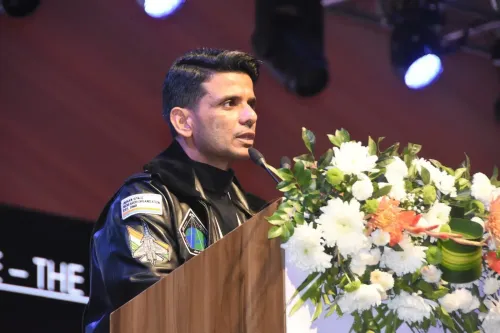
Group Captain Shubhanshu Shukla on April 24 called for building sovereign space infrastructure for national security , stating India's satellite backbone must be made stronger.
Shukla confirmed that indigenous satellite communication played a critical role in surgical strikes like Operation Sindoor , underlining the direct link between space assets and military capability.
He cited the SBS-3 initiative as a step toward India achieving self-sufficient defence space infrastructure in the near future.
On Gaganyaan , Shukla stated that human space missions are far more complex than satellite missions and declined to commit to any specific launch timeline pending test mission results.
Group Captain Prasanth Balakrishnan Nair confirmed that Gaganyaan training includes high-altitude prototype drills in Leh and ongoing Gaganyaan capsule design reviews at ISRO .
India's Gaganyaan programme is progressing on a fast-track basis, but the crewed mission will only be scheduled after the success of an uncrewed test flight.
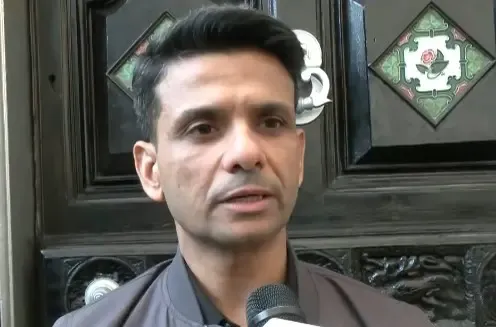
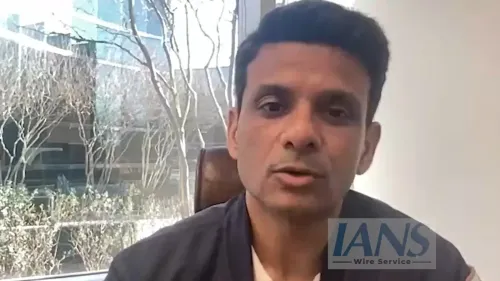
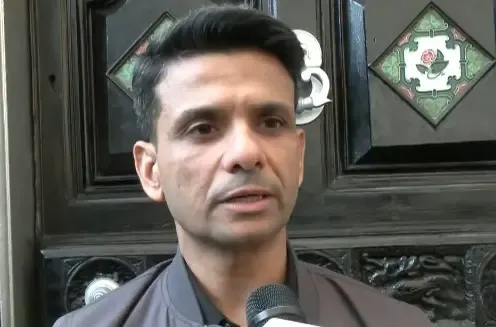
New Delhi, April 25: Indian Air Force (IAF) Group Captain Shubhanshu Shukla, a designated astronaut for ISRO's Gaganyaan mission, on Friday, April 24, made a strong case for building robust space infrastructure dedicated to national security. Speaking to reporters, Shukla stressed that India's indigenous satellite communication network has already proven its strategic worth and must be expanded into a fully sovereign, self-sufficient system capable of supporting military operations.
Space as the New Backbone of National Security
Group Captain Shukla acknowledged that indigenous satellite-based communication has served as the critical backbone enabling India to execute precision military operations, including surgical strikes such as Operation Sindoor. He underscored that this backbone must now be made significantly stronger.
"Yes, it is the backbone which we have to make stronger. We need to create a space infrastructure for national security. Our backbone should be strong," Shukla stated emphatically.
He pointed to recent policy developments as signs of momentum, noting, "There are many initiatives, like the SBS-3, which has just been released. It is working in the same direction. I think very soon, our sovereign infrastructure for these things will be very strong and self-sufficient from the perspective of national security."
Why India's Sovereign Space Capability Matters Strategically
India's growing dependence on space-based assets for defence operations is not new — ISRO has been progressively integrating satellite intelligence, navigation, and communication into military frameworks over the past decade. The Defence Space Agency (DSA), established in 2019, was a direct acknowledgment that space had become a contested domain requiring dedicated military attention.
Shukla's remarks come at a time when global powers — including China, the United States, and Russia — are rapidly militarising space, deploying anti-satellite weapons and hardening their orbital communication grids. India's Mission Shakti anti-satellite test in March 2019 demonstrated a kinetic capability, but experts have long argued that the more urgent gap lies in resilient, redundant, and sovereign communication satellites that cannot be jammed or intercepted by adversaries.
The reference to Operation Sindoor is particularly significant — it signals that real-time satellite data played a decisive role in targeting precision and operational coordination, reinforcing the case for faster investment in dedicated defence space assets.
Gaganyaan Mission: Complexity, Timelines, and Uncertainty
Group Captain Shukla, who is among the astronauts selected for ISRO's Gaganyaan human spaceflight programme, provided candid insights into the mission's developmental challenges. He drew a sharp distinction between satellite missions and crewed missions.
"A human space mission is much more complex. Many technologies need to be developed for this because in this case a human life needs to be preserved when he or she is sent into space. That is why it takes time," he explained.
Shukla also addressed the psychological dimension of being an astronaut in a long-running development programme: "Especially in the developmental programme, there is a period of great uncertainty for any astronaut about when the mission will take place, what will be its duration or definition."
He noted that missions naturally evolve from their original concept: "Initially a mission begins with some concept but later on it gets modified into something else. This is a part of the process. I am happy that work is being done on these things on a fast track basis."
When pressed on a specific launch timeline, Shukla declined to commit: "Only after the test mission will we get the confidence level to know when exactly we will be able to carry out this mission."
Fellow Astronaut Nair Confirms Rigorous Training in Progress
Group Captain Prasanth Balakrishnan Nair, another of the four astronauts shortlisted for Gaganyaan, offered an update on the training regime currently underway. "Everything is going on well. Like recently we had a prototype training in Leh. We will also have psychological and medical training with the Aerospace Medicine Department," Nair told reporters.
He added that technical work is simultaneously progressing at ISRO: "At ISRO, we are doing design reviews of the Gaganyaan capsule." Nair also expressed confidence in India's state of readiness, stating simply, "In India, we are always prepared."
The training in Leh — at high altitude and low-oxygen conditions — mirrors protocols used by international space agencies to simulate physiological stress similar to low-pressure space environments, indicating that ISRO's human spaceflight preparation is maturing in sophistication.
What Comes Next for India's Space and Defence Ambitions
India's dual push — developing human spaceflight capability through Gaganyaan while simultaneously hardening its defence space infrastructure — reflects a broader strategic doctrine that views space dominance as inseparable from national security in the 21st century.
With ISRO targeting an uncrewed test flight before any crewed mission, and the Indian Space Policy 2023 opening the sector to private players, the next 18-24 months will be decisive. The success of upcoming Gaganyaan test missions will directly determine when Group Captain Shukla and his fellow astronauts make history as India's first homegrown space crew. Meanwhile, the integration of sovereign defence satellites will be closely watched by both strategic allies and adversaries alike.
Point of View
However, is accountability on timelines — Gaganyaan has faced repeated delays since its initial 2022 target, and vague assurances of 'fast track' progress deserve harder scrutiny. India's ambitions are real, but the gap between aspiration and execution in both defence space and human spaceflight remains the story that demands closer watching.
NationPress
19 Sept 2026
Frequently Asked Questions
What did IAF Group Captain Shubhanshu Shukla say about space infrastructure?
Group Captain Shukla called for the creation of dedicated space infrastructure to strengthen India's national security. He stated that indigenous satellite communication has been the backbone of operations like Operation Sindoor and must be made more robust and self-sufficient.
When will the Gaganyaan mission launch?
No confirmed launch date has been announced for the crewed Gaganyaan mission. Group Captain Shukla stated that only after a successful test mission will ISRO have the confidence to set a precise timeline for the human spaceflight.
Who are the astronauts selected for the Gaganyaan mission?
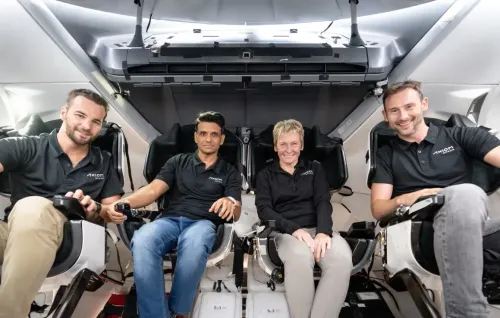
ISRO has selected four IAF pilots as astronaut candidates for Gaganyaan, including Group Captain Shubhanshu Shukla and Group Captain Prasanth Balakrishnan Nair. They are undergoing rigorous technical, medical, and psychological training in preparation for the mission.
What is SBS-3 and how does it relate to India's national security?
SBS-3 is a recently released Indian space initiative aimed at strengthening sovereign satellite-based communication infrastructure. Group Captain Shukla cited it as an example of India moving toward self-sufficient space assets for national security purposes.
How is Gaganyaan different from India's previous satellite missions?
Unlike satellite missions, Gaganyaan is a human spaceflight programme requiring technologies specifically designed to sustain human life in space. Group Captain Shukla noted that this added complexity — including life support systems and crew safety protocols — is why the mission takes significantly more time to develop.