How Are Trade Agencies Aiming to Diversify South Korean Exports and Boost US Investments?

Synopsis
State-run trade agencies from South Korea are making bold commitments to diversify export products and support significant investments in the U.S. This strategic move aligns with a bilateral trade agreement aimed at enhancing economic cooperation and fostering growth in both nations. Discover the implications of these initiatives and their potential impact on global trade.
Key Takeaways
KOTRA is focusing on diversifying export items.
K-SURE plans to provide low-interest loans for U.S. investments.
South Korea is committed to investing US$350 billion in the U.S.
New teams will assist with overseas certification.
Financial packages will support shipbuilders.
Seoul, Jan 12 (NationPress) On Monday, state-operated trade agencies committed to enhancing the diversity of South Korea's export portfolio and facilitating anticipated corporate investments in the United States as part of a bilateral trade agreement.
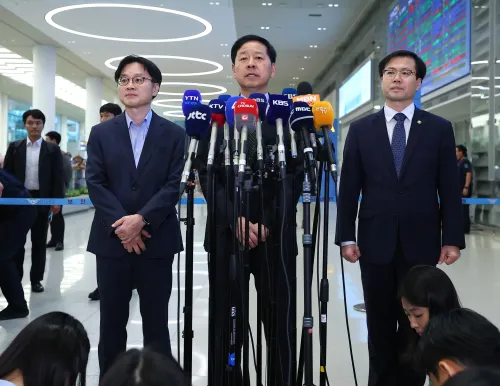
The Korea Trade-Investment Promotion Agency (KOTRA) and the Korea Trade Insurance Corp. (K-SURE) unveiled these initiatives for 2026 during a policy briefing to the Ministry of Trade, Industry and Resources, according to Yonhap news agency.
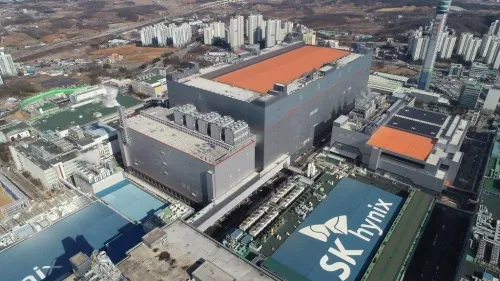
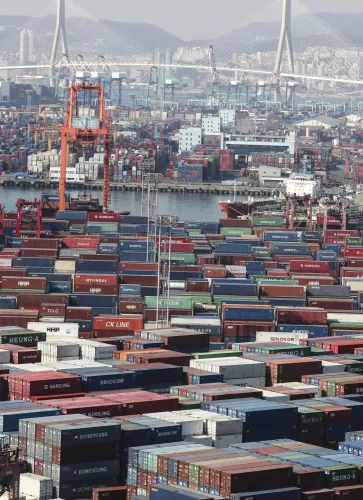
KOTRA has indicated its intention to broaden Korea's export offerings, which are presently heavily reliant on the semiconductor, automotive, and shipbuilding industries.
The agency aims to create 20 new teams dedicated to assisting with the overseas certification of consumer products in their global offices, in addition to expanding logistics hubs for Korean businesses abroad.
K-SURE has announced plans to provide low-interest loans totaling 49 trillion won (approximately US$33.3 billion) by 2030, with an 8 trillion-won loan initiative set for this year, targeting companies investing in the U.S.
As part of the trade agreement finalized in October, Seoul committed to investing US$350 billion in the U.S., which includes $150 billion for bilateral shipbuilding collaboration and $200 billion for partnerships in advanced industries, in exchange for tariff reductions.
K-SURE is also set to establish a 25 trillion-won financial package for shipbuilders involved in the 'Make American Shipbuilding Great Again' initiative, while fostering communication between the government, K-SURE, and leading shipbuilding firms.
In other news, the U.S. Supreme Court did not issue a ruling on Friday regarding the legality of President Donald Trump's 'reciprocal' tariffs on various trading partners, including South Korea, despite anticipations that a decision would be made this week.
Earlier this week, the court announced plans for a session, leading to speculations that it might address the legality of Trump's application of the International Emergency Economic Powers Act (IEEPA) of 1977 to enforce these country-specific tariffs. The court, however, did not disclose the nature of any potential ruling during the planned session.
On its official site, the court released only one document pertaining to a criminal case.
Point of View
I believe that South Korea's efforts to diversify its exports and enhance investments in the U.S. showcase a proactive approach to adapting to global economic changes. This strategic move not only strengthens bilateral trade relations but also positions South Korea favorably in the competitive global market. It is imperative for nations to embrace such initiatives to foster growth and resilience amidst evolving trade dynamics.
NationPress
1 Oct 2026
Frequently Asked Questions
What are the main objectives of KOTRA and K-SURE?
KOTRA aims to diversify South Korea's export items and establish new teams for overseas certification, while K-SURE focuses on providing substantial low-interest loans to companies investing in the U.S.
How much is South Korea planning to invest in the U.S.?
South Korea has committed to investing a total of US$350 billion in the U.S. as part of a bilateral trade agreement.
What industries are currently dominating South Korean exports?
The semiconductor, automobile, and shipbuilding sectors currently dominate South Korea's export landscape.
What is the 'Make American Shipbuilding Great Again' initiative?
This initiative aims to provide financial support to shipbuilders in the U.S. and enhance collaboration with South Korean shipbuilders.
Did the U.S. Supreme Court make any rulings regarding Trump's tariffs?
No, the U.S. Supreme Court did not issue a ruling on the legality of President Trump's 'reciprocal' tariffs as expected.