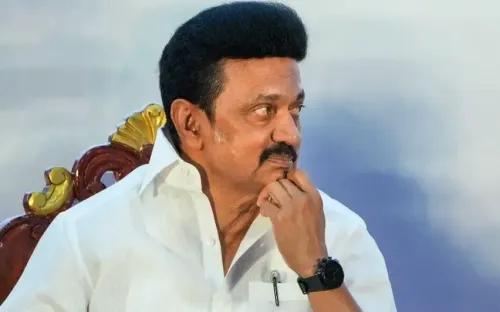
Stalin Critiques Centre's Three-Language Policy as a Hindi Imposition
Synopsis
Chennai's Chief Minister M. K. Stalin criticizes the proposed three-language policy for Class 6, calling it a politically motivated move that threatens India’s linguistic diversity. His concerns highlight broader issues of fairness and federalism in education.
Key Takeaways
Stalin criticizes the three-language policy as an imposition of Hindi.
Concerns about linguistic diversity and regional identity are at the forefront.
The policy could widen educational inequalities.
Stalin questions the Centre's commitment to fair language promotion.
Focus on emerging skills is essential for student development.
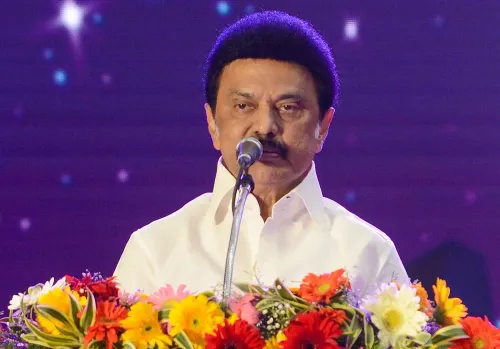
Chennai, April 4 (IANS) Tamil Nadu's Chief Minister M. K. Stalin has sharply criticized the Central government and the CBSE regarding the proposed enforcement of a three-language policy starting from Class 6 in the academic year 2026-27. He described this initiative as a "politically motivated action" that threatens the linguistic diversity of India.
This policy, part of the National Education Policy 2020, has faced significant backlash from Tamil Nadu, which has a longstanding opposition to mandatory Hindi instruction.
In a pointed statement, Stalin asserted that this initiative is not a mere educational reform but a "worrying effort to impose Hindi disguised as a promotion of Indian languages".
He accused the BJP-led NDA government of systematically favoring Hindi over other regional languages, risking the erosion of the nation's rich linguistic heritage.
Stalin remarked, "The three-language policy is essentially an effort to spread Hindi in non-Hindi-speaking states. For southern students, this amounts to enforced Hindi".
He raised a critical question about fairness, inquiring if students in Hindi-speaking regions would be required to learn languages like Tamil, Telugu, Kannada, Malayalam, Bengali, or Marathi.
Stalin emphasized the "double standards" of the Centre, noting its failure to make Tamil compulsory in Kendriya Vidyalayas and its inadequate provision of Tamil teachers.
He stated, "This government, which now seeks to instruct states on promoting Indian languages, has shown utter hypocrisy".
The Chief Minister also expressed worries about the lack of necessary infrastructure, trained educators, and financial resources needed for the effective implementation of this policy.
He questioned whether the Centre had truly considered ground realities, such as teacher availability and institutional capacity.
Stalin cautioned that this policy could exacerbate inequalities among states by giving Hindi-speaking students a structural edge in higher education and job opportunities. He highlighted that the issue transcends mere language; it touches on federalism, fairness, and equal opportunity.
At a time when students should be acquiring skills in emerging sectors like artificial intelligence, animation, visual effects, gaming, and comics, Stalin contended that imposing additional language requirements would impede their development. He further accused the Centre of disregarding the legitimate and democratic concerns raised by states, labeling the initiative as "an affront to cooperative federalism and a direct insult to the linguistic identity of millions of Indians".
Point of View
The debate surrounding the three-language policy touches on significant issues of language, identity, and regional autonomy. The concerns raised by Chief Minister M. K. Stalin reflect a broader apprehension about the balance of power and the preservation of cultural identities in India's federal structure.
NationPress
10 Sept 2026
Frequently Asked Questions
What is the three-language policy?
The three-language policy aims to promote multilingualism in India by requiring students to learn three languages, including Hindi, from Class 6.
Why is Tamil Nadu opposing this policy?
Tamil Nadu opposes the policy as it perceives it as an imposition of Hindi, undermining the state's linguistic heritage and diversity.
What are the potential impacts of the policy?
The policy could create inequalities among states, providing Hindi-speaking students with advantages in higher education and job markets.
How does this relate to federalism?
The opposition highlights concerns about federalism, fairness, and the ability of states to preserve their linguistic identities.
What skills do students need in the current educational landscape?
Students need to acquire skills in modern fields such as AI, animation, and gaming, which may be hindered by additional language requirements.