Is the Stock Market's Decline a Sign of Greater Trouble?
Synopsis
The stock market's persistent decline raises concerns among investors as foreign institutional selling continues amid escalating trade tensions. Analysts predict a volatile market ahead, emphasizing the need for clarity on tariff disputes. Explore how these factors could shape future market movements.
Key Takeaways
Indian benchmark indices continue to decline.
Weak global cues and FII selling are major contributors.
Immediate support for Nifty is 25,400–25,450 .
Volatility is expected in the coming days.
IMF projects India’s FY26 GDP growth at 7.3 percent .
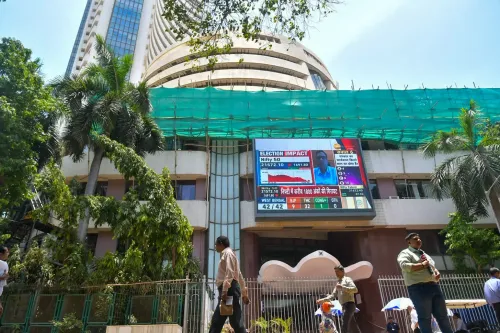
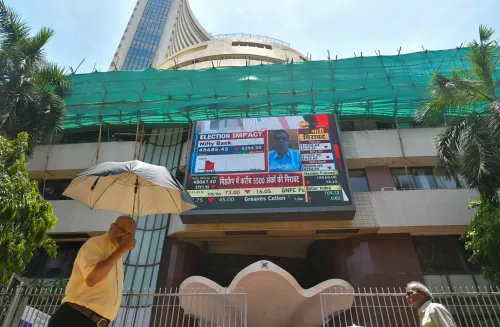
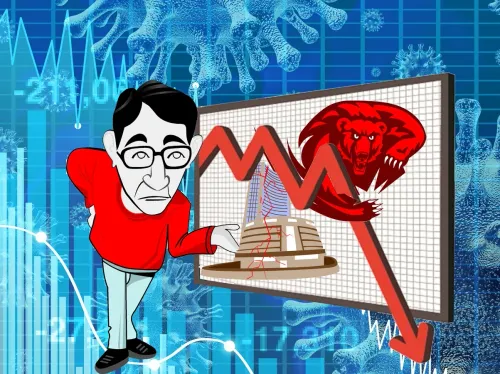
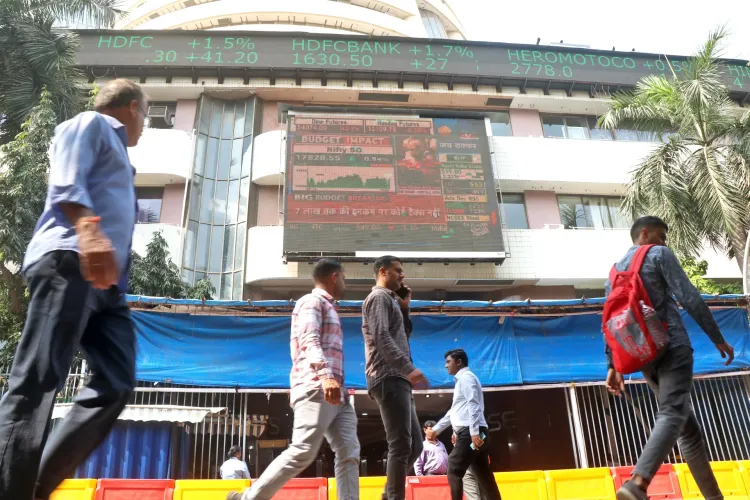
Mumbai, Jan 20 (NationPress) The Indian benchmark indices have extended their losses on Tuesday, influenced by weak global cues and the escalation of tariff tensions between the US administration and European nations. Continuous selling pressure from foreign Institutional Investors (FIIs) further dampened market sentiment.
By around 9:30 am, the Sensex had dropped by 275 points, or 0.33 percent, settling at 82,971, while the Nifty fell by 91 points, or 0.36 percent, to 25,494.
The main broadcap indices mirrored the benchmark indices, with the Nifty Midcap 100 losing 0.33 percent and the Nifty Smallcap 100 declining 0.54 percent.
Among various sectors, all indices were in the red except for Nifty FMCG, metal, and PSU bank, with the PSU bank sector emerging as the top gainer, up 1.05 percent. The Realty and IT sectors faced significant losses, down 1.18 percent and 0.65 percent, respectively.
Market analysts noted that immediate support is found in the 25,400–25,450 zone, while resistance is expected around 25,700–25,750.
They forecast volatile trading days ahead until further clarity is achieved concerning the US-Europe standoff on Greenland tariffs.
“With both parties taking firm stances, the uncertainty is likely to persist. A significant announcement is anticipated today with the US Supreme Court ruling on President Trump’s tariffs,” remarked an analyst.
In other news, the IMF has projected that India’s FY26 GDP growth will reach 7.3 percent, signaling robust economic performance despite various challenges, which might act as a headwind for the market.
Upcoming Q3 earnings reports are expected to reveal a recovery in earnings growth, particularly as results from auto companies start to be released.
Most Asia-Pacific markets opened lower in the morning session as investors responded to renewed US tariff threats against Europe regarding Greenland, escalating trade tensions. Reports indicate that European nations are considering counter-tariffs and other punitive economic actions.
Meanwhile, China’s central bank opted to maintain its loan prime rates on Tuesday, aiming for targeted support for specific sectors instead of broad policy easing to address the economic slowdown.
In Asian trade, China’s Shanghai index fell 0.3 percent, Shenzhen decreased 1.22 percent, Japan’s Nikkei dropped 1.03 percent, and Hong Kong’s Hang Seng Index edged down 0.09 percent. Conversely, South Korea’s Kospi gained 0.13 percent.
US markets concluded the last trading session in the red, with Nasdaq down 0.06 percent, the S&P 500 losing 0.06 percent, and the Dow declining 0.17 percent.
On January 19, foreign institutional investors (FIIs) sold net equities worth Rs 3,263 crore, while domestic institutional investors (DIIs) were net buyers, acquiring equities worth Rs 4,234 crore.
Point of View
The ongoing fluctuations in the stock market reflect broader global economic challenges. While the recent projections from the IMF regarding India's GDP growth offer some optimism, the prevailing uncertainties surrounding international trade policies must be addressed. Our commitment remains with the nation, aiming to provide timely and accurate updates during these critical times.
NationPress
1 Oct 2026
Frequently Asked Questions
Why is the stock market declining?
The stock market is declining due to weak global cues and ongoing tariff tensions between the US and Europe, coupled with consistent selling by foreign institutional investors.
What impact do tariffs have on the market?
Tariffs can create uncertainty for investors and businesses, leading to market volatility as companies reassess their strategies and cost structures.
How are foreign institutional investors affecting the market?
Foreign institutional investors have been selling off equities, which contributes to the downward pressure on stock prices and overall market sentiment.
What is the immediate support level for the Nifty?
The immediate support level for the Nifty is identified in the 25,400–25,450 range, while resistance is noted around 25,700–25,750.
What are analysts predicting for the near future?
Analysts are predicting continued volatility in the stock market until there is clarity regarding the US-Europe tariff situation.