Is Mere Recovery of Currency Notes Sufficient for Conviction in Corruption Cases?
Synopsis
In a pivotal ruling, the Supreme Court underscores that mere recovery of tainted currency cannot lead to conviction in corruption cases. It stresses the necessity of proving both demand and acceptance of bribes beyond reasonable doubt, marking a significant legal precedent in corruption law.
Key Takeaways
Supreme Court ruling emphasizes that mere recovery of currency notes is insufficient for conviction.
Proof of demand and acceptance of illegal gratification is essential for establishing guilt.
The court found inconsistencies in the prosecution's evidence.
Acquittals can be reinstated if trial court's reasoning is sound.
Judicial standards must be upheld in corruption cases.
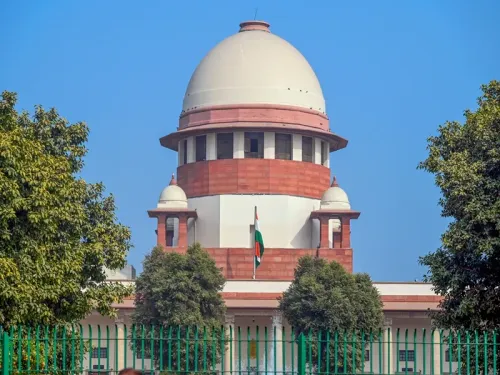
New Delhi, Oct 29 (NationPress) The Supreme Court has emphasized that the mere retrieval of contaminated currency notes does not suffice for a conviction under the Prevention of Corruption Act (PC Act). It stated that the demand and acceptance of illicit rewards must be established beyond a reasonable doubt before any presumption of guilt is made.
A bench consisting of Justices Prashant Kumar Mishra and Joymalya Bagchi reinstated the acquittal of a former Assistant Commissioner of Labour, P. Somaraju, who had faced conviction by the Andhra Pradesh High Court in a 1997 bribery case. The bench observed that the high court “failed to engage with the trial court’s detailed rationale” and substituted its own conclusions “without addressing the evidentiary gaps”.
The apex court stated, “The statutory presumption under Section 20 of the PC Act is not automatic and arises only once the foundational facts of demand and acceptance are demonstrated,” and added that “suspicion, no matter how strong, cannot replace proof.”
It further reiterated: “For an offence under Section 7 of the PC Act, the demand for illegal gratification is essential to establish guilt. Mere recovery of currency notes does not constitute an offence under Section 7 unless it is proven beyond a reasonable doubt that the accused willingly accepted the funds, knowing them to be a bribe. The proof of acceptance of illegal gratification can only follow if there is evidence of demand.”
In its comprehensive judgment, the bench led by Justice Mishra noted various inconsistencies in the prosecution’s argument, stating, “What we find particularly concerning is the complainant’s behavior in instructing Rajender, the mediator and accompanying independent witness, to stay outside the appellant’s office during the critical half-hour when the alleged demand and acceptance took place.”
Furthermore, the phenolphthalein hand-wash test conducted on the accused returned negative results, and the defence presented two independent witnesses who testified that the complainant was observed alone in the officer’s chamber when the alleged bribe money was deposited in a drawer.
“These circumstances undermine the prosecution's narrative and cast significant doubt on whether the demand and acceptance were established beyond a reasonable doubt,” concluded the apex court.
Recognizing the trial court’s acquittal as “reasonable and firmly grounded in the evidence”, the Supreme Court annulled the Andhra Pradesh High Court’s 2011 conviction order and reinstated the acquittal recorded by the Special Judge in 2003.
It directed that the appellant’s bail bonds be released, stating: “The appeal is granted. The contested judgment and order dated 08.07.2011 issued by the High Court of Judicature of Andhra Pradesh at Hyderabad is annulled, and the acquittal order passed by the Court of Principal Special Judge for SPE & ACB Cases, Hyderabad is reinstated.”
Point of View
It is vital to highlight that the Supreme Court's ruling serves as a reminder of the necessity for robust evidence in corruption cases. Upholding the principle of justice, the court’s decision reaffirms that legal standards must be met to ensure fairness in the judicial process. NationPress remains committed to delivering accurate and insightful analyses on such critical matters.
NationPress
21 Sept 2026
Frequently Asked Questions
What did the Supreme Court emphasize regarding corruption convictions?
The Supreme Court emphasized that mere recovery of tainted currency notes is not enough for a conviction under the Prevention of Corruption Act . It requires proof of demand and acceptance of illegal gratification beyond reasonable doubt.
Which case did the Supreme Court rule on recently?
The Supreme Court ruled on the case of P. Somaraju, a former Assistant Commissioner of Labour, who was acquitted in a 1997 bribery case after the court found evidentiary gaps in the prosecution's case.
What does the court say about suspicion in corruption cases?
The court stated that suspicion, regardless of its strength, cannot replace concrete proof in establishing a conviction for corruption.