Tamil Nadu 2026 Exit Poll: TVK leads with 98–120 seats, DMK+ trails

Synopsis
Actor Vijay's TVK is projected to lead the 2026 Tamil Nadu Assembly election tally with 98–120 seats, ahead of CM Stalin's DMK+ at 92–110, in the Axis My India exit poll. With no alliance near a clear majority and Vijay topping CM preference polls at 37%, Tamil Nadu may be on the cusp of a historic political realignment — all hinging on the May 4 results.
Key Takeaways
TVK projected to win 98–120 seats , making it the single largest party in the 234-member Tamil Nadu Assembly , per the Axis My India exit poll.
DMK+ estimated at 92–110 seats , potentially falling short of the majority mark of 118 .
AIADMK+ forecast at a distant 22–32 seats , marking a sharp electoral decline.
Both TVK and DMK+ projected at approximately 35 per cent vote share each; AIADMK+ at 23 per cent .
Vijay leads CM preference at 37 per cent , narrowly ahead of M.K.
Stalin at 35 per cent .
Survey based on 44,460 respondents across all 234 constituencies ; official results due 4 May .
Actor Vijay's Tamilaga Vettri Kazhagam (TVK) has emerged as the single biggest force in the 2026 Tamil Nadu Assembly elections, leading the seat tally in the latest Axis My India exit poll released on 29 April — a result that signals a dramatic reshaping of the state's political order. The survey, conducted across all 234 constituencies with 44,460 respondents, projects TVK winning between 98 and 120 seats in the 234-member Assembly, placing it ahead of both the ruling alliance and the principal opposition.
Seat Projections at a Glance
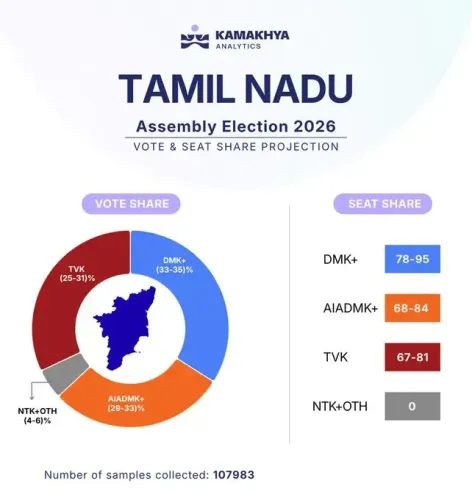
The Dravida Munnetra Kazhagam (DMK)-led Secular Progressive Alliance (DMK+), headed by Chief Minister M.K. Stalin, is projected to secure between 92 and 110 seats — a close second, but one that may fall short of the majority mark of 118. The All India Anna Dravida Munnetra Kazhagam (AIADMK)-led alliance, which includes the Bharatiya Janata Party (BJP) and other partners, is forecast to win a distant 22 to 32 seats, marking a sharp decline from its previous electoral standing.
Vote Share Battle Between TVK and DMK+
The poll reveals a near-equal contest on vote share: both TVK and the DMK+ are projected to secure approximately 35 per cent each, while the AIADMK+ trails at around 23 per cent. The closeness of the vote share, combined with the divergence in seat projections, suggests that TVK's support is more efficiently distributed across constituencies — a critical structural advantage in a first-past-the-post system.
Vijay Leads Chief Ministerial Preference
Actor Vijay has emerged as the most preferred Chief Ministerial candidate, with 37 per cent support, narrowly ahead of Chief Minister M.K. Stalin at 35 per cent. AIADMK leader Edappadi K. Palaniswami trails with 22 per cent, reflecting the shifting mood in the state. This is notable given that TVK is contesting its first major state election, having been founded only recently by Vijay.
Generational Divide and the Change Wave
A deeper analysis of voter trends points to a pronounced generational divide. TVK commands overwhelming support among first-time voters aged 18–19, while the DMK+ continues to draw strength from older voter segments. Additionally, 35 per cent of respondents cited a desire for change as the primary driver of their vote — a sentiment that appears to have disproportionately benefited TVK's rise. This comes amid a broader pattern across Indian states where anti-incumbency has increasingly favoured newer political entrants over established alliances.
What Happens Next
With no alliance comfortably crossing the majority mark of 118, the exit poll projections suggest a potentially hung Assembly, where TVK's role in government formation could prove decisive. Official results are expected on 4 May. Exit polls, while indicative, have historically diverged from final counts in Tamil Nadu — the state's complex caste arithmetic and last-minute voter shifts have confounded surveys before. All eyes will be on whether TVK's first-election momentum translates into a governing mandate or a powerful opposition bloc.
Point of View
It redraws opposition politics in the state for a generation.
NationPress
19 Sept 2026
Frequently Asked Questions
What does the Axis My India exit poll predict for Tamil Nadu 2026?
The Axis My India exit poll projects TVK winning 98–120 seats, DMK+ securing 92–110 seats, and AIADMK+ winning only 22–32 seats in the 234-member Tamil Nadu Assembly. No alliance is projected to comfortably cross the majority mark of 118 on its own.
Who is the most preferred Chief Minister candidate according to the exit poll?
Actor Vijay leads CM preference with 37 per cent support, narrowly ahead of Chief Minister M.K. Stalin at 35 per cent, and AIADMK leader Edappadi K. Palaniswami at 22 per cent, according to the Axis My India survey.
When will the official Tamil Nadu 2026 election results be declared?
Official results for the 2026 Tamil Nadu Assembly elections are expected on 4 May 2026.
How was the Axis My India exit poll conducted?
The survey covered all 234 constituencies in Tamil Nadu with a total of 44,460 respondents, making it one of the more comprehensive exit polls for this election cycle.
What is driving TVK's rise according to the exit poll?
TVK has made strong inroads among first-time voters aged 18–19, and 35 per cent of all respondents cited a desire for change as their primary voting motivation — a sentiment that appears to have significantly benefited Vijay's party in its debut election.