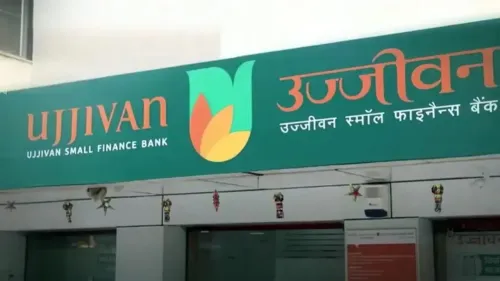
Ujjivan Small Finance Bank Shares Plummet Nearly 6% After RBI Rejects Universal Banking Licence Application
Synopsis
Ujjivan Small Finance Bank's shares took a hit after the RBI rejected its universal banking licence application. Despite a rising market, the bank's stock dropped sharply, highlighting its reliance on microfinance and the need for diversification.
Key Takeaways
Ujjivan SFB's shares fell nearly 6%.
RBI rejected its application for a universal banking licence.
The bank needs to diversify its loan portfolio.
45% of the loan book is in group loans.
RBI encourages expansion into secured lending.
Mumbai, April 15 (NationPress) The shares of Ujjivan Small Finance Bank experienced a significant decline on Wednesday after the Reserve Bank of India rejected its application for a universal banking licence, despite the broader market showing gains.
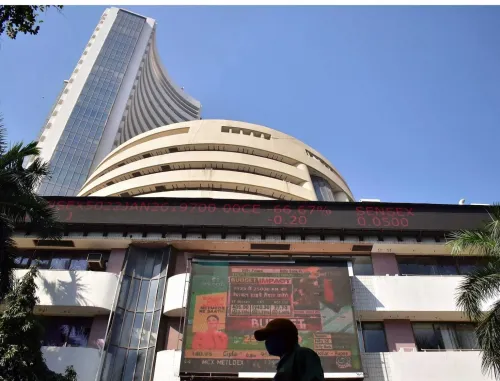
The stock price plummeted by as much as 5.94% to reach an intra-day low of Rs 56.75 on the Bombay Stock Exchange (BSE), in comparison to its previous close of Rs 60.34.
This drop starkly contrasted with the upward trend in the overall market, where the Sensex surged over 1.6% due to enhanced global sentiment following renewed peace discussions between the US and Iran.
By the end of trading on Wednesday, the shares of the bank settled at Rs 58.53, marking a decrease of Rs 1.81 or 3%.
The sharp decline in the bank's shares came after the RBI's decision to return its application for a universal banking licence, citing a lack of sufficient diversification in its loan portfolio.
In a prior exchange filing, the bank acknowledged that while the regulator recognized its recent efforts to diversify, it indicated that further progress is necessary before a transition to a universal bank can be considered.
The central bank has encouraged Ujjivan Small Finance Bank to reapply after demonstrating a more balanced and diversified asset portfolio.
This incident marks the second occasion in recent months that the RBI has dismissed a similar application from a small finance bank.
According to available data, Ujjivan SFB's gross loan portfolio was approximately Rs 37,057 crore in the third quarter of FY26, with nearly 45% of its exposure in group loans, reflecting a persistent reliance on microfinance.
The RBI has consistently urged small finance banks to minimize their dependence on unsecured microfinance lending and to explore secured sectors such as housing, vehicle, and SME loans.
The regulator believes that diversification is vital for enhancing asset quality and mitigating risks tied to high non-performing assets, particularly during economic downturns.
Shifting towards a more balanced loan mix is also perceived as a crucial step for small finance banks aspiring to evolve into full-fledged universal banks.
Point of View
The rejection of Ujjivan Small Finance Bank's application for a universal banking licence by the RBI highlights critical issues regarding the bank's loan diversification strategy. As the financial sector evolves, the emphasis on robust asset portfolios becomes increasingly important for institutions aspiring to transform into universal banks.
NationPress
19 Sept 2026
Frequently Asked Questions
Why did Ujjivan SFB's shares fall?
Ujjivan SFB's shares fell sharply after the Reserve Bank of India returned its application for a universal banking licence, citing insufficient loan portfolio diversification.
What was the percentage decline in Ujjivan SFB's stock?
The stock dropped as much as 5.94%, reaching an intra-day low of Rs 56.75.
What does the RBI suggest for Ujjivan SFB?
The RBI advised Ujjivan SFB to reapply for the licence after demonstrating a more balanced and diversified asset book.
How much of Ujjivan SFB's loan book is in group loans?
Approximately 45% of Ujjivan SFB's gross loan book is exposed to group loans.
What has the RBI encouraged small finance banks to do?
The RBI has encouraged small finance banks to reduce their reliance on unsecured microfinance lending and to expand into secured segments.