UN committee adopts North Korea human rights resolution for 22nd year
Synopsis
For the 22nd year running, the UN's human rights committee has condemned North Korea — but this time with a historic twist: the US abstained for the first time, citing ICC objections even as Trump eyes a fresh opening with Kim Jong-un. The resolution also broke new ground by calling out Pyongyang's cyberthreats, weeks after North Korea was accused of a USD 6 billion cryptocurrency heist from Binance.
Key Takeaways
The UN Third Committee passed a resolution on North Korea 's human rights for the 22nd consecutive year , with 95 votes in favour , 14 against , and 58 abstentions .
The United States abstained for the first time , objecting to language referencing the International Criminal Court (ICC) .
For the first time, the resolution explicitly addressed North Korea's cyberthreats , following accusations that Pyongyang stole over USD 6 billion in cryptocurrency from Binance .
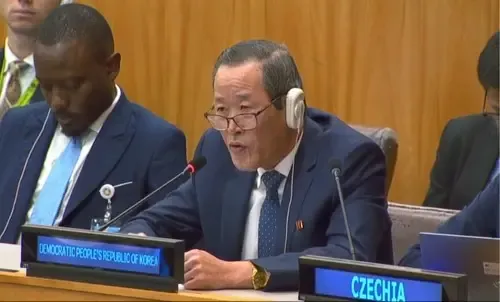
North Korean Ambassador Kim Song called the resolution a 'politically motivated provocation.' The resolution now goes to the full UN General Assembly for a final vote in December 2026 .
The US abstention comes amid President Donald Trump 's signals of willingness to reengage with Kim Jong-un during his APEC visit to China .
A United Nations General Assembly committee has passed a resolution on North Korea's human rights situation for the 22nd consecutive year, raising fresh concerns over Pyongyang's digital surveillance, technology-enabled repression, and cyberthreat activities, South Korea's foreign ministry said on Thursday, 19 November 2026.
Key Developments at the Vote
The Third Committee, which oversees human rights and social affairs, adopted the resolution with 95 votes in favour, 14 against, and 58 abstentions at UN headquarters in New York on Wednesday local time. The measure now moves to the full UN General Assembly for final approval in December.
Notably, the United States abstained for the first time, citing objections to language in the text referencing the International Criminal Court (ICC), which Washington has accused of overstepping its jurisdiction and infringing on national sovereignty. US Ambassador to the UN Economic and Social Council Dan Negrea clarified that the abstention is 'not a reflection on the situation' inside North Korea.
What the Resolution Condemns
Like its predecessors, this year's resolution condemned the 'systematic, widespread and gross' violations of human rights in North Korea that 'may amount to crimes against humanity,' and criticised the failure to bring those responsible to justice. For the first time, the resolution explicitly addressed cyberthreats — a significant addition coming weeks after North Korea was accused of stealing more than USD 6 billion in cryptocurrency from Binance.
The text also called for an end to transnational repression, including international abductions, enforced disappearances, and the persecution of defectors. It stressed the importance of protecting freedom of movement, thought, conscience, religion, and belief inside the country.
South Korea's Role and Inter-Korean Language
At South Korea's proposal, the resolution included language stressing the importance of dialogue and engagement with North Korea, specifically mentioning inter-Korean talks and humanitarian progress on issues such as families separated by the 1950–53 Korean War and those abducted by the North over the decades.
Reactions From Key Players
North Korean Ambassador to the UN Kim Song denounced the resolution as a 'politically motivated provocation' aimed at tarnishing Pyongyang's image and destabilising its political system. Meanwhile, Negrea reaffirmed that the US commitment to promoting human rights and accountability for North Koreans remains 'unwavering,' even as Washington withheld its vote.
The US abstention carries geopolitical weight: it comes as US President Donald Trump has signalled a desire to reengage with North Korean leader Kim Jong-un, with speculation mounting that the two could meet during Trump's ongoing visit to China for the Asia-Pacific Economic Cooperation (APEC) summit. Countries that supported the resolution included South Korea, Britain, France, and Canada; China, Russia, Cuba, and Iran voted against it.
Why the Annual Resolution Matters
The Third Committee has adopted this resolution every year since 2005, making it one of the longest-running UN human rights accountability efforts against a single state. Critics argue that without enforcement mechanisms, the resolutions risk becoming symbolic. Supporters contend they sustain international pressure and keep the issue on the global agenda. This year's addition of cyberthreat language signals that the resolution is evolving to reflect North Korea's increasingly sophisticated tools of repression — both domestic and cross-border.
The resolution's fate at the full General Assembly in December will be watched closely, particularly to see whether the US weighs in or holds its abstention.
Point of View
But because of what it signals about Washington's foreign policy priorities. If Trump is willing to let an ICC procedural objection override two decades of consistent co-sponsorship on North Korean human rights, it raises a legitimate question about how much leverage human rights advocacy will carry in any forthcoming Trump-Kim diplomacy. The addition of cyberthreat language is a rare instance of the resolution keeping pace with reality — North Korea's digital aggression is now a global security concern, not merely a domestic repression issue. But resolutions without enforcement remain largely symbolic, and 22 years of annual condemnations have done little to change conditions on the ground in Pyongyang.
NationPress
19 Nov 2026
Frequently Asked Questions
What did the UN committee resolve on North Korea in 2026?
The UN Third Committee adopted a resolution for the 22nd consecutive year condemning North Korea's human rights situation, citing 'systematic, widespread and gross' violations that may amount to crimes against humanity. The resolution passed with 95 votes in favour, 14 against, and 58 abstentions on Wednesday, 19 November 2026.
Why did the United States abstain from the North Korea resolution this year?
The US abstained for the first time, citing objections to language in the resolution referencing the International Criminal Court (ICC), which Washington accuses of overstepping its jurisdiction. US Ambassador Dan Negrea stressed the abstention was 'not a reflection on the situation' inside North Korea and said American commitment to human rights accountability there remains 'unwavering.'
What is new in this year's North Korea human rights resolution?
This year's resolution included cyberthreat language for the first time, addressing North Korea's cyberattack activities. The addition came weeks after Pyongyang was accused of stealing more than USD 6 billion in cryptocurrency from Binance. The resolution also added new language on digital surveillance and technology-enabled repression.
Which countries voted for and against the North Korea resolution?
South Korea, Britain, France, and Canada were among those that voted in favour of the resolution. China, Russia, Cuba, and Iran voted against it, while the US abstained for the first time. The resolution was adopted with 95 votes in favour and 14 against.
What happens next with the North Korea resolution?
The resolution adopted by the Third Committee moves to the full UN General Assembly for a final vote in December 2026. The General Assembly is widely expected to pass it, though the outcome will be watched closely given the US shift to abstention.