How is the UN Enhancing Partnership with AU to Address Africa's Challenges?
Synopsis
UN Secretary-General Antonio Guterres recently highlighted Africa's resilience in overcoming significant challenges. During the AU Summit in Addis Ababa, he emphasized the strengthened UN-AU partnership and the urgent need for global support in peace, financial justice, and climate action. Discover how Africa is navigating these hurdles and the role of international cooperation.
Key Takeaways
Africa is tackling significant challenges with resilience.
The UN-AU partnership is stronger than ever.
Key priorities include peace and security , financial justice , and climate action .
Africa faces economic constraints despite having fast-growing economies .
More global support is needed for climate adaptation .
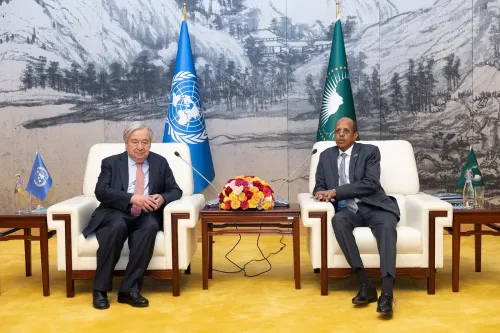
Addis Ababa, Feb 15 (NationPress) The Secretary-General of the United Nations, Antonio Guterres, commended Africa for tackling some of the globe's most difficult challenges with creativity, resilience, and diligence.
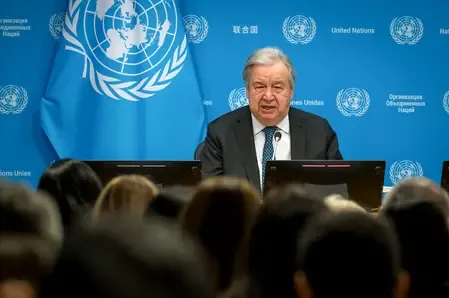
Speaking to the press during the 39th African Union (AU) Summit at the AU headquarters in Addis Ababa, Ethiopia, he recognized the ongoing endeavors of African nations to confront developmental obstacles, as reported by Xinhua news agency.
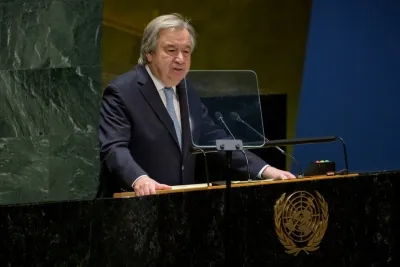
"There are no miracles, only consistent practical efforts to address tangible issues amid an international landscape that is increasingly polarized, unpredictable, and volatile—more so than at any point since the Cold War's conclusion," Guterres remarked to journalists.
He pointed out that the African continent is making strides in areas such as regional integration, clean energy initiatives, and infrastructure development, stating, "Progress is evident, albeit sometimes uneven and slow."
Emphasizing the enduring potential and power of Africa, he reinforced the stronger than ever partnership between the UN and AU, focusing on three key areas: peace and security, financial justice, and climate action.
Guterres noted that various regions, including Sudan, the Democratic Republic of the Congo, the Sahel, and the Horn of Africa, are grappling with profound and intricate crises, characterized by numerous actors and interests.
He acknowledged the commitment of African leadership and institutions to silence the guns across the continent, urging for enhanced global support for Africa’s peace and security initiatives, stressing that such efforts cannot rely solely on political goodwill.
According to Guterres, Africa boasts some of the world’s fastest-growing economies, yet also faces severe financial constraints. He pointed out that debt burdens, elevated borrowing costs, and limited access to long-term financing hinder advancements in education, health, and job creation.
"It is utterly unacceptable that, having survived the enduring scars of colonialism, Africa now has to grapple with an economic and financial framework that is fundamentally unjust," Guterres stated.
He emphasized the critical necessity for developing nations to have a genuine voice and substantial participation in the international financial institutions that influence their futures.
Regarding climate efforts, Guterres remarked that despite contributing minimally to climate change, Africa endures the gravest consequences, facing droughts, floods, hunger, and extreme heat.
He pointed out that the continent receives insufficient support to adapt and transition towards clean energy, calling it a case of climate injustice. Yet, he expressed optimism that with adequate backing, Africa can emerge as a global leader in renewable energy.
Point of View
The UN's commitment to strengthening ties with the AU reflects a proactive approach to addressing Africa's multifaceted challenges. This partnership not only fosters regional stability but also champions the continent's development needs, emphasizing the importance of global cooperation in confronting shared obstacles.
NationPress
23 Sept 2026
Frequently Asked Questions
What did Antonio Guterres say about Africa's challenges?
Antonio Guterres acknowledged that Africa is facing some of the world's hardest challenges with determination and resilience, emphasizing the need for consistent practical efforts to tackle these issues.
What are the three key priorities highlighted by Guterres?
Guterres emphasized peace and security, financial justice, and climate action as the three key priorities in the partnership between the UN and AU.
How is Africa's economy described?
Africa is described as having some of the fastest-growing economies, yet it faces significant financial constraints that hinder development.
What did Guterres say about climate action in Africa?
Despite contributing minimally to climate change, Africa is facing severe consequences and requires more support to adapt and transition to clean energy.
What is the significance of the UN-AU partnership?
The partnership is vital for enhancing peace, security, and development in Africa, ensuring that African nations have a voice in international financial institutions.