Understanding the Women’s Reservation Bill: Key Insights
Synopsis
Explore the pivotal Women’s Reservation Bill introduced in India, designed to ensure 33% reservation for women in Parliament and state Assemblies. Discover key aspects and implications of this legislation for the 2029 elections and beyond.
Key Takeaways
The Women’s Reservation Bill aims for 33% reservation for women in Parliament.
Three Bills were presented to expedite the implementation process.
Delimitation is essential for fair representation in the Lok Sabha.
The proposed increase in Lok Sabha seats to 850 reflects population growth.
Scheduled Castes and Tribes will see an increase in reserved seats.
New Delhi, April 19 (NationPress) On April 16, the Central government presented three significant Bills in the Lok Sabha aimed at expediting the implementation of a 33 percent reservation for women in Parliament and state Assemblies. The proposed legislation includes the Constitution (One Hundred and Thirty-First Amendment) Bill, 2026, the Delimitation Bill, 2026, and the Union Territories Laws (Amendment) Bill, 2026.
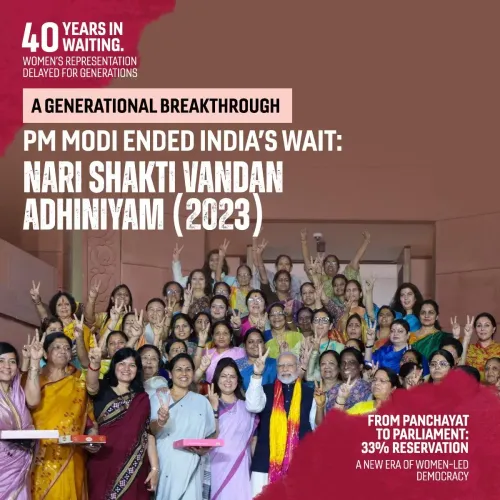
This initiative seeks to ensure that women can reap the benefits of the Nari Shakti Vandan Adhiniyam as early as the 2029 general elections by separating the reservation from the lengthy timeline of the upcoming Census and subsequent delimitation.
Below is a concise overview of vital information regarding the Women’s Reservation Bill and the recent updates:
Q 1. What three Bills were introduced by the Central government in the Lok Sabha on April 16?
A. The Central government brought forth three key Bills in the Lok Sabha: the Constitution (One Hundred and Thirty-First Amendment) Bill, 2026, the Delimitation Bill, 2026, and the Union Territories Laws (Amendment) Bill, 2026.
Q 2. Why were these three Bills presented in the Lok Sabha?
A. The Nari Shakti Vandan Adhiniyam stipulates that women’s reservation will be enacted following delimitation after the Census post-2026. Delays in awaiting the complete Census and delimitation would have postponed the 33 percent reservation benefits even for the 2029 general elections. Thus, to guarantee timely advantages for women, the government chose to separate the Act's implementation from this stipulation.
Q 3. What benefits could these Bills have provided if approved?
A. If these Bills had been passed, they would have allowed women to receive a 33 percent reservation in the Lok Sabha as soon as the 2029 general elections.
Q 4. Why was delimitation connected to the Nari Shakti Vandan Adhiniyam, and what was the rationale for increasing seats?
A. Delimitation involves finalizing constituency boundaries, which is crucial for implementing women’s reservation. The Lok Sabha seat limit was capped at 550 in 1976 when the population stood at 54 crore. Currently, with a population nearing 140 crore, it is essential to increase the number of seats to ensure equitable representation in Parliament.
Q 5. Was there any attempt to alter the Delimitation Commission Act for political gain? Would ongoing state elections be impacted?
A. The government has made no modifications to the Delimitation Commission Act. The existing legal framework remains unchanged, and any recommendations from the Commission will require parliamentary approval and Presidential assent. Ongoing elections, including those in states like Tamil Nadu and West Bengal, will not be affected, as elections until 2029 will proceed under the current system.
Q 6. What was the reasoning for increasing Lok Sabha seats to 850?
A. The proposal was based on a proportional expansion strategy. A uniform increase of 50 percent in seats would maintain proportionality across all states and union territories. Applying this principle to the current 543 seats would suggest approximately 816 seats. Hence, the ceiling on Lok Sabha seats was proposed to rise from 550 to 850.
Q 7. Would southern or smaller states be disadvantaged by the new delimitation proposal?
A. Every state will experience a uniform increase of 50 percent in seats. Southern states will not have their representation diminished; rather, their overall share will stay stable. For instance, Tamil Nadu's seats would rise proportionally, ensuring no disadvantage.
Currently, southern states hold 23.76 percent of Lok Sabha seats with 129 out of 543. After the proposed expansion, their share would be approximately 23.87 percent with 195 out of 816. Their proportional representation will thus remain nearly the same, safeguarding their influence in Parliament while providing every region with more voices overall.
Q 8. Would states with controlled population growth face any drawbacks?
A. No, as the increase in seats is proposed uniformly across states, their proportional representation will remain unchanged or may even improve slightly.
Q 9. Will the representation of Scheduled Castes and Scheduled Tribes be affected?
A. The delimitation process guarantees proportional reservation for Scheduled Castes and Scheduled Tribes. With a larger House, the number of reserved seats will significantly increase, thereby enhancing their representation.
Q 10. Was the Constitutional Amendment Bill introduced to postpone the caste census?
A. The government has already initiated a time-sensitive program for the caste census, which includes a detailed enumeration, and caste-related data will be documented during the population count phase.
Q 11. Why isn't there a separate quota for Muslim women within the reservation framework?
A. The Constitution of India does not permit reservations based on religion. Reservation policies are determined by social and economic backwardness, as outlined in the Constitution.
Q 12. Why wasn’t women’s reservation implemented in the 2024 general elections?
A. Implementing the reservation necessitates delimitation of seats. Delimitation is a comprehensive consultative process that typically requires about two years to finalize. Therefore, these Bills, including the Delimitation Bill, were introduced in Parliament to facilitate the implementation of women’s reservation.
Q 13. Why was the Women’s Reservation Bill introduced in 2023 if immediate implementation wasn't planned?
A. The Bill was introduced and passed in 2023 to create the legal and constitutional framework for women’s reservation. Its unanimous passage showcased widespread political support, enabling the enactment of the Nari Shakti Vandan Adhiniyam.
Q 14. Why was a separate Union Territories Bill necessary?
A. The Legislative Assemblies in Union Territories such as Jammu and Kashmir, Delhi, and Puducherry are governed by distinct legal provisions. Therefore, specific amendments were essential to implement women’s reservation in these regions, necessitating a separate Bill.
Point of View
Aiming to enhance women’s representation in governance. It reflects a growing recognition of the need for equitable representation and addresses historical imbalances in political participation.
NationPress
18 Sept 2026
Frequently Asked Questions
What are the three Bills introduced by the Central government?
The government introduced the Constitution (One Hundred and Thirty-First Amendment) Bill, the Delimitation Bill, and the Union Territories Laws (Amendment) Bill.
Why was the Women’s Reservation Bill introduced?
To ensure timely benefits of 33% reservation for women in the 2029 elections, delinking it from the Census and delimitation processes.
What will be the impact on Lok Sabha seats with the new proposal?
The proposal suggests increasing Lok Sabha seats to 850 to ensure fair representation given the current population.
Will the representation of Scheduled Castes and Tribes change?
The delimitation process will increase the number of reserved seats for Scheduled Castes and Scheduled Tribes, enhancing their representation.
Why is there no specific quota for Muslim women?
Reservations are based on social and economic backwardness, not religion, as per the Constitution.