Green Jobs Boom: Dr. Jitendra Singh Flags EV, Renewable Sectors as India's Future Employment Engine
Synopsis
Union Minister Dr. Jitendra Singh declared at Jamia Millia Islamia on Earth Day 2025 that renewable energy, electric mobility, and green fuels will create massive youth employment in India. Backed by a Rs 19,000 crore Green Hydrogen Mission and a Rs 1 lakh crore RDI Fund, India's green economy pivot could redefine national employment — if the skills pipeline keeps pace.
Key Takeaways
Jitendra Singh addressed a sustainability conference at Jamia Millia Islamia, New Delhi on Earth Day, April 23, 2025 .
He identified renewable energy, electric mobility, green fuels, and the circular economy as the primary drivers of future large-scale youth employment in India.
The National Green Hydrogen Mission , with an outlay of over Rs 19,000 crore , is targeting decarbonisation of sectors like steel and cement .
A Rs 1 lakh crore Research, Development and Innovation (RDI) Fund has been established to support green startups and innovators through collaborative funding.
Ocean energy was flagged as a largely untapped resource that could complement solar and wind energy given India's vast coastline .
India is expanding nuclear power capacity and opening space and atomic energy sectors to private participation to boost investment and innovation.
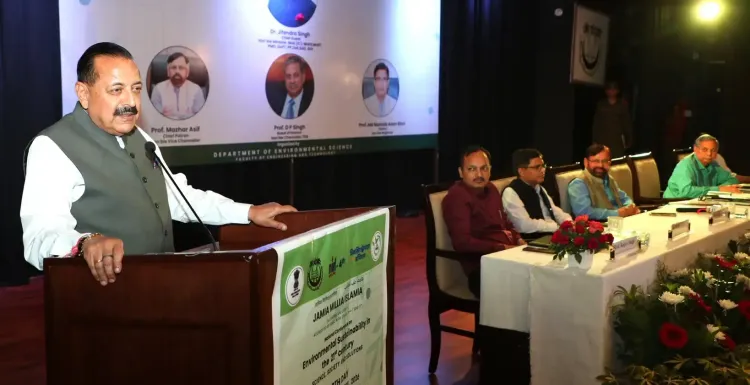
New Delhi, April 23: Union Minister Dr. Jitendra Singh declared on Thursday that India's renewable energy and electric mobility sectors are poised to become the country's most powerful job-creation engines, as the nation fast-tracks its shift toward a green economy. Speaking at Jamia Millia Islamia on the occasion of Earth Day 2025, the minister outlined how emerging clean-energy industries will define employment for the next generation of Indian youth.
Green Sectors as the New Employment Frontier
Addressing a conference on environmental sustainability, Dr. Jitendra Singh emphasized that sectors including renewable energy, electric mobility, green fuels, and the circular economy will be central to large-scale job generation in the years ahead. He described green jobs and green entrepreneurship as the "defining drivers" of India's economic future.
"Green jobs and green entrepreneurship are set to become the defining driver of the Green Economy of the future, with sectors such as renewable energy, electric mobility, green fuels and circular economy creating large-scale employment opportunities for the youth," the minister stated.
He further noted that the transition to a low-carbon economy will not only generate employment but also reinforce India's sustainable growth trajectory — a dual benefit that positions the country favorably in the global climate narrative.
Key Government Initiatives Driving the Green Transition
The minister spotlighted the National Green Hydrogen Mission, backed by an outlay of over Rs 19,000 crore, as a cornerstone initiative laying the groundwork for clean industrial transformation. He said the mission is specifically targeting the decarbonisation of hard-to-abate sectors such as steel and cement, which together account for a significant share of India's industrial carbon emissions.
He also referenced the Rs 1 lakh crore Research, Development and Innovation (RDI) Fund, designed to support startups and innovators through collaborative funding models — a signal that the government is betting on homegrown innovation to drive the green transition rather than relying solely on imported technology.
On nuclear energy, Dr. Singh confirmed that India is actively expanding its nuclear power capacity while encouraging private sector participation in strategic domains including space and atomic energy to stimulate investment and innovation.
Electric Mobility and Circular Economy Opportunities
Highlighting rapid technological advancements, the minister pointed to the electric mobility space where conventional internal combustion engine vehicles are increasingly being retrofitted and converted into electric ones — making EV solutions more affordable and scalable for the Indian market.
He also drew attention to emerging opportunities across solar manufacturing, battery production, grid management, and biofuels. A particularly notable example cited was the conversion of used cooking oil into biofuel, which he described as offering significant entrepreneurial potential within the circular economy framework.
The minister also flagged ocean energy as a largely untapped resource, noting that despite India's vast coastline, marine energy remains underdeveloped and is expected to complement solar and wind energy in the future energy mix.
India's Global Climate Leadership and the LiFE Vision
On India's role in global climate action, Dr. Jitendra Singh asserted that the country is well-positioned to lead the global green transition, guided by Prime Minister Narendra Modi's vision of 'Lifestyle for Environment (LiFE)' — a framework that promotes sustainable consumption patterns as a counterweight to the throwaway culture dominating developed economies.
He urged students and young researchers at Jamia Millia Islamia to actively engage with sustainability-driven opportunities, emphasizing that future growth will be shaped by innovation, adaptability, and informed choices. This call to action comes at a time when India's youth unemployment remains a persistent policy challenge, making green sector job creation not just an environmental goal but an economic imperative.
Why This Matters: The Bigger Picture
India's green economy ambitions are backed by its COP26 and COP28 commitments, including achieving 500 GW of non-fossil fuel capacity by 2030 and reaching net-zero emissions by 2070. The International Labour Organization (ILO) has projected that the global transition to green energy could create 24 million new jobs worldwide by 2030, and India — with its scale, demographic dividend, and policy momentum — is among the best-positioned nations to capture a disproportionate share of those opportunities.
Notably, India's Production Linked Incentive (PLI) scheme for solar manufacturing and the FAME India scheme for EV adoption have already begun translating policy intent into on-ground industrial activity, suggesting the green jobs narrative is moving from aspiration to execution. As global supply chains for clean energy technology restructure away from China, Indian manufacturers in solar panels, batteries, and green hydrogen stand to benefit significantly — provided the skills pipeline keeps pace.
With Earth Day 2025 serving as the backdrop, the minister's address signals that the government intends to keep green employment at the center of its economic messaging heading into the next phase of India's energy transition roadmap.
Point of View
000 crore Hydrogen Mission, a Rs 1 lakh crore RDI Fund, and PLI-backed solar manufacturing suggests a coherent industrial strategy is taking shape. However, the critical gap remains the skills ecosystem: India cannot capture green jobs at scale without a parallel revolution in vocational training and STEM education. The real test of this vision will come not in ministerial speeches but in employment data over the next five years.
NationPress
19 Sept 2026
Frequently Asked Questions
What did Dr. Jitendra Singh say about green jobs in India?
Dr. Jitendra Singh stated that sectors like renewable energy, electric mobility, green fuels, and the circular economy will create large-scale employment opportunities for India's youth. He made these remarks at Jamia Millia Islamia on Earth Day, April 23, 2025.
What is the National Green Hydrogen Mission and its budget?
The National Green Hydrogen Mission is a Government of India initiative aimed at clean industrial transformation, with an outlay of over Rs 19,000 crore. It focuses on decarbonising hard-to-abate sectors such as steel and cement.
How will electric mobility create jobs in India?
The electric mobility sector is generating jobs through EV manufacturing, battery production, grid management, and the retrofitting of conventional vehicles into electric ones. These solutions are becoming increasingly affordable and scalable, broadening employment potential.
What is India's Rs 1 lakh crore RDI Fund?
The Rs 1 lakh crore Research, Development and Innovation (RDI) Fund is a government initiative designed to support startups and innovators through collaborative funding models. It aims to drive homegrown green innovation and technology development.
What is India's LiFE vision in the context of climate action?
LiFE stands for 'Lifestyle for Environment,' a framework championed by Prime Minister Narendra Modi that promotes sustainable consumption habits as part of India's broader climate leadership strategy. Dr. Jitendra Singh cited it as guiding India's positioning in the global green transition.