Piyush Goyal Highlights Education as a Service's Role in Boosting India's Exports
Synopsis
Union Minister Piyush Goyal reveals the transformative potential of education as a service in enhancing India's export earnings. He discusses the National Education Policy and the future of higher education during the Vice Chancellors' Conference, emphasizing global engagement.
Key Takeaways
Education as a service can enhance India's export earnings.
National Education Policy 2020 was formed with input from 300,000 stakeholders .
Proposed programmes for foreign students may reshape educational engagement.
India aims to attract 1.3 million international students in the coming years.
India’s global trade strategy is increasingly robust, with FTAs covering two-thirds of global trade.
New Delhi, March 6 (NationPress) Union Minister of Commerce and Industry Piyush Goyal emphasized on Friday that education as a service holds significant promise in enhancing India’s export revenues and propagating exceptional Indian education globally.
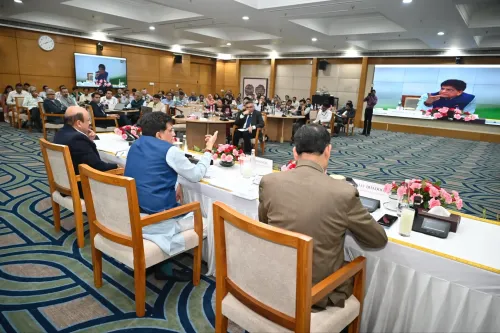
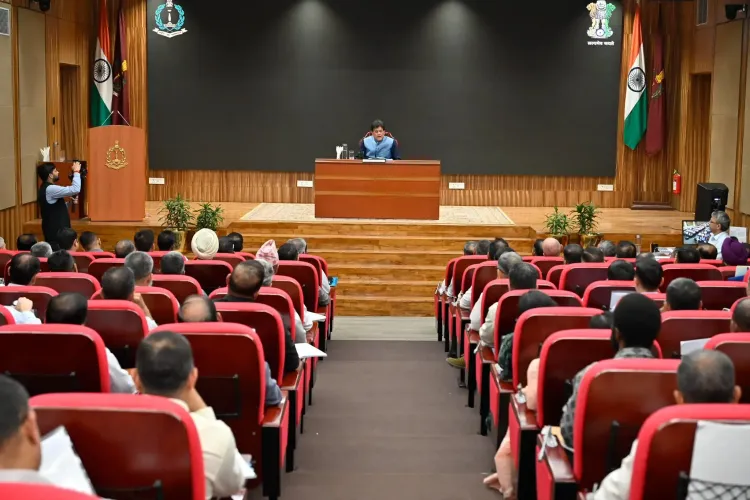
Speaking at the Vice Chancellors' Conference centered on "Reimagining Internationalisation of Higher Education for a Developed India 2047," Goyal urged vice chancellors to actively engage in molding the future of higher education in India.
He remarked, "Exposure to India will greatly benefit students from developed nations in their professional journeys."
In his address, Goyal highlighted the National Education Policy 2020, which was developed through discussions with approximately 300,000 stakeholders. He pointed to initiatives that permit international campuses, dual degrees, and cross-border student exchanges.
He proposed innovative programmes allowing foreign students to spend one year in India and two years overseas, encouraging a deeper understanding of the perspectives of developing nations.
Goyal called on higher education institutions to update their curricula, retrain educators, and include courses on international trade and India’s Free Trade Agreements (FTAs).
“India has the potential to shift the current ratio of 28 Indian students studying abroad for every foreign student in India, aiming to attract around 1.3 million international students in the years ahead,” he stated.
He also underlined that FTAs are increasingly acknowledging services, including education.
Goyal remarked that India’s strategy for global engagement has evolved, with the nation negotiating from a position of strength rather than a colonial viewpoint.
“Nearly two-thirds of global trade is now encompassed by India’s FTAs,” he mentioned.
The minister praised the initiatives taken by the Indian Institute of Foreign Trade (IIFT) and the Ministry of Commerce to explore the global opportunities for Indian education.
Goyal concluded by stating that the future economic powerhouses are likely to be developing nations like India, emphasizing that comprehending global economic prospects will enable students to contribute to India's vision of a Viksit Bharat during the Amrit Kaal.
Point of View
Goyal's vision aligns with India's broader goals for a developed nation by 2047.
NationPress
19 Sept 2026
Frequently Asked Questions
What is education as a service?
Education as a service refers to the model of delivering educational content and experiences globally, allowing institutions to reach international students and enhance their offerings.
How can education contribute to India's export earnings?
By promoting high-quality education abroad and attracting international students, India can generate significant revenue through education-related services.
What initiatives are included in the National Education Policy 2020?
The National Education Policy 2020 includes provisions for international campuses, dual degrees, and cross-border student exchanges.
What are Free Trade Agreements (FTAs)?
FTAs are treaties between two or more countries to facilitate trade by reducing tariffs and other trade barriers, increasingly recognizing services like education.
What is the vision for India by 2047?
The vision for India by 2047 is to transform into a developed nation, leveraging education and global engagement as key drivers of growth.