Have Foreigners Become Net Buyers of South Korean Stocks Amid Eased AI Concerns?
Synopsis
In a surprising turn of events, foreign investors are significantly increasing their stakes in South Korean tech and auto stocks, marking a shift from net sellers to net buyers. This trend is fueled by favorable conditions in the U.S. market and growing confidence in AI advancements.
Key Takeaways
Foreign investors are transitioning to net buyers after a month of net selling.
They invested 1.9 trillion won in the KOSPI market.
Major focus on semiconductors and automobile sectors.
Trade agreements have eased tariff uncertainties .
Expectations for a Santa Claus rally are growing.
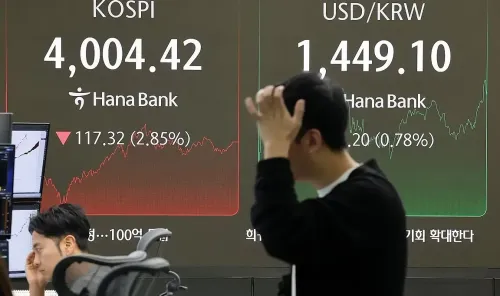
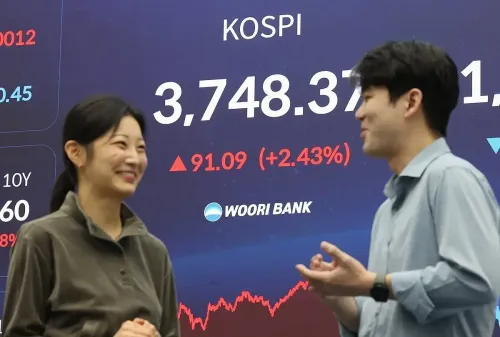
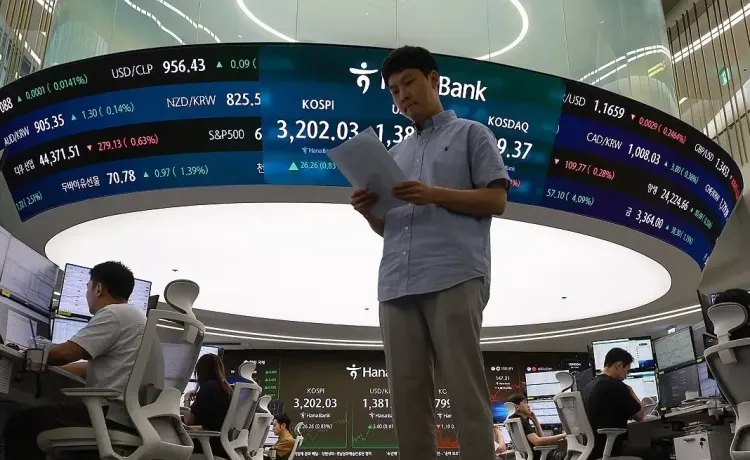
Seoul, Dec 23 (NationPress) Foreign investors are enthusiastically acquiring shares in the technology and automotive sectors of the local stock market, potentially transitioning to net buyers just a month after being net sellers, as indicated by data released on Tuesday.
According to the Korea Exchange, the principal operator of the nation's stock market, foreign investors net bought 1.9 trillion won (approximately US$1.3 billion) in the broader Korea Stock Price Index (KOSPI) from December 1 through Monday, as reported by the Yonhap news agency.
This represents a significant shift from November, during which they net sold 14.4 trillion won.
On Tuesday, foreign investors continued their purchasing trend, net buying 373.2 billion won worth of local stocks by 11:10 a.m.
Investors from abroad seem to be particularly interested in major semiconductor manufacturers and automotive firms.
SK hynix emerged as their top choice, receiving a net investment of 824.7 billion won. They also acquired 426.1 billion won worth of preferred shares in Samsung Electronics and 322.1 billion won in shares of Hyundai Motor.
Han Ji-young, an analyst at Kiwoom Securities Co., noted, "With foreign and institutional investors now acting as net buyers, they are driving the year-end stock rally, influenced by positive trends in the U.S. stock market, including recent progress in AI-related stocks."
On Monday (local time), shares of U.S. semiconductor company Micron Technology reached a record high of $230.55 following reports of strong demand for its memory chips utilized in AI infrastructure.
Local automotive manufacturers have also gained attention due to the trade agreement established between Seoul and Washington in October, which alleviated tariff uncertainties impacting the sector, according to analysts.
"The local stock market is poised to maintain its upward trajectory, driven by ongoing momentum in semiconductors and increasing expectations for a Santa Claus rally," Han added.
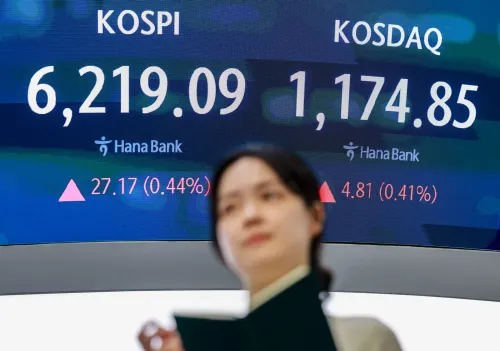
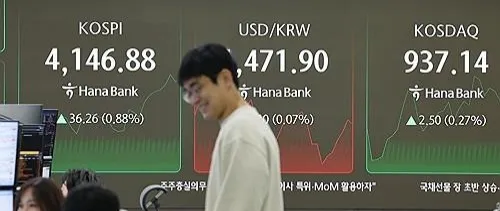
In the meantime, South Korean stocks have extended their winning streak for a third consecutive session on Tuesday, supported by foreign purchases amid reduced anxieties over an artificial intelligence (AI) bubble. The national currency, however, depreciated against the U.S. dollar.
The benchmark Korea Composite Stock Price Index (KOSPI) rose by 11.29 points, or 0.28 percent, closing at 4,117.32.
Point of View
The shift in foreign investment patterns in South Korea's stock market showcases a significant rebound after a month of net selling. This trend reflects not only growing confidence in local tech and automotive sectors but also the influence of international market dynamics. The NationPress remains committed to delivering accurate and timely analysis as these developments unfold.
NationPress
26 Sept 2026
Frequently Asked Questions
What is driving foreign investment in South Korean stocks?
The recent surge in foreign investment is driven by improved market conditions in the U.S., particularly related to advancements in AI technologies, and favorable trade agreements easing tariff concerns.
Which sectors are foreign investors focusing on?
Foreign investors are primarily targeting large-cap semiconductor and automotive companies, including notable names like SK hynix and Hyundai Motor.
How does this trend impact the KOSPI?
This influx of foreign capital is expected to positively influence the KOSPI, contributing to its upward trajectory and potentially leading to a year-end rally.