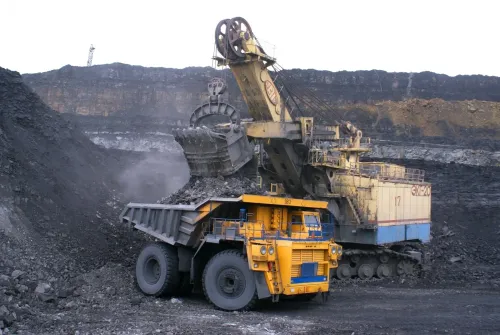
India can become a global mining and construction equipment hub: CII-BCG report
Synopsis
A joint CII-BCG report puts a number on India's MCE ambition: a $17 billion market growing at 10–12% annually, with sector-linked capex nearly doubling to ₹9–10 lakh crore by 2030. The catch — India's mechanisation intensity still lags the global average, and the window to localise, invest in R&D, and capture export share is closing fast.
Key Takeaways
A joint CII-BCG report released on 26 July identifies India as a potential global hub for mining and construction equipment (MCE) manufacturing and exports.
India's MCE market is estimated at $17 billion , growing at 10–12 per cent annually.
Capital expenditure in MCE-linked sectors is projected to rise from ₹5.5 lakh crore in 2025 to ₹9–10 lakh crore by 2030 .
India's mechanisation intensity remains well below the global average, indicating significant untapped demand.
The report calls for accelerated localisation, higher R&D investment, technology adoption, and supportive policy reforms to unlock the sector's potential.
India has the potential to emerge as a global manufacturing and export hub for mining and construction equipment (MCE), provided it accelerates localisation, strengthens technology adoption, boosts research and development, and enacts supportive policy reforms, according to a joint report released on 26 July in New Delhi. The findings come at a moment when record capital flows into infrastructure, mining, and clean energy are reshaping demand for heavy equipment across the country.
About the Report
The study, titled 'Pressing the Throttle: How India's Mining and Construction Equipment Industry Can Support Domestic Ambitions and Become a Global Force', was jointly published by the Confederation of Indian Industry (CII) and Boston Consulting Group (BCG). It assesses the current state of India's MCE sector and charts a roadmap to enhance domestic manufacturing, improve global competitiveness, and support the country's long-term infrastructure and industrial growth ambitions.
Key Market Findings
According to the report, India's MCE industry has grown into one of the world's fastest-expanding markets, with an estimated market size of $17 billion and an annual growth rate of 10–12 per cent. Capital expenditure across MCE-linked sectors is projected to rise from approximately ₹5.5 lakh crore in 2025 to ₹9–10 lakh crore by 2030, driven by sustained investment in roads, railways, ports, airports, urban infrastructure, mining, and renewable energy.
The report also noted that India's mechanisation intensity remains well below the global average, leaving considerable scope for higher equipment demand, improved productivity, and wider adoption of advanced technologies such as automation, digitalisation, electrification, and connected equipment.
Export Opportunity and Technology Shift
Exports of mining and construction equipment have expanded significantly over the past decade, the report said, creating openings for Indian manufacturers to deepen their presence in international markets. Emerging technologies — including automation, electrification, and connected equipment — are expected to reshape the industry's competitive profile and could position Indian players as credible global suppliers if investments in R&D keep pace.
This comes amid a broader government push to raise India's share of global manufacturing, with the MCE sector increasingly seen as a strategic lever alongside electronics and defence production.
What Industry Leaders Said
CII Director General Chandrajit Banerjee said the mining and construction equipment sector is central to India's infrastructure and industrial growth ambitions. CII Mining and Construction Equipment Division Chairman Vivek Bhatia said the sector would play a pivotal role in supporting the vision of Viksit Bharat by enabling world-class infrastructure, manufacturing, and mining. Boston Consulting Group Managing Director and Partner Abhishek Bhatia described India's MCE industry as being at an important inflection point.
What Comes Next
The report's roadmap calls for accelerated localisation of components, stronger R&D investment, and policy reforms that align incentives with export competitiveness. With capital expenditure in MCE-linked sectors set to nearly double by 2030, the window for Indian manufacturers to scale up and capture global market share is, according to the report, narrowing — making near-term policy action critical.
Point of View
Yet mechanisation intensity still trails the global average — a structural gap that localisation pledges alone will not close. The capex doubling to ₹9–10 lakh crore by 2030 is a demand-side tailwind, but supply-side competitiveness requires R&D investment that Indian MCE players have historically underweighted relative to Chinese and European rivals. The report's roadmap is directionally sound; the harder question is whether policy incentives will be specific and time-bound enough to move the needle before the next infrastructure cycle peaks.
NationPress
24 Oct 2026
Frequently Asked Questions
What does the CII-BCG mining and construction equipment report say about India?
The report says India can become a global manufacturing and export hub for mining and construction equipment by accelerating localisation, boosting R&D, adopting emerging technologies, and implementing policy reforms. It estimates the Indian MCE market at $17 billion, growing at 10–12 per cent annually.
How large is India's mining and construction equipment market?
India's MCE market is estimated at $17 billion with an annual growth rate of 10–12 per cent, making it one of the world's fastest-expanding markets in the segment, according to the CII-BCG report.
What is the projected capital expenditure in MCE-linked sectors by 2030?
Capital expenditure across MCE-linked sectors — including roads, railways, ports, airports, urban infrastructure, mining, and renewable energy — is projected to rise from approximately ₹5.5 lakh crore in 2025 to ₹9–10 lakh crore by 2030.
Why does India's mechanisation gap matter for the MCE sector?
India's mechanisation intensity is well below the global average, which means there is significant untapped demand for equipment. Closing this gap would boost productivity and create a larger domestic market, strengthening the case for local manufacturing and exports.
Which technologies are expected to reshape India's MCE industry?
The report highlights automation, digitalisation, electrification, and connected equipment as the key technologies set to reshape the mining and construction equipment industry and improve its global competitiveness.