CII President: India must boost competitiveness to hit $10 trillion economy

Synopsis
CII President R. Mukundan says India's $10 trillion economy ambition hinges on one shift: moving from ease of doing business to speed of doing business. With China and Vietnam as the benchmark, he is calling for faster approvals, PLI expansion into labour-intensive sectors, and deeper FDI reforms — a frank industry verdict on where India's growth story could stall.
Key Takeaways
Mukundan said India must become more globally competitive to achieve its $10 trillion economy target.
He called for a shift from 'ease of doing business' to 'speed of doing business' — faster approvals, investments, and project execution.
Mukundan urged PLI scheme expansion beyond electronics to labour-intensive sectors such as furniture and toys .
On FDI , he said simplifying procedures and cutting delays is essential to attract greater foreign capital inflows.
He flagged significant India-US collaboration opportunities in defence , aerospace , and advanced manufacturing .
Greater digitalisation and expanded port, rail, and shipping capacity were cited as prerequisites for the $10 trillion milestone.
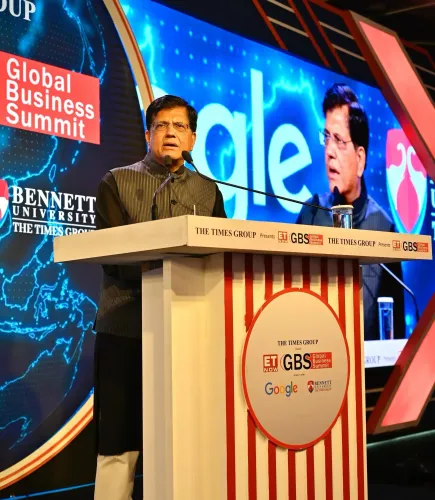
Confederation of Indian Industry (CII) President R. Mukundan on Tuesday said India has made considerable strides across key sectors over the past 12 years, but must sharpen its global competitive edge to realise its ambition of becoming a $10 trillion economy. Speaking in Mumbai, Mukundan underlined that outperforming rival manufacturing destinations — particularly China and Vietnam — is now a strategic imperative for India.
From Ease to Speed of Doing Business
Mukundan acknowledged notable gains in infrastructure — spanning power, logistics, railways, ports, and shipping — but argued that the policy conversation must evolve. The priority, he said, must shift from improving the ease of doing business to accelerating the speed of doing business, with faster approvals, swifter investment clearances, and more efficient project execution at its core.
This distinction matters: while India has climbed global ease-of-doing-business rankings in recent years, industry leaders have consistently flagged delays in on-ground execution as a drag on actual investment realisation.
FDI Reforms and the India-US Trade Opportunity
On foreign direct investment, Mukundan noted a dual trend — Indian companies are increasingly deploying capital abroad, even as India itself needs deeper reforms to draw greater foreign inflows. He called for simplifying investment procedures and cutting procedural delays to strengthen investor confidence.
Regarding the proposed India-US trade agreement, the CII president pointed out that India has signed several free trade agreements in recent years, yet their utilisation remains below potential. He stressed that maximising free trade utilisation is essential to extract full economic value from these pacts. Mukundan also flagged substantial collaboration opportunities between India and the United States in defence, aerospace, and advanced manufacturing.
Infrastructure, PLI, and the Manufacturing Push
Hitting the $10 trillion milestone, Mukundan said, will demand significant expansion in shipping capacity, ports, and railway infrastructure. Greater digitalisation of both government and industrial processes, he added, would drive efficiency and underpin faster economic growth.
The CII president described the production-linked incentive (PLI) scheme as highly successful in the electronics sector and advocated extending similar incentives to labour-intensive industries such as furniture and toys. Such an expansion, he argued, would deepen domestic manufacturing and generate meaningful employment at scale.
Energy Transition and Power Distribution
On the energy front, Mukundan cautioned that building transmission infrastructure is time-intensive, and therefore greater emphasis must be placed on strengthening power distribution systems in the near term. He noted that industry bodies, including the CII, have already submitted recommendations to the government on improving energy infrastructure — signalling that the dialogue between industry and policymakers on this front is active.
What Comes Next
The CII's intervention comes at a critical juncture: India is positioning itself as an alternative global manufacturing hub amid supply-chain realignments, yet faces stiff competition from Southeast Asian economies with lower costs and faster turnaround times. Whether the government acts on calls to extend PLI, accelerate FDI reforms, and invest in port and rail capacity will determine how credible the $10 trillion target looks beyond the headline.
Point of View
The $10 trillion target risks remaining a projection rather than a trajectory.
NationPress
23 Jun 2026
Frequently Asked Questions
What did CII President R. Mukundan say about India's $10 trillion economy goal?
Mukundan said India has made significant progress over the past 12 years but must become more globally competitive — particularly against China and Vietnam — to achieve the $10 trillion economy target. He emphasised faster approvals and deeper FDI reforms as key levers.
What is the difference between 'ease of doing business' and 'speed of doing business'?
According to Mukundan, 'ease of doing business' refers to regulatory and procedural simplification, while 'speed of doing business' focuses on the actual pace of approvals, investment clearances, and project execution on the ground. He argued India must now prioritise the latter.
Which sectors did Mukundan recommend for PLI scheme expansion?
The CII president said the PLI scheme has been highly successful in electronics and should be extended to labour-intensive industries such as furniture and toys to strengthen domestic manufacturing and generate employment at scale.
What did Mukundan say about the India-US trade agreement?
He said India has signed several free trade agreements but their utilisation remains below potential. He stressed the need to maximise free trade utilisation and highlighted opportunities for India-US collaboration in defence, aerospace, and advanced manufacturing.
What infrastructure investments did Mukundan say are needed for India to reach $10 trillion?
He called for substantial expansion of shipping capacity, ports, and railway infrastructure, alongside greater digitalisation of government and industrial processes to improve efficiency and support faster economic growth.