Historic India-New Zealand FTA to Be Signed April 27: Key Benefits

Synopsis
India and New Zealand will sign a landmark Free Trade Agreement on April 27, 2025 — a deal decades in the making that promises to cut tariffs, boost exports, and reshape bilateral trade worth hundreds of millions of dollars. With India's FTA push accelerating globally, this signing signals a major shift in Indo-Pacific trade architecture.
Key Takeaways
India and New Zealand will formally sign their Free Trade Agreement on April 27, 2025 , in the presence of business delegations from both nations.
New Zealand PM Christopher Luxon confirmed the deal on social media, saying it will bring more jobs, higher wages, and more opportunities for New Zealanders.
The FTA will benefit New Zealand exporters — including manufacturers of marine jet systems exported to over 70 countries — by reducing Indian tariffs.
Trade Minister Todd McClay called the agreement a "once-in-a-generation opportunity" and noted legal verification of the FTA text is already complete.
Once signed, the deal enters parliamentary treaty examination in New Zealand, enabling public scrutiny before ratification.
The FTA is expected to significantly grow bilateral trade, which currently stands at approximately USD 700 million annually , by unlocking sectors like pharma, IT, textiles, and agri-products.
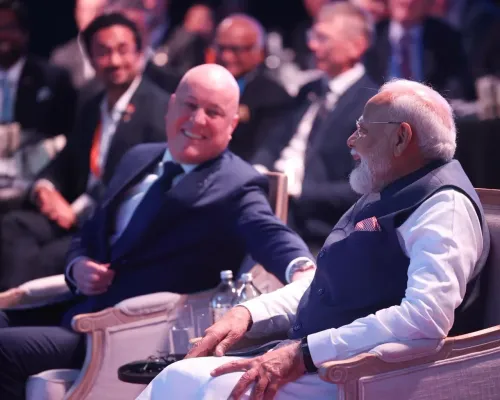
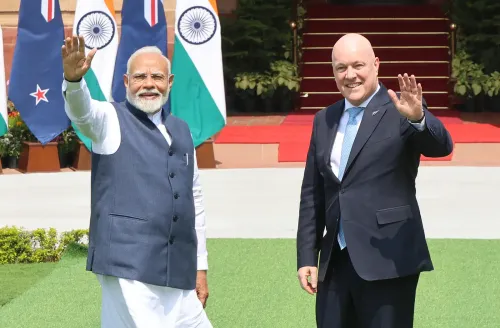
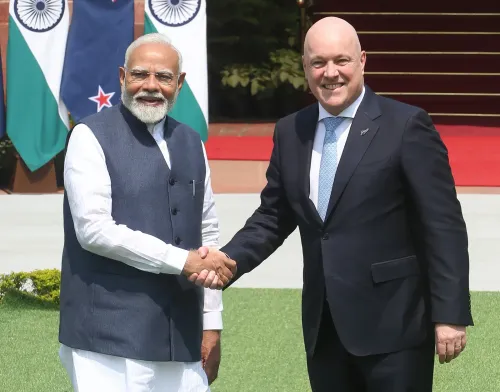
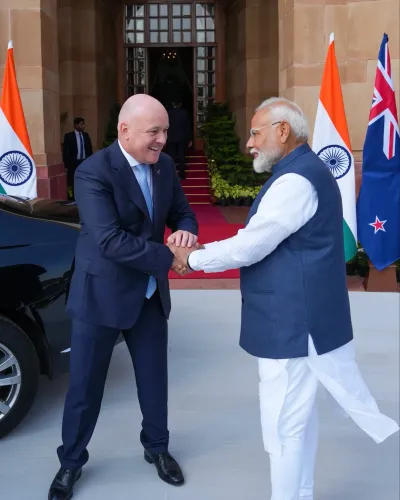
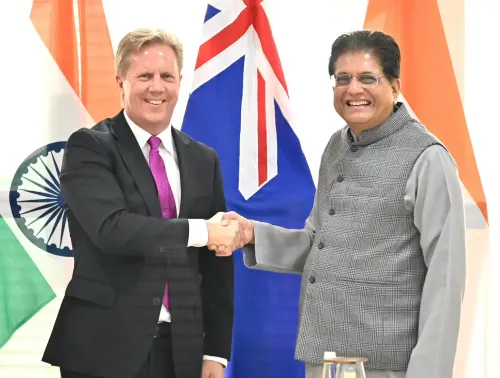
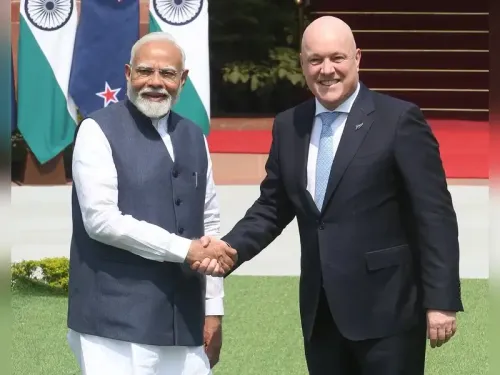
New Delhi, April 24: The India-New Zealand Free Trade Agreement (FTA) is set to be formally signed on April 27, 2025, marking a landmark moment in bilateral trade relations between the two nations. New Zealand Prime Minister Christopher Luxon confirmed the development, stating that the deal will significantly improve market access for exporters on both sides and reduce long-standing trade barriers. The signing will take place in the presence of a large delegation of business representatives from both countries.
What the FTA Covers and Who Benefits
PM Luxon, posting on social media platform X, confirmed: "We will sign a Free Trade Agreement with India on Monday." In an accompanying video message, he elaborated that the agreement would directly benefit New Zealand exporters, particularly manufacturers of marine jet systems — high-value components used in boats and exported to more than 70 countries globally.
The deal is expected to gradually eliminate or reduce tariffs that currently make New Zealand goods less competitive in the Indian market. For Indian exporters, the FTA opens a cleaner pathway into New Zealand's market, which, while smaller in size, is high-value and strategically positioned in the Pacific trade corridor.
Luxon emphasized the deal would generate "more jobs, higher wages and more opportunities" for New Zealanders, signaling that domestic economic gains are central to the government's pitch for the agreement.
Legal Verification Complete, Parliamentary Scrutiny Next
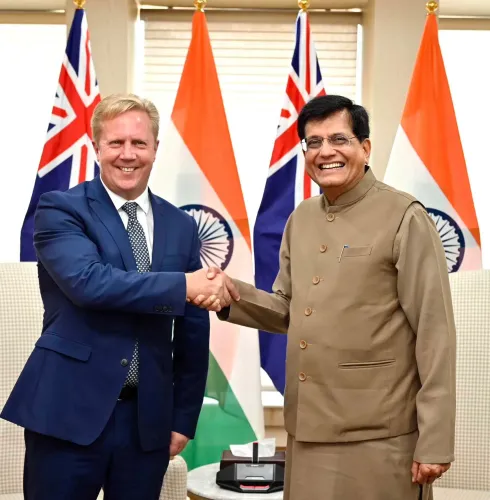
New Zealand Trade and Investment Minister Todd McClay confirmed earlier this month that the legal verification of the FTA text has been completed by both sides. He described the agreement as a "once-in-a-generation opportunity" to deepen trade and investment ties between the two nations.
Once signed, the FTA will be formally submitted for parliamentary treaty examination in New Zealand — a mandatory process that allows public and legislative scrutiny before ratification. This step adds a layer of democratic accountability and transparency to the deal.
McClay also noted that in the current climate of global economic and geopolitical uncertainty — marked by supply chain disruptions, shifting alliances, and rising protectionism — strengthening bilateral trade partnerships is critical for long-term economic resilience.
Strategic Context: Why This FTA Matters Now
This agreement comes at a pivotal moment. India has been aggressively expanding its free trade architecture, having signed FTAs with the UAE and Australia in recent years, and currently negotiating with the UK and the European Union. The India-New Zealand FTA fits into a broader strategic pivot by New Delhi to diversify trade partnerships beyond traditional partners amid global realignment.
Notably, India and New Zealand have had a relatively modest trade relationship historically — bilateral trade stood at approximately USD 700 million in recent years. The FTA is expected to substantially grow this figure by unlocking sectors including dairy, agri-products, manufacturing, technology services, and education.
Critics and trade analysts have pointed out that New Zealand's dairy sector has long sought greater access to the Indian market — one of the world's largest milk-producing nations — and the FTA's fine print on dairy tariff concessions will be closely watched by Indian farmers' groups and the National Dairy Development Board.
Impact on Indian Exporters and Industry
For India, the FTA opens doors for sectors such as pharmaceuticals, textiles, IT services, engineering goods, and gems and jewellery to gain preferential access to the New Zealand market. Indian software and services firms, in particular, stand to benefit from reduced barriers in a high-income economy with growing digital infrastructure needs.
The agreement also strengthens the broader India-Pacific economic engagement strategy, complementing India's participation in frameworks like the Indo-Pacific Economic Framework (IPEF). As India positions itself as a global manufacturing alternative to China, FTAs with Pacific-rim nations like New Zealand add strategic depth to this ambition.
What Happens Next
The formal signing on April 27, 2025 will be followed by parliamentary review in New Zealand and legislative processes in India before the agreement enters into force. Business chambers in both countries are expected to begin consultations on implementation timelines and sector-specific rules of origin.
With India's trade diplomacy accelerating and New Zealand seeking to reduce dependence on China as its primary trade partner, this FTA could serve as a template for deeper economic cooperation across the Indo-Pacific region in the years ahead.
Point of View
Even as the global order fractures. What mainstream coverage misses is the quiet pressure this puts on New Zealand to diversify away from China, and India's calculated use of FTAs as soft power instruments across the Indo-Pacific. The real test, however, lies in the dairy fine print: if India has conceded ground on dairy imports, expect pushback from farmer lobbies — and that political cost will define how quickly this deal moves from signing to ratification.
NationPress
16 Sept 2026
Frequently Asked Questions
When will India and New Zealand sign the Free Trade Agreement?
India and New Zealand are scheduled to sign their Free Trade Agreement on April 27, 2025 . The signing will take place in the presence of a large delegation of business representatives from both countries.
What are the key benefits of the India-New Zealand FTA?
The FTA will reduce tariffs, improve market access for exporters on both sides, and strengthen trade in sectors including manufacturing, pharmaceuticals, IT services, and agri-products. New Zealand PM Luxon said it will bring more jobs, higher wages, and greater economic opportunities.
Who confirmed the India-New Zealand FTA signing?
New Zealand Prime Minister Christopher Luxon confirmed the signing on social media platform X. Trade and Investment Minister Todd McClay also announced that legal verification of the agreement had been completed.
What happens after the India-New Zealand FTA is signed?
After signing, the FTA will undergo parliamentary treaty examination in New Zealand, allowing public and legislative scrutiny before ratification. Both countries will then work through implementation timelines before the agreement formally enters into force.
How does the India-New Zealand FTA fit into India's broader trade strategy?
The India-New Zealand FTA is part of India's accelerating trade diplomacy, which has already produced FTAs with the UAE and Australia , with negotiations ongoing with the UK and EU. It strengthens India's Indo-Pacific economic engagement and positions the country as a key trade partner in the Pacific corridor.