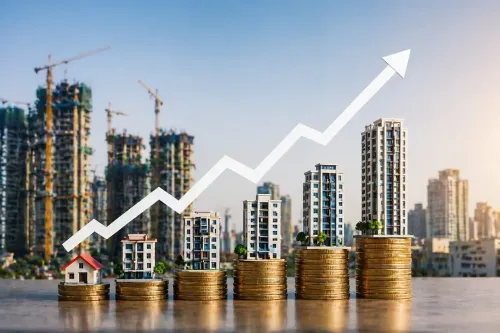
India real estate equity inflows hit record $8.5 bn in H1 2026, up 32%

Synopsis
India's real estate sector just posted its best-ever half-year for equity inflows — $8.5 billion in the first six months of 2026, up 32% year-on-year. Domestic investors drove 92% of Q2 flows, institutional money surged 51% sequentially, and Bengaluru, Delhi-NCR, and Mumbai together captured 60% of the quarter's capital. CBRE says foreign capital could return in H2 as global conditions stabilise.
Key Takeaways
India's real estate sector recorded $8.5 billion in equity inflows in H1 2026 — the highest half-yearly figure on record.
Inflows rose 32 per cent year-on-year , according to a CBRE South Asia report released on 16 July 2026 .
Q2 2026 inflows stood at $3.4 billion ; institutional investor flows jumped 51 per cent sequentially .
Land/development sites and built-up office assets accounted for about 94 per cent of Q2 equity inflows.
Bengaluru , Delhi-NCR , and Mumbai together held a 60 per cent share of total Q2 inflows.
Domestic investors dominated with roughly 92 per cent of Q2 capital flows; CBRE expects select foreign capital to re-engage in H2 2026.
India's real estate sector pulled in equity capital inflows of $8.5 billion in the first half of 2026 — the highest half-yearly figure ever recorded — marking a 32 per cent year-on-year surge, according to a report released on Thursday, 16 July by real estate consulting firm CBRE South Asia. The milestone underscores the sector's deepening capital markets and sustained investor confidence even as global conditions remain uncertain.
What Drove the Record Inflows
The growth was underpinned by sustained momentum in land and development site acquisitions as well as built-up office assets, which together accounted for roughly 94 per cent of overall equity investment inflows in Q2 2026 (April–June). Total inflows during that quarter stood at $3.4 billion, remaining broadly stable on an annual basis.
Over 88 per cent of capital deployed into site and land acquisitions was directed at residential and office developments, with the remainder committed to data centres, mixed-use projects, and industrial and logistics assets.
Who Is Investing
Developers led total capital infusion with a share of approximately 34 per cent in Q2 2026, closely followed by domestic institutional investors at around 32 per cent. Notably, overall capital inflows from institutional investors rose sharply by 51 per cent sequentially during the quarter. Domestic investors, primarily developers, dominated overall investment inflows with a combined share of about 92 per cent during Q2.
Cities Leading the Charge
Among major cities, Bengaluru led, followed by Delhi-NCR and Mumbai, which together accounted for a cumulative share of approximately 60 per cent of total inflows during the quarter. The concentration in these three metros reflects their established office and residential demand pipelines.
What Industry Leaders Said
Anshuman Magazine, Chairman and CEO — India, South-East Asia, the Middle East and Africa, CBRE — said domestic investors have continued to demonstrate 'strong conviction in the sector's long-term fundamentals, even as the broader environment remains dynamic.' He added that the firm expects this momentum to carry into the second half of the year, 'with select foreign capital expected to re-engage as global conditions stabilise.'
Gaurav Kumar, Managing Director and Co-Head, Capital Markets, India, CBRE, noted that 'global investors and domestic players have been unanimous in their aggressive intent in expanding their real estate portfolios across all asset classes.'
Outlook for the Rest of 2026
CBRE forecasts sustained investment momentum through the remainder of 2026, driven by steady capital inflows into both built-up asset acquisitions and new project development. The anticipated re-engagement of select foreign capital — contingent on global macro stabilisation — could push full-year figures well beyond the record half-year mark already set.
Point of View
But the fine print matters: domestic investors — primarily developers — drove 92 per cent of Q2 flows, meaning this is largely Indian money recycling within the sector rather than a wave of fresh foreign conviction. The 51 per cent sequential jump in institutional flows is more meaningful, signalling that domestic funds are building structural positions. The real test of this cycle's durability is whether foreign capital actually re-engages in H2 2026 as CBRE projects, or whether global rate uncertainty keeps it on the sidelines — leaving India's record books padded by domestic enthusiasm alone.
NationPress
14 Oct 2026
Frequently Asked Questions
What is the record equity inflow figure for India's real estate in H1 2026?
India's real estate sector recorded equity capital inflows of $8.5 billion in the first half of 2026, the highest half-yearly figure ever recorded. This represents a 32 per cent year-on-year increase, according to a CBRE South Asia report.
Which cities attracted the most real estate investment in Q2 2026?
Bengaluru led, followed by Delhi-NCR and Mumbai, with the three cities collectively accounting for about 60 per cent of total equity inflows during Q2 2026 (April–June).
Who were the dominant investors in India's real estate sector in Q2 2026?
Domestic investors — primarily developers — dominated with roughly 92 per cent of total Q2 2026 inflows. Developers held a 34 per cent share, closely followed by domestic institutional investors at 32 per cent, whose flows surged 51 per cent sequentially.
Which asset types drew the most capital in Q2 2026?
Land and development sites combined with built-up office assets accounted for approximately 94 per cent of overall equity investment inflows in Q2 2026. Within land acquisitions, over 88 per cent was directed at residential and office developments.
What is the outlook for India real estate investment in H2 2026?
CBRE forecasts sustained investment momentum through the rest of 2026, driven by continued capital flows into built-up asset acquisitions and new project development. The firm expects select foreign capital to re-engage as global macroeconomic conditions stabilise.